









Germany and Gaza: Caught Between Historical Memory and Present Responsibility

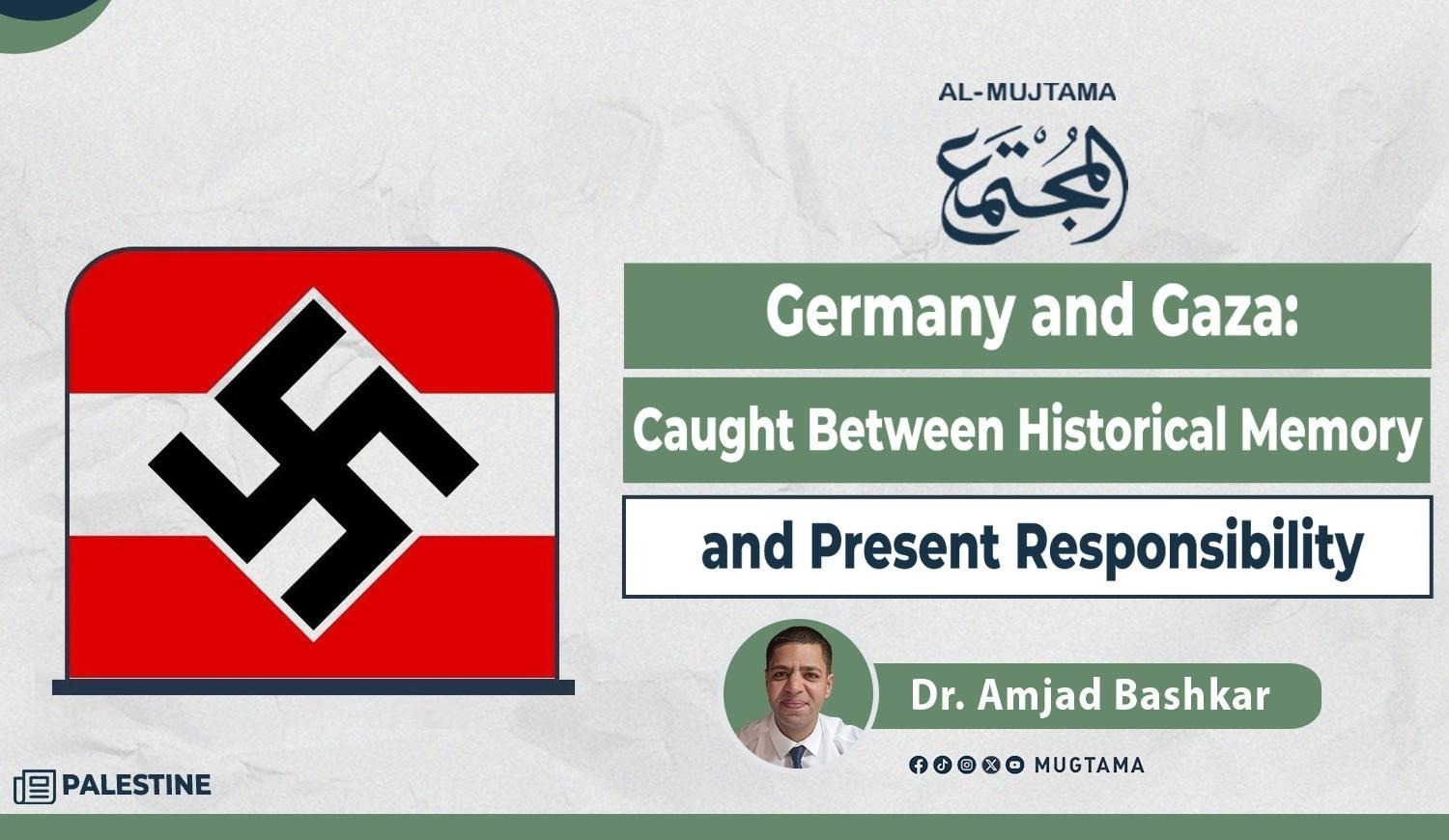
The genocidal war on Gaza no
longer merely lays bare the scale of atrocities inflicted upon Palestinians,
nor does it simply expose the depth of Western political bias toward the
Israeli occupying power. Rather, it compels a critical question: can nations that
pull no triggers truly remain absolved of responsibility when they furnish the
weapons, provide the political cover, and sustain the war effort? In the case
of Germany and Gaza, Berlin now confronts one of its most compromising
political moments since the founding of its modern republic.
Berlin was never an ordinary
actor in its posture toward the occupying state. Ever since accountability for
past crimes was enshrined as a cornerstone of German policy toward Israel,
safeguarding the state has been framed across German political discourse as a
core national interest and an indelible historical duty. Yet Gaza has thrust
this long-held dogma into an unprecedented trial—one entirely absent from
Berlin’s geopolitical calculus.
Germany and Gaza: When History
Becomes a Burden on the Present
No one can deny the atrocities committed by Nazi Germany
against the Jews and others, nor can Germany’s historical accountability ever
be erased or disavowed. Yet the dilemma emerges when this responsibility ceases
to function as a historical and moral reckoning, morphing instead into a policy
that effectively grants Israel an exceptional measure of political impunity.
History cannot serve as a perpetual license for the present, nor can a crime
committed against one people justify silence in the face of another's
suffering—let alone unlimited military and political support in carrying out
genocide.
True historical responsibility does not mean standing
unconditionally by a state regardless of its actions; it means defending the
very principle that such collective crimes must never be repeated against any
people. Here lies Germany’s profound paradox: can Berlin genuinely declare
"never again" while remaining indifferent to what Palestinians are
enduring today? If so, the very notion of historical responsibility has been
stripped of its moral core.
German Weapons in the Crosshairs of Accountability
The case before the International Court of Justice derives its
significance not from asking the simplistic question: did Germany bomb Gaza?
That was never the point of contention. The far more consequential question is:
what does state responsibility entail when a nation's contribution to a war is
indirect?
Today, states no longer need to deploy boots on the ground for
their political stance to carry lethal weight on the battlefield. Weapons
funneled to an army, munitions that sustain continuous operations, and
diplomatic cover that reassures a warring government it will face no real
international isolation—all these factors shape the calculus of war and peace.
It is precisely why Germany’s reckoning carries profound implications that
reverberate far beyond the courtroom itself.
If the state perpetrating genocide and massacres bears
undeniable guilt, what of the nation that recognizes the grave risk of
violations yet persists in supplying the very instruments that fuel prolonged
warfare? This is no longer merely a Palestinian issue; it is a precedent bound
to haunt the future of the global arms trade and interstate military alliances.
It will inevitably force governments to abandon the illusion that military aid
can ever remain divorced from its consequences on the ground.
The gravest danger in this case is that it threatens to
shatter a long-standing paradigm. For decades, international conflicts were
viewed through a deceptively simple lens: a state wages war, and allies stand
behind it. Under this logic, benefactor states could conveniently claim: we
are not the ones pulling the trigger. Yet Gaza has rendered this convenient
dichotomy impossible to sustain. Modern warfare is no longer confined to the
battlefield; it is orchestrated on the assembly lines of arms factories, inside
war cabinets and ministries, through intelligence nerve centers, within the
halls of diplomacy and the Security Council, and across global financial
markets.
Consequently, political accountability cannot simply halt at
the geographic borders where bombs and missiles detonate. The arms manufacturer
does not necessarily fire the weapon; the arms dealer does not select the
strike target; and the diplomat providing political cover does not execute the
raid. Through this fragmented chain, the international system has engineered a
convenient loophole—one that fractures any atrocity into isolated links,
ensuring that no single actor ever bears ultimate responsibility.
Gaza and the Shifting Meaning of Complicity
Prior to Gaza, it was politically expedient to frame arms
exports merely as routine defense cooperation between states. Yet in the wake
of the catastrophic devastation and massacres witnessed across Gaza, a far more
urgent question has emerged: to what extent can an arms-exporting nation remain
willfully blind to how its weapons are deployed? International law does not
merely scrutinize the precise moment an atrocity is carried out; it imposes
affirmative legal obligations on states. Should these principles crystallize
into firmly established international practice, their ramifications will hardly
stop at Israel.
In any future conflict, every arms deal could be called into
question: Did the exporting state truly understand the nature of the war and
the perils of how its weapons would be used? Did it take tangible measures to
prevent them from enabling grave violations? These questions may well prove far
more consequential than the German case itself.
The acute sensitivity of Berlin's stance stems from the fact
that it does not view Israel merely as a military ally; it engages with it
through the prism of a crushing historical memory. This makes Germany’s dilemma
markedly more complex than that of other Western capitals. A nation that built
a core pillar of its modern political identity on the rejection of mass
atrocities and persecution should, by that very virtue, be the most attuned to
human suffering—transcending the boundaries of identity and inherited memory.
Defending Israel should never mean underwriting the policies of every Israeli
government.
The Court Is Putting More Than Just Berlin on Trial
Even if the case remains confined within its legal contours,
the political message it projects reverberates far wider. The world is watching
the nations that supply Israel with arms, those that shield it with diplomatic
cover, and those that may find themselves embroiled in similar conflicts in the
future. Any breakthrough in this case is poised to ignite a global debate on
state responsibility for the conduct of allies.
Here lies the striking paradox: while the direct perpetrator
may remain insulated from accountability behind a shield of military might and
political patronage, the supplier furnishing the weapons could find itself
summoned to a courtroom, answering for the limits of its complicity. That reality
alone marks a tectonic shift.
Ultimately, the core issue is not merely whether Palestine
scores a legal victory against Germany or whether Berlin loses the suit. At
stake is whether international law can effectively confront political and
military power as an interconnected web, or whether it will remain held captive
to the archaic notion that accountability rests solely with the hand that pulls
the trigger.
From Holocaust Memory to Universal Responsibility
If the memory of the past has
forged a profound moral commitment within Germany, the ultimate crucible of
that commitment lies not merely when the victim is Jewish, but when the victim
is also Palestinian. Only then does history transcend the realm of mere
realpolitik and genuinely become ethics.
What is unfolding in The
Hague is no detached legal abstraction remote from Gaza; it is integral to a
far broader struggle over the very essence of international law. Either the law
remains an instrument wielded ruthlessly against the weak while flinching in the
face of the powerful and their allies, or it evolves into an unyielding,
universal standard that never wavers—regardless of the victim's identity or the
perpetrator's might. It is this defining dilemma that now forces Germany to
confront its history, compels Israel’s benefactors to reckon with their
actions, and leaves the entire international order facing its ultimate test of
conscience.
If Germany’s historical responsibility for its past forged its political
doctrine toward Israel, Gaza now subjects that very dogma to the harsh scrutiny
of the present. Will memory serve as a pathway to safeguarding universal
humanity, or will it mutate into a wall that obscures the profound suffering of
the Palestinian people?