




Israel Officially Turns the Ibrahimi Mosque into a Jewish site
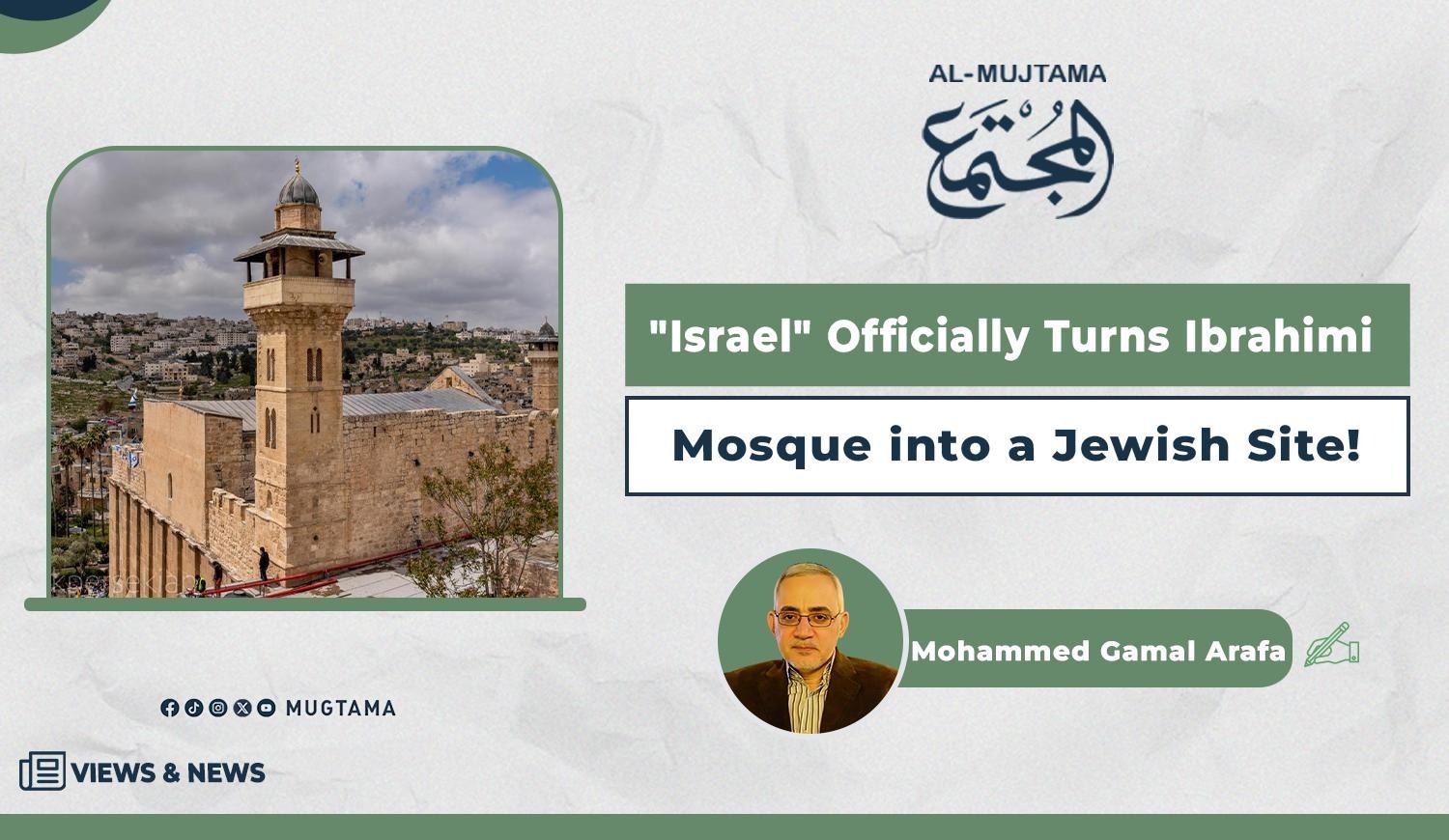
Since the
Zionist occupation abolished the 'Hebron Agreements'—part of the 'Oslo II
Accord'—on June 16, 2026, and the extremist minister Smotrich, responsible for
settlement affairs in the occupied territories, transferred planning and
construction authorities in Hebron city in the West Bank from the Palestinian
municipality to the 'Israeli' administration, what was anticipated has
occurred: official Judaization plans for the Ibrahimi Mosque have commenced,
aiming to transform it exclusively into a Jewish temple or sanctuary.
This plan
manifests in two aspects. First, completely banning the Adhan (call to prayer)
inside the mosque—a practice that has been ongoing for two weeks, leaving the
mosque without the call to prayer, alongside periodically barring worshippers
from entering. This follows a prior pattern where the Adhan was banned for only
a day or two under the pretext of Jewish holidays inside the Ibrahimi Mosque.
Second:
making adjustments and alterations inside the Ibrahimi Mosque aimed at
undermining its identity as a mosque for the benefit of Jewish worshippers.
This includes constructing a roof over the mosque’s courtyard (Sahn) area where
Jews pray, closing doors, and implementing arrangements that bar Muslims from
entering the mosque—all amid Islamic silence.
Since the
occupation of Hebron city in 1967, 'Israel' has taken a series of gradual
measures to impose its control over the Ibrahimi Mosque. However, the most
significant shift came in the wake of the Ibrahimi Mosque massacre committed by
the Jewish settler Baruch Goldstein in 1994.
Following
the massacre committed by Goldstein—a follower of Rabbi Kahane—where he killed
30 Muslim worshippers and injured 125, the occupation intervened under the
pretext of resolving the issue. However, it rewarded the murderous Jewish
settlers by granting them control over 63% of the sanctuary, giving the
settlers control over the Isaac Hall (Al-Ishaqiya), the Jacob Hall
(Al-Yaqubiya), as well as the main courtyards and facilities. Meanwhile, the
remaining part—a mere 37% of its area—was allocated to Muslim worshippers.
Israel thus exploited the massacre to impose a temporal and spatial division of
the sanctuary between Muslims and Jews, in addition to restricting prayers,
banning the Adhan, and barring them from entering their mosque during Jewish
holidays!
This plan
is not limited to the Ibrahimi Mosque; rather, the ultimate goal is to apply
the same blueprint to the Holy Sanctuary (Al-Haram al-Sharif) and the Al-Aqsa
Mosque through gradual steps, alongside imposing restrictions on mosques in
general. This comes after the Knesset approved, in a preliminary reading in
early July 2026, the 'Muezzin Bill' project, which restricts the use of loudspeakers
in mosques within the Green Line under the pretext of combating noise.
Since the
occupation of Palestine, the occupation forces have converted numerous mosques
into temples, taverns, and barns. Many mosques have suffered from deliberate
'Israeli' desecration and neglect, alongside a refusal to allow their
renovation, leaving them to collapse.
According
to a previous study prepared by Sheikh Kamal Khatib, Deputy Leader of the
Islamic Movement in Palestine occupied in 1948, 15 mosques were converted into
synagogues and Jewish temples, 40 mosques were either demolished, closed, or
left abandoned, and 17 mosques were turned into sheep and cattle barns,
restaurants, taverns, museums, and warehouses!
The Judaization Conversion Plan
On June
16, 2026, the Zionist Finance Minister, Bezalel Smotrich—who also serves as the
'Minister in the Defense Ministry responsible for civil affairs in the West
Bank' within the war ministry—announced the transfer of planning and
construction authorities in Hebron city in the West Bank from the Palestinian
municipality to the 'Israeli' Civil Administration under his supervision.
He
announced that the occupation cabinet had granted him this authority in
February 2026, thereby abolishing the 'Hebron Agreements'—namely, 'Oslo II'. The
Hebron Agreement is the common designation for the 'Protocol Concerning the
Redeployment in Hebron', which was signed on January 15, 1997, between 'Israel'
and the Palestine Liberation Organization (PLO) as part of implementing the
obligations of the Oslo II Accord; the Hebron Protocol serves as a completion
of the implementation of Oslo II in 1995.
Under
this protocol, the agreement divided the city of Hebron into two zones: the
'H1' zone, representing about 80% of the city's area, which falls under Palestinian
security and administrative control and is home to the majority of Hebron's
Palestinian population. The 'H2' zone represents about 20% of the city and
remained under 'Israeli' military control, encompassing the Old City, the
Ibrahimi Mosque (sanctuary), and the Jewish settlements within the city.
However,
Smotrich's declaration abolishing the Hebron Agreements allowed him to seize
control over everything in the city, including the Ibrahimi Mosque. It strips
control away from the Islamic Waqf (endowments) and transfers it to the Jewish
settlement councils, enabling them to gradually alter the mosque's character
and transform it into a temple.
The
'Israeli' minister's decision effectively signifies the official burial of the
Oslo Accords, completely transferring the administrative powers of a
Palestinian Authority city—including the Ibrahimi Mosque (currently divided
between Muslims and Jews)—entirely to the occupation.
The
occupation forces have already initiated measures to alter the mosque's identity
by pouring a roof over the courtyard (Sahn) of the Ibrahimi Mosque, .in an
attempt to Judaize the site the site and change its features. The director of
the Ibrahimi Mosque, Munjid al-Ja'bari, stated that the occupation forces
expelled the sanctuary's guards and removed a group of custodians (Sadana) and
their chief because they opposed the army’s entry into the sanctuary.
The Waqf
Department states that constructing this roof will cause further damage beyond
the Jews encroaching upon a new part of the mosque. Since the courtyard is the
only ventilation area for the walled mosque—drawing oxygen from the sky for the
worshippers inside—sealing this roof effectively means suffocating the Muslim
worshippers.
Furthermore,
the occupation's closure of the 'Eastern Gate' of the sanctuary, which leads to
the courtyard, and its refusal to hand it over to the Islamic Waqf, harms
Muslim worshippers. This area contains a water well, serves as a prayer space
for women, and the Eastern Gate itself functions as an emergency exit.
Complete Judaization
Scholars
of the Ibrahimi Mosque state that the current step—represented by the
occupation seizing oversight and management of the mosque, stripping this right
from the Waqf, and then imposing a fait accompli by transforming the mosque's
courtyard into a Jewish temple—is merely part of the larger blueprint that
began following the occupation of Jerusalem and the West Bank.
The
mosque used to be fully opened to Muslims on specific religious occasions,
including Eid al-Fitr and Eid al-Adha; however, this has faced mounting
restrictions in recent years.
The issue
lies not only in the fact that the Zionist minister's decision will strip the
planning and construction authorities over the Ibrahimi Mosque—including the
Jewish quarter in the city, as well as its holy sites—away from the Hebron
Municipality and transfer them to 'Israeli' responsibility; rather, it lies in
the fact that the occupation considers the holy sites in Hebron, including the
Ibrahimi Mosque, the Cave of the Patriarchs, and others, as part of their own
holy sites!
Previously,
in February 2025, the occupation had withdrawn the authority to oversee the
'Ibrahimi Mosque' from the Palestinian Waqf and assigned it to the 'Israeli
Civil Planning Authority' as part of a scheme to expand its control over the
Ibrahimi Mosque. This effectively means that 'Israel' is seizing the mosque and
handing it over to the settlers.
This
Zionist move to hand over the mosque’s management entirely to a Jewish body
served as a prelude to transferring authority once again to the Kiryat Arba
settlement council, eliminating any remaining jurisdiction of the Palestinian
Waqf over the mosque, pursuant to the decision issued on July 15, 2025.
Since the
current right-wing government came to power, 'Israel' has implemented a series
of measures. These include expanding the authorities of the occupation’s Civil
Administration, legalizing settlement outposts, transferring powers from the
military to civilian ministers, facilitating land registration for settlement
purposes, and diminishing the authorities of Palestinian institutions in the
West Bank. The Hebron decision has now added a new dimension, manifested in the
unilateral modification of an existing international agreement.
As for
why Hebron specifically, it is because the city occupies an exceptional
position in the Palestinian-'Israeli' conflict and contains religious sites
whose ownership the occupation disputes with Muslims, such as the Ibrahimi
Mosque.
Furthermore,
hundreds of settlers live in the heart of Hebron under the protection of
thousands of 'Israeli' soldiers. It was the only city where Oslo's security and
civil arrangements remained complex and intertwined; thus, new legal realities
have been created there that would be difficult to reverse in any future
negotiations.
The
city—which houses approximately 800 Jewish settlers and around 40,000
Palestinians—has fallen completely under 'Israeli' military and civil rule.
Moreover, control over the Ibrahimi Mosque is being seized under the pretext
that it is a purely Jewish temple and heritage site.
These
measures represent a continuation of the policy of imposing a fait accompli, by
transforming the sanctuary from a historical Islamic site managed by the
Islamic Waqf into a site subject to 'Israeli' security and administrative
management, while granting settlers increasing privileges in its use and
administration.