






Building a New Home
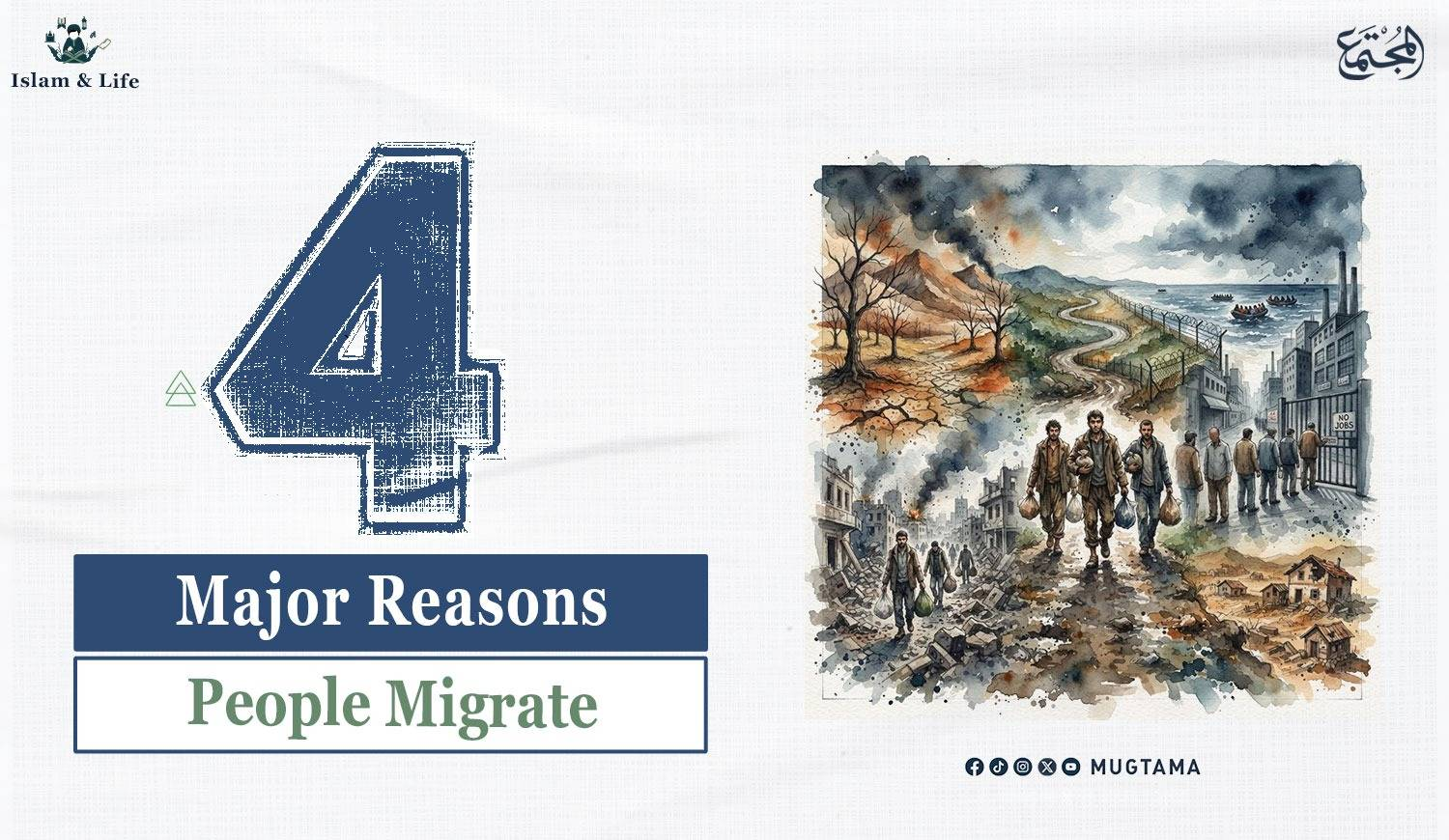
4 Major Reasons People Migrate
At some point, leaving may become the hardest decision a
person can make—and the most necessary one.
The motives for migration vary widely. Some people leave in
search of safety, work, education, or a more stable life. Yet when they cross a
border, they do not leave behind merely an address. They leave a language,
memories, relationships, and an entire chapter of life that once felt like
home.
Today, with around 304 million international migrants worldwide in 2024, migration is no longer a story confined to
those fleeing war. It is an experience shared by millions for very different
reasons, from security and employment to education, family, and environmental
pressures. But behind every number lies a more human question: What makes a
person decide to start life again somewhere other than home?
Motives for Migration: Why Leave a Place You Know?
The motives for migration cannot be reduced to a single cause.
A decision to leave often emerges from a combination of economic, security,
family, educational, and environmental pressures. In some cases, migration is a
choice; in others, it becomes a necessity.
1.
When Staying Becomes More Dangerous Than Leaving
For some people, there is no real choice.
War, persecution, violence, and human rights violations are
among the major forces behind displacement, turning departure into a matter of
survival. According to UNHCR, 117.8
million people were forcibly displaced worldwide by the end of 2025 as a result
of persecution, conflict, violence, human rights violations, and other events
seriously disrupting public order.
It is important to distinguish between different legal
categories: refugees, asylum-seekers, and internally displaced people are not
all migrants in the same legal sense. What they may share, however, is the
experience of being forced to leave a place they once considered home.
A striking 65% of refugees and other people in need of
international protection were living in countries neighboring their countries
of origin in 2025, while low and middle income countries hosted 68% of them.
This shows that the motives for migration do not necessarily lead people toward
the wealthiest or most distant countries.
2.
When Work Becomes a Path to a Better Life
Fear is not the only reason people leave.
A country may be safe, yet offer limited employment
opportunities or wages that do not match a person’s aspirations or
responsibilities. Someone may also believe that their skills will be better
valued elsewhere. According to the International Organization for Migration, work is the main reason for international
migration, and migrant workers make up the majority of international migrants.
Therefore, an economic migrant is not necessarily someone who
has rejected their home. They may simply be looking for an opportunity to
support their family, advance professionally, or build a future they consider
more secure.
The United Nations also reports that nearly 45% of
international migrants in 2024 were living within their region of origin. Much
international migration, therefore, takes place between geographically or
culturally connected countries rather than across the farthest possible
borders.
3.
Education, Family, and the Future
Sometimes leaving is not driven by crisis, but by opportunity.
A student may leave home to pursue an education that is
unavailable locally. Someone may move to reunite with family, relocate after
marriage, or begin a professional career abroad and eventually decide to settle
there.
This reveals another side of reasons for migration: not
everyone who leaves is escaping danger. Some are moving toward an opportunity
they believe could change the course of their lives.
Years later, however, a different question may emerge: Am I
still living in a foreign country, or has this place become my home?
4.
When the Environment Around Us Changes
Environmental and climate-related factors are becoming an
increasingly important part of discussions about human mobility. Floods,
droughts, rising sea levels, wildfires, and other environmental pressures can
damage livelihoods or make remaining in a particular place increasingly
difficult.
But the relationship between climate change and migration is
neither simple nor automatic. The International Organization for Migration
emphasizes that environmental pressures interact with poverty, food insecurity,
inequality, livelihoods, and conflict in shaping decisions about whether people
move or remain where they are.
A person may therefore not be responding to one identifiable
cause, but to a chain of pressures that eventually makes leaving the most
viable option.
When Migrants Arrive, Does the Real Test Begin?
The story of migration does not end when a person leaves home.
In many ways, another part of it begins when they arrive somewhere new.
A host society may see a newcomer as someone who speaks a
different language, follows a different religion, or has customs unfamiliar to
the majority. In some settings, these differences can become sources of
suspicion, fear, or stereotyping.
Yet public perceptions do not always correspond to the
evidence.
The OECD and
European Commission’s Indicators of Immigrant Integration 2023 notes
that public perceptions of migrants and their contribution to society are often
at odds with available evidence. For example, although the share of highly
educated migrants from outside the European Union increased, this change was
not reflected to the same extent in public perceptions.
Integration is not
the responsibility of one side alone. Migrants need to learn the language,
understand the law, respect the public order, and participate in society. Host
communities, in turn, need to provide genuine opportunities for participation
without requiring newcomers to erase the identities and histories that
distinguish them.
Can a Migrant Become a Citizen Without Losing Who They Are?
The word migrant describes one part of a person’s journey. It
does not define their entire identity.
Someone may be born in one country, hold the citizenship of
another, work in a third, and raise children in a society that becomes their
children’s first home. After years of residence, a migrant may acquire
citizenship in the country where they settled, becoming a citizen in legal
terms while retaining memories, cultural ties, and relationships connected to
their country of origin.
But citizenship does not always begin with a passport.
There is a difference between citizenship as a legal status
and belonging and participation as lived relationships between individuals and
the societies around them.
The OECD measures migrant integration across several areas,
including employment, education, living conditions, civic engagement, social
integration, and trust in institutions. Its data show that, across the European
Union, immigrants were more likely than the native-born to report trusting the
police and the legal system, although the results vary across countries and
institutions.
This suggests that a sense of belonging is shaped not only by
where a person comes from, but also by whether they can participate
meaningfully and feel that they are accepted as members of the society around
them.
Can a Society Turn Newcomers Into Citizens?
Citizenship may begin legally with birth or the acquisition of
nationality. But a deeper sense of citizenship is built through participation.
Islamic history offers a distinctive example of how a
community can respond to newcomers. The Quran not only speaks of those who migrated, but
also praises the people who welcomed them: {As for
those who had settled in the city and ˹embraced˺ the faith before ˹the arrival of˺ the emigrants, they love whoever immigrates to them, never
having a desire in their hearts for whatever ˹of the gains˺ is given to the emigrants. They give ˹the emigrants˺ preference over themselves even
though they may be in need.} [Al-Hashr 59:9]
Al-Ansar did more than open their homes to the Muhajirun or
sympathize with their displacement. They shared resources and opportunities
with them. Sa`d Ibn Ar-Rabi`, for example, offered to share his wealth with his
brother in faith, `Abdul Rahman Ibn `Awf. `Abdul Rahman declined and instead
asked to be shown the marketplace, where he began working and trading.
Al-Ansar also proposed sharing their date palms with Al-Muhajirun,
while the emigrants contributed their own labor.
The experience of Madinah, therefore, was not simply a story
of one side giving and the other receiving. It was a process of mutual
contribution, bringing together people who had left their homes and a community
willing to make room for them.
Healthy integration does not require newcomers to
abandon their identity, nor does it place the entire burden of adaptation on
the host society. It creates space for both sides to participate and
contribute, allowing difference to become a source of enrichment rather than a
barrier between people.
Does a Person Forget Home After Leaving It?
People leave their homes for many reasons, but leaving a place
does not necessarily mean forgetting it.
A migrant may carry their language, food, childhood memories,
family ties, religion, and culture with them. Over time, they may discover that
their relationship with home is no longer defined simply by the question,
“Where do I live?”, but by a more complicated one: “Where do I belong?”
The life of the Prophet Muhammad (peace be upon him) offers a
powerful example.
Makkah was his home, and he loved it despite the persecution
and suffering he experienced there. When he was forced to leave, that pain did
not erase his attachment to the city. He said of Makkah: “I swear by God that you are the best part of God’s earth
and the part dearest to Him. Had I not been expelled from you I would not have
gone out.”
After settling in Madinah, he did not simply erase his
attachment to Makkah. Instead, he prayed: “Make
Medina as dear to us as Mecca, or more so.”
His experience shows that migration does not necessarily
require a person to replace one attachment with another. A person may leave a
place because circumstances force them to, while carrying its language,
memories, family ties, and formative experiences into a new life.
The motives for migration may begin with fear, necessity, or
ambition, but they do not end when a person crosses a border.
A person may leave one place behind and still carry it within
them, while gradually building a new life and a new sense of belonging
elsewhere.
Perhaps the success of migration is not measured by whether a
person forgets where they came from or rejects where they have arrived. It may
instead lie in transforming displacement from one place into the building of a
place where belonging becomes possible.