






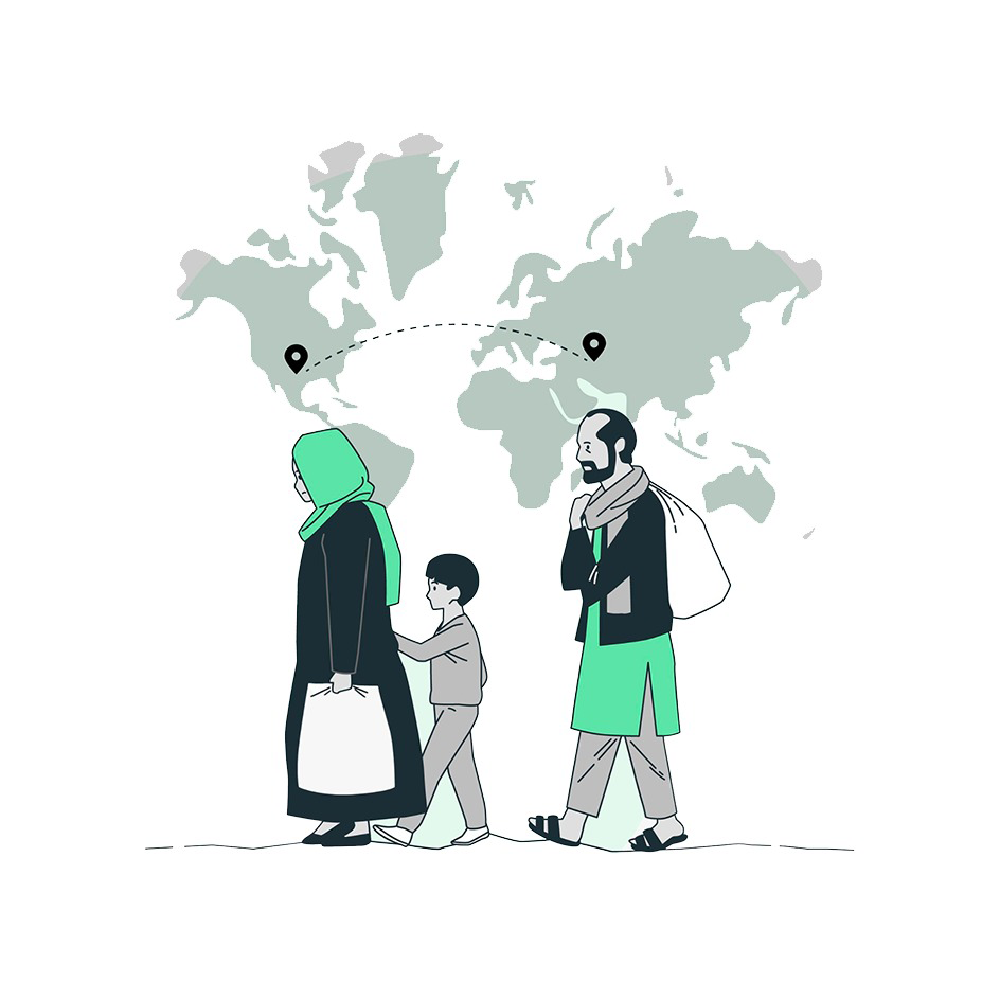


Quranic Reflection on Hijrah: Does Hijrah Begin within the Heart?
{Whoever emigrates in the cause of Allah will find many safe havens and
bountiful resources throughout the earth. Those who leave their homes and die
while emigrating to Allah and His Messenger—their reward has already been
secured with Allah. And Allah is All-Forgiving, Most Merciful.} [An-Nisa’
4:100]
The verse
begins with a promise: new horizons, wider opportunities, and room to practice
one's faith freely. But before the migrant can enjoy any of these blessings,
the scene suddenly changes.
Death
appears on the road. The traveler never reaches the destination, yet the Quran
declares the journey a success.
How can a
journey be complete with no arrival? And what if the most important journey of
your life ended before you reached your destination?
In a
world that measures success by outcomes, completed goals, and visible
achievements, the Quran tells the story of a man whose greatest act was
accepted even though he never arrived where he intended to go. His journey was
cut short. His destination remained unseen. Yet Allah declared his reward
guaranteed.
This
verse invites us to rethink what migration really means.
When
people hear the word hijrah (migration),
they often think of crossing borders, leaving one country for another, or
seeking a new life elsewhere. In modern Western societies, migration is usually
discussed in political, economic, or social terms.
But the
Quran presents a far deeper reality.
Sometimes
the most transformative migration is not from one place to another. It is from
heedlessness to faith, from attachment to surrender, from a life centered on
the self to a life centered on Allah.
A Journey That Never Reached Its
Destination
Classical
Muslim scholars mention several reports concerning the revelation of this
verse. The most famous account concerns an elderly Muslim named Damrah Ibn
Jundub.
After the
revelation of the verses criticizing those who were capable of leaving Makkah
but remained among the persecuting idolaters, Damrah realized that he could no
longer delay his migration. Though old, weak, and seriously ill, he instructed
his family to carry him out of Makkah so that he could join the Prophet
Muhammad (peace be upon him) in
Madinah.
His words
were striking: “O Allah, You have left no excuse and no argument for me.”
He knew
what Allah required of him, and he was determined to respond.
Yet he
never reached Madinah. Death overtook him on the road.
From a
purely worldly perspective, his journey seemed unfinished. He left his home but
never arrived at his destination. He endured hardship but did not witness the
outcome.
Then came
the verdict of Allah: {Those who leave their homes
and die while emigrating to Allah and His Messenger—their reward has already
been secured with Allah.}
The Quran
shifted attention away from the destination and toward the intention. The
journey was accepted before it was completed.
The Migration of the Heart
For many
readers today, physical migration may not be relevant. Most Muslims are not
being asked to leave their countries or homes.
Yet the spiritual meaning of Hijrah remains as urgent as ever.
The
Prophet (peace
be upon him) said: “A
Muhajir (emigrant) is the one who gives up (abandons) all what Allah has
forbidden.” (Al-Bukhari)
This
hadith expands the meaning of migration far beyond geography.
A person
may never leave their city, yet perform a profound Hijrah by abandoning sin,
arrogance, addiction, dishonesty, or lifestyle that distances them from Allah.
Likewise,
a person may travel thousands of miles while their heart remains attached to
the very things they were supposed to leave behind.
True
Hijrah begins before the feet move. It begins when the heart decides that Allah
is more important than comfort.
Leaving Behind What We Love
One
reason the story of Damrah resonates so deeply is that it highlights the human
cost of faith.
Leaving
one’s homeland is not easy. Human beings are naturally attached to familiar
streets, family memories, lifelong friendships, and places that shaped their
identity. The early Muslims were not emotionless heroes detached from the world
around them. They loved Makkah. They loved their homes. Yet they loved Allah
more.
This is
what made their migration extraordinary.
They were
willing to sacrifice certainty for faith, familiarity for purpose, and comfort
for obedience.
In a
different form, modern believers face similar choices. Many are called to leave
destructive relationships, harmful habits, unethical careers, toxic
environments, or social circles that pull them away from their values. Such
decisions often involve loss, loneliness, and uncertainty.
The road
may look different, but the principle remains the same. Every sincere act of
obedience requires a form of migration.
Success Is Not Measured by Arrival
Perhaps
the most powerful lesson in this verse is that Allah judges people by their
sincerity, not merely by visible outcomes.
Damrah
did not reach Madinah, yet Allah guaranteed his reward.
In a
culture obsessed with results, achievements, and measurable success, this Quranic
perspective is profoundly liberating.
A person
may strive to become better but die before seeing the fruits of that effort.
A parent
may struggle to raise righteous children without witnessing the final outcome.
A
believer may begin a difficult journey of repentance and fall short of the
finish line.
The story
of Damrah reminds us that Allah does not waste sincere efforts.
What
matters is not only where we arrive, but whether we genuinely set out for the
sake of Allah.
Where Does Hijrah Begin?
The Quranic
answer is clear. Hijrah begins neither at an airport nor at a border crossing.
It begins
in the heart. It begins the moment a person decides that Allah deserves their
highest loyalty.
The
elderly companion who died before reaching Madinah teaches a timeless lesson:
sometimes the most important step of the journey is the first one. The moment
he left his home, his migration had already begun. The moment he chose Allah
over hesitation, his reward was secured.
That is
why this Quranic lesson remains relevant for every generation. Not because all
believers are required to leave their homes, but because every believer is
required to leave something behind for the sake of Allah.
And every
great migration starts from within.
For Further Reading:
- The Meaning and Significance of the Hijrah
- Traits and Divine Rewards of Real Believers
- 5 Great Lessons from the Battle of Tabuk — The Prophet's (PBUH) Final Campaign
-------------------------------------------------------------