




The Migration That Changed the Course of History
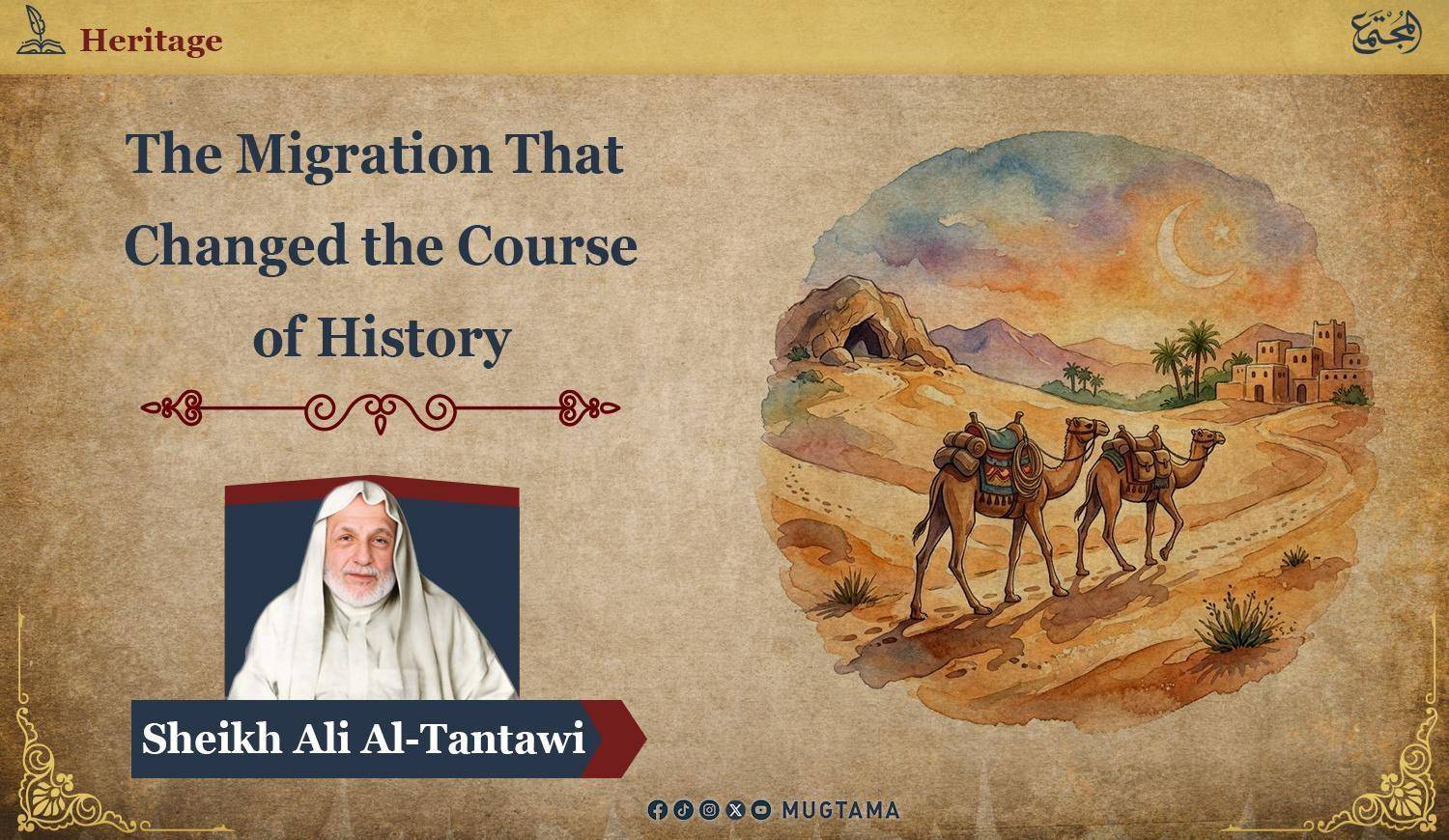
The chieftains of Quraysh conspired to commit the most heinous
crime in human history.
Had it succeeded, history would never have known Damascus,
Baghdad, Cairo, or Córdoba. There would have been no Rashidun Caliphate, nor
the empires of the Umayyads or the Abbasids. The Ottomans would never have
conquered Constantinople; the Umayyad Mosque, the Nizamiyya Madrasa, and the
Alhambra would never have been built. The very civilization from which Europe
drew its own awakening—first from the Levant during the Crusades, and later
from Andalusia—would never have arisen. History would have charted an entirely
different course, leaving humanity in a state known only to God.
Prophetic Courage: Defying the Conspiracy
Here shone the supreme courage, resolute composure, and valor
of Muhammad, as divine triumph favored the righteous. He opened the door and
stepped out, cutting straight through their ranks and striding fearlessly past
the very mob that had come thirsty for his blood. They sought his demise, but
God willed his survival—and the will of God prevailed. Stunned by astonishment
and blinded to his presence, the conspirators only regained their senses long
after Muhammad had vanished. Awaking as if from a fleeting trance, they peered
through the door to confirm their kill. They saw Muhammad’s bed with a figure
lying asleep beneath the mantle; rubbing their eyes in relief, they breathed a
collective sigh of certainty.
Only after Muhammad was long gone did Quraysh grasp the truth.
Alarm echoed through Mecca and its surrounding valleys. The men of Quraysh
surged forth—cavalry and infantry—spurring their horses, scouring every corner,
and casting frantic glances in all directions.
What had overcome them? What struck these proud guardians of
the sanctuary, these seasoned masters of war, that terror should strip them of
their senses and shatter their resolve?
'What ails you, people?'
'Muhammad has escaped!' they cried.
'And what do you demand of him? Did he seize your wealth?' 'God forbid! He is the Trustworthy and Faithful, who
returned every last coin to its rightful owner.'
'Did he commit a crime that you hunt him so?' 'Far from it! He is the most noble of character, the
purest of hands.'
'What, then, do you seek from him?' 'He will rally the entire world against our deities and
idols, against our ignorance and pride! He will compel us to tear down these
lifeless stones, to bow before the One God, and to follow the path of
righteousness, truth, and virtue.'
'Is this, then, your grievance against Muhammad?'
And once again, history laughed in the face of Quraysh.
Unwavering Faith: In the Company of God
Quraysh returned defeated in their disgrace, and the entire
Arabian Peninsula was stirred into a frenzy against Muhammad. A bounty was
declared: one hundred camels for anyone who brought him in, dead or alive.
After Muhammad and his companion departed the Cave of Thawr, a
lone horseman—Suraqah ibn Malik(1)—caught up with them. Overcome with fear, Abu
Bakr said: 'By God, I fear not for my own soul, but for yours.' Muhammad
replied with the words that embody the ultimate miracles of faith in all their
forms—valor, sacrifice, steadfastness, and selfless devotion. He said: 'Do
not grieve; indeed, God is with us.'
For God is ever with those who remain faithful to Him; God
aids those who champion His cause, and no soul accompanied by God shall ever
know despair. A front upheld by God shall never be broken, even if the entire
universe were arrayed against it.
And so, the procession set forth into the wide world. It was a
modest party, yet more momentous than the grandest pageant that ever tread the
face of this earth. History has never known a march with a nobler purpose, a
farther-reaching horizon, a purer devotion, or a deeper imprint upon the earth.
A humble caravan traversing the silent desert—bereft of
banners and standards, without the fanfare of trumpets or drums; no soldiers
flanked its path in salutation, nor did crowds cheer from windows. Instead, the
sands clapped with delight for the one destined to drape them in the mantle of
fertility and flourishing; the mountains swelled with pride for the one who
would plant upon their peaks the standards of victory and glory; and from the
womb of the unseen emerged legions of commanders, scholars, and literary
luminaries—all nurtured by Muhammad’s stride across these barren wastes, until
at last, the sanctuary of Medina rose into view.
A Grand Reception and the Humility of a Leader
Here we stand at the gates of Medina, which has emptied itself
entirely to welcome Muhammad. Out of sheer devotion, had its people been able,
they would have paved his path with fragments of their very hearts, so that he
might tread upon their souls. Together, they raised the timeless anthem of
reception:
'The full moon has risen upon us,
From the valleys of Wada'a.
Gratitude is incumbent upon us,
So long as any caller calls unto God.'
In the surging crowd, people began to ask: 'Which of them
is he? Which one is Muhammad?'
They could not single him out, for he rode not as a monarch;
he wore no silk, bore no insignia of royalty, and wore no crown upon his brow.
He was merely a humble servant of God—wearing what common folk wore, eating
what they ate, hungry when they hungered, and contented when they were
satisfied.
'Let the she-camel proceed,'
he said, 'for she is divinely commanded.' The camel walked on until she
knelt before the home of Abu Ayyub al-Ansari.
Abu Ayyub—the very man whom God decreed would, decades later,
take part in the siege of Constantinople, pressing deep into enemy lines
seeking martyrdom at the farthest frontier. There he fell, laid to rest upon
the shores of the Bosphorus. For centuries, his lonely tomb stood as a beacon
summoning Muslim armies to the conquest, until God bestowed that ultimate honor
upon Sultan Mehmed the Conqueror.
Building the Mosque: The Cornerstone of the Ummah
We are now alongside Muhammad (PBUH) in Medina. As he lays the
foundations of the nascent state, where do you suppose he begins? With a lavish
coronation ceremony where crowds pledge him their allegiance as king? He seeks
no earthly crown! Does he inaugurate a garrison with grand fanfare and mobilize
a standing army? He pursues no earthly supremacy! Does he levy taxes? No.
Instead, he begins by building the mosque.
This is a profound phenomenon upon which the reader ought to
reflect: he begins with the mosque, just as revelation itself began with the Quran
and instruction by the pen.