






Fiqh of Migration and Refuge in the Modern World

Human
beings are naturally inclined to love their homeland and remain within it,
where their family, relatives, and memories reside. A homeland is not merely a
piece of land; it is spirit, history, and life itself. Thus, it is often said
that love of one’s homeland is part of human nature.
Yet
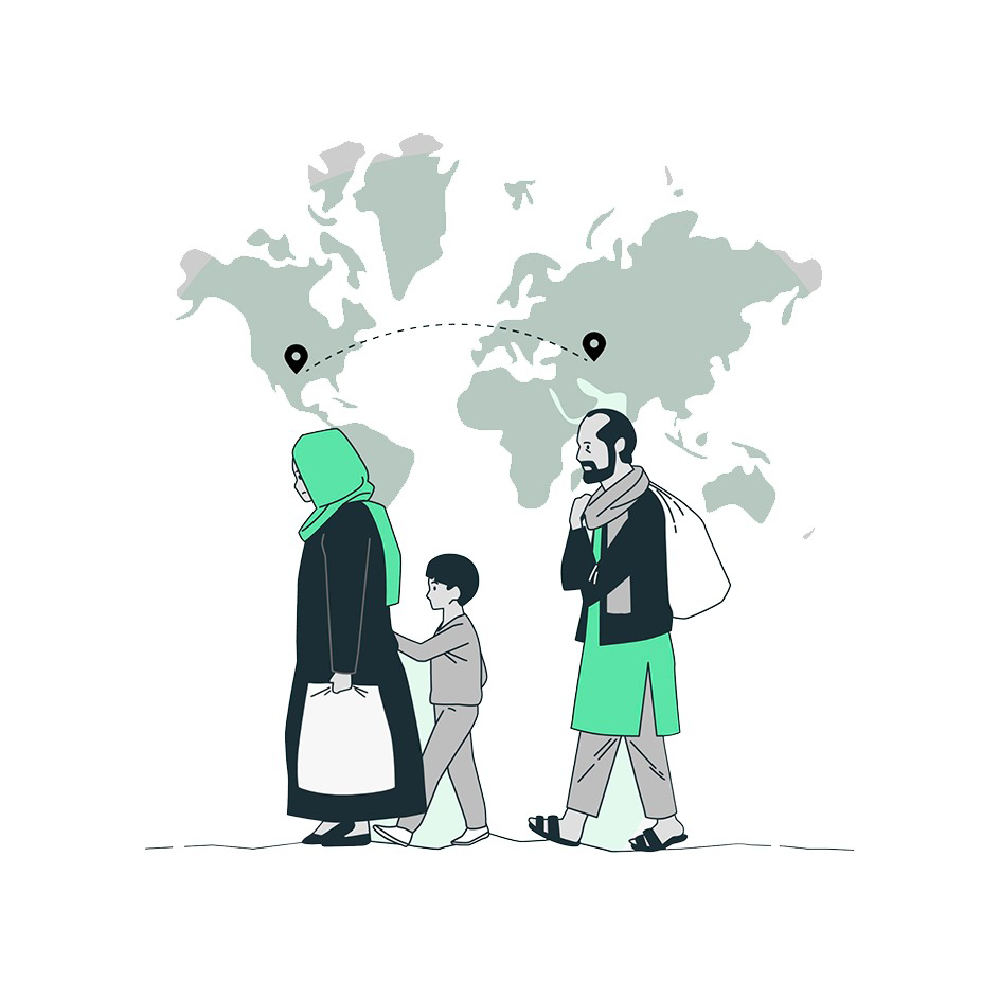
people may leave their homeland for another country for various reasons. When a
person voluntarily leaves his homeland in search of employment, education, or
other opportunities, this departure is called migration.
However, when a person is forced to leave because of war, persecution, or
similar circumstances, this departure is called refuge or asylum.
There is
a vast difference between voluntary migration and forced displacement. The
first is a matter of choice and is often accompanied by hope and aspiration,
while the second is compelled and is usually accompanied by grief and
suffering. One clear indication of this difference is that a person may spend
considerable money in pursuit of migration, willingly leaving his homeland in
search of a better life and choosing his destination. A refugee, by contrast,
is often compelled to leave and may have little or no choice regarding where he
ultimately goes.
There is
also a third concept known as mixed migration, which combines both the desire
for a better life and the need to flee war, oppression, or harsh conditions.
The Islamic Ruling on Migration
In
classical Islamic jurisprudence, migration refers to moving from a land of
disbelief to a land of Islam in order to preserve one’s religion. This type of
migration ended as a collective obligation after the establishment of the
Islamic state, although it may still apply to certain individuals or groups
under specific circumstances.
The
Prophet (peace and blessings be upon him) said: “There
is no emigration after the Conquest but Jihad and intentions.” (Reported
by Al-Bukhari and Muslim)
As for
migration in the contemporary sense—moving from one country to another for
legitimate purposes such as employment, education, marriage, or similar
reasons—it is permissible.
The
degree of its permissibility varies according to the purpose. It may be
recommended when undertaken for seeking knowledge, or simply permissible in
other lawful circumstances.
Its
permissibility is supported by the legal principle established by jurists that
the default ruling regarding things and actions is permissibility. Numerous
texts support this principle, including Allah’s saying: {He is the One Who created everything in the earth for you.}
[Al-Baqarah 2:29]
Migration
may, however, become prohibited if it results in harm to one's religion or
personal safety. This is because protecting faith
and life takes precedence over remaining in one’s homeland. The entire earth
belongs to Allah, and wherever a person finds safety for himself, his religion,
and his family, that place becomes his homeland.
The Islamic View of Refuge and Asylum
Refuge or
asylum, however, carries a different ruling. The 1951 Refugee Convention and
its 1967 Protocol define a refugee as someone who is unable or unwilling to
return to their country of origin owing to a well-founded fear of being
persecuted for reasons of race, religion, nationality, membership of a
particular social group, or political opinion.
When a
person faces imprisonment, torture, persecution, or religious oppression in his
homeland, seeking refuge may become religiously obligatory. The preservation of
religion and life takes precedence over remaining in a particular land, since
land can be replaced, whereas faith and life cannot.
Numerous
Quranic verses support this principle, including: {When
the angels seize the souls of those who have wronged themselves1—scolding them,
“What was wrong with you?” they will reply, “We were oppressed in the land.”
The angels will respond, “Was Allah’s earth not spacious enough for you to
emigrate?” It is they who will have Hell as their home—what an evil
destination!} [An-Nisa’ 4:97]
Religious
persecution must be resisted and escaped from, as Allah says, {O My believing servants! My earth is truly spacious, so
worship Me ˹alone˺.} [Al-`Ankabut 29:56]
Allah has
provided His servants with spacious alternatives throughout the earth and
established the golden principle: {And Allah’s
earth is spacious.} [Az-Zumar 39:10]
Preserving Faith and Life
The life
of the Prophet Muhammad (peace and blessings be upon him) clearly demonstrates
this principle.
When the
persecution of Quraysh intensified against him and his Companions, he did not
cling to the land in which he was born. Rather, Allah commanded him to migrate to Madinah.
Hundreds
of male and female Companions migrated as well. Many left behind their wealth,
businesses, and homes in order to preserve their religion and escape
oppression, injustice, and death.
This
reflects one of the fundamental objectives of Islamic law: the preservation of
religion and life takes precedence over the preservation of wealth and land. Wealth
comes and goes. Land comes and goes. But faith and life do not.
Refuge As a Universal Human Reality
Forced
displacement and exile are not experiences unique to Muslims. According to
statistics from the United Nations High Commissioner for Refugees, the number
of displaced people worldwide has exceeded 120 million individuals.
A Muslim
should therefore feel no shame if circumstances compel him to leave his
homeland. He is not alone in doing so.
If
possible, he may seek refuge in another Muslim country. If that is not
available, he may seek safety in any country where he can protect his life,
family, dignity, religion, and beliefs, and freely practice his faith—even if
that country is not Muslim.
Is the Division of the World into
“Islamic” and “Non-Islamic” Lands Permanent?
Dividing
the world into lands of belief and lands of disbelief was a juristic
interpretation shaped by historical realities.
Today's
world differs significantly from the world of earlier centuries. In some cases,
a Muslim may find greater religious freedom in a non-Muslim country than in
certain Muslim-majority states.
The
original principle remains that Muslims should reside among fellow Muslims
because such an environment generally helps preserve faith, family, and
property.
However,
if that reality changes, it may become necessary to leave one country for
another in order to safeguard one’s religion, life, identity, freedom, and
dignity.
Human
dignity itself is one of the central objectives of Islamic law for all people,
Muslims and non-Muslims alike.
Allah
says, {Indeed, We have dignified the children of
Adam, carried them on land and sea, granted them good and lawful provisions,
and privileged them far above many of Our creatures.} [Al-Isra’ 17:70]
Wherever
human dignity exists, people can exercise their freedom and fulfill their role
as stewards on earth according to both religious and human interests.
The Folly of Remaining Under Oppression
It is
unwise for a person to remain in a country where his religion is restricted and
his dignity violated under the banner of patriotism.
The
entire earth is the homeland of the believer. Protecting one’s faith and life
from persecution is part of the natural instinct with which all human
beings—Muslim and non-Muslim alike—have been created.
Oppression and injustice recognize no religion. Therefore, oppression and
wrongdoing are among the gravest sins and greatest prohibitions.
Leaving
one’s homeland because of such circumstances does not mean hating one’s country
or remaining outside it forever. Rather, such migration is often temporary and
ends when conditions improve and the causes of displacement disappear.
Nor does
Islamic law require migration in every circumstance. Despite the command to
migrate from Makkah to Madinah, not all Muslims left. Some remained hidden,
unknown even to others.
This is
reflected in Allah’s statement: {Had there not been
believing men and women, unknown to you. You might have trampled them
underfoot, incurring guilt for ˹what you did to˺ them unknowingly.} [Al-Fath 48:25]
What
Allah prohibited after the conquest was the return of emigrants to Makkah as a
land requiring migration, because Makkah had become part of the Islamic realm.
This is
the meaning of the Prophet’s statement: “There
is no emigration after the Conquest but Jihad and intentions.”
The Islamic Understanding of Asylum and
Protection
The
concept of asylum corresponds to what Islamic jurisprudence traditionally
called granting protection or security.
Islamic
law recognizes the right of protection for every human being, even if that
person is not Muslim. The Shari`ah gives special attention to vulnerable and
oppressed groups.
One of
the duties of legitimate governance is to establish security and spread it
throughout society so that Muslims and non-Muslims alike feel safe regarding
their lives, honor, and property. No one should be harmed or punished without
guilt or crime.
The
Prophet (peace and blessings be upon him) said: “All
things of a Muslim are inviolable for his brother in faith: his blood, his
wealth and his honour.”
He also
established the social principle: “A believer to
another believer is like a building whose different parts enforce each other.”
(Reported by Al-Bukhari)
Human Rights in Islamic Jurisprudence
Islam
established a comprehensive theory of rights within society.
It
guaranteed every resident the right to life, security, and protection from
aggression. It recognized property rights. It affirmed the right to work and
earn a livelihood, teaching that the best earnings are those acquired through
one's own labor.
It also
recognized freedom of belief. Allah says, {Let
there be no compulsion in religion.} [Al-Baqarah 2:256]
The Principle of Non-Refoulement in
Islam
Among the
contemporary principles that Islam guaranteed long before modern international
law is the principle of non-refoulement.
This
principle, considered a cornerstone of international refugee law, prohibits
returning a person seeking protection to a place where he fears persecution.
Islamic
jurisprudence established this principle centuries ago by forbidding the
surrender of those who seek security in Muslim lands when their lives or safety
are at risk.
More
recently, this principle has been reflected in initiatives such as the Cairo
Declaration on the Protection of Refugees and Displaced Persons in the Arab
World.
It also
aligns with Islamic legal principles, which prohibit any state from extraditing
a person who entered legally under a valid visa to another state unless he has
committed genuine crimes that warrant prosecution according to justice and due
process—not fabricated charges related to opinion, expression, or personal
freedoms.
In
conclusion, migration is a voluntary act undertaken for legitimate interests,
while refuge or asylum is a necessity that may become obligatory in order to
preserve religion, life, and human dignity.
Seeking
refuge does not contradict patriotism, for it is often temporary and driven by
necessity. The preservation of life takes precedence over attachment to land.
Islam
affirmed these just principles centuries before the emergence of modern
human-rights conventions, and it did not restrict them to Muslims alone. Rather,
these rights are guaranteed for every human being.
For Further Reading:
- The Ummah Obligatory Migration from Disunity to Unity
- Be Kind to Your Wife and Children, Dear Expat
- 10 Steps to Help You Adapt to Expatriation
-------------------------------------------------------------