







Tipu Sultan: How the Tiger of Mysore Resisted British Rule
In the late eighteenth century, as the British East India
Company expanded its power across the Indian subcontinent, one ruler in
southern India refused to accept its growing dominance.
His name was Sultan Fateh Ali Sahab Tipu (Tipu Sultan), ruler
of the Kingdom of Mysore.
Known as the “Tiger of Mysore,” Tipu spent much of his reign
fighting the East India Company and attempting to preserve Mysore’s
independence. He combined military resistance with administrative reforms,
technological innovation and diplomacy, including efforts to strengthen
relations with France.
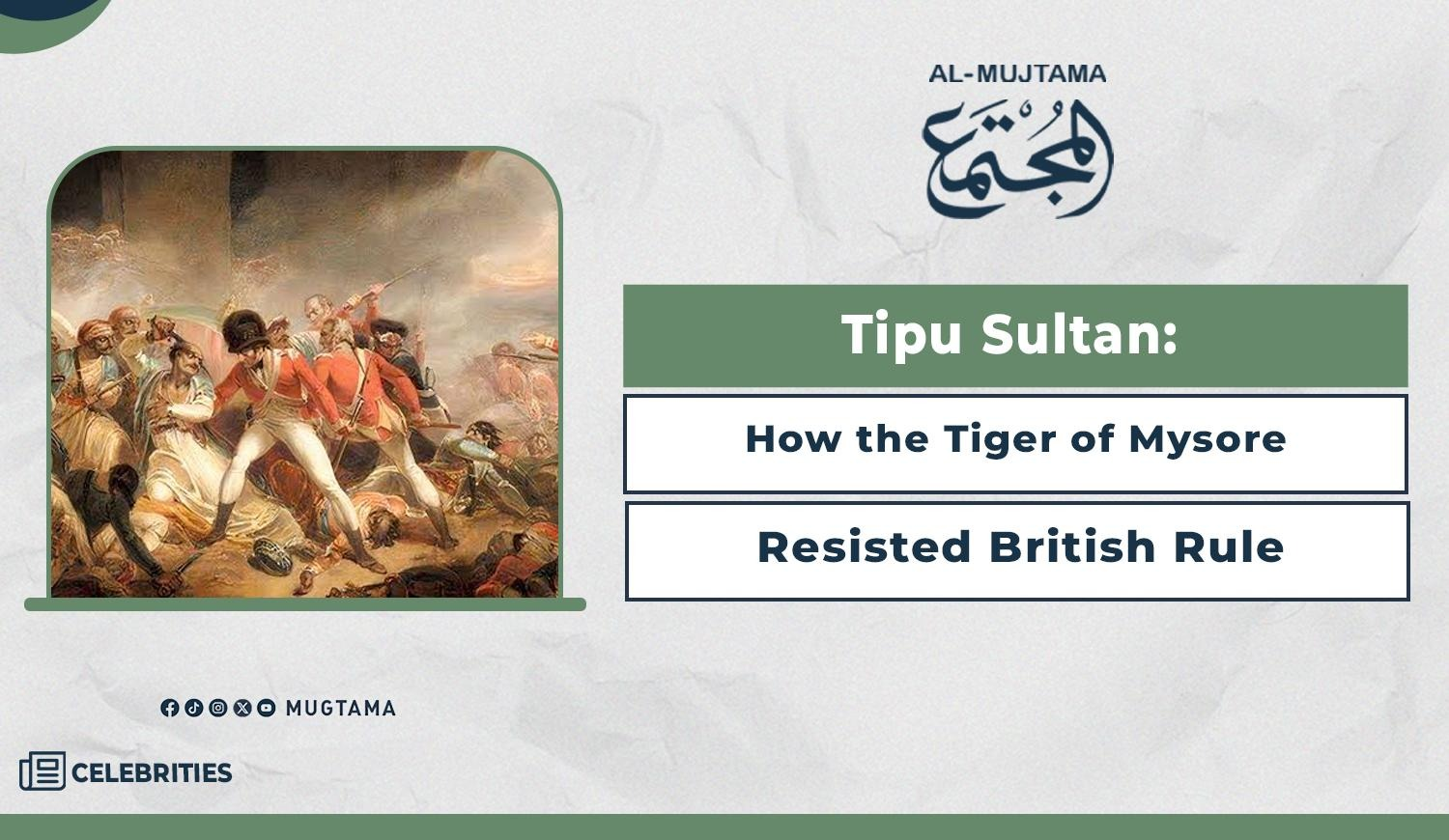
His final stand came on May 4, 1799, when British-led forces
stormed his capital, Seringapatam. Tipu was killed while defending the city.
More than two centuries later, his legacy remains deeply
contested, making him one of the most striking figures in the history of
British expansion in India.
A Kingdom Caught Between Empires
Tipu Sultan was born in 1750, the son of Hyder Ali, the
powerful ruler who had risen to prominence in Mysore.
From an early age, Tipu was trained for military and political
leadership. His education included Islamic studies, history, martial skills and
several languages, including Persian, Arabic and Indian languages. His father
also placed him directly in the field, allowing him to gain military experience
while still young.
This was a turbulent period in Indian history.
The Mughal Empire had declined as a dominant political power,
while regional kingdoms competed for territory and influence. At the same time,
the British East India Company had transformed itself from a commercial
enterprise into a major military and political power.
By the middle of the eighteenth century, the Company was using
its armies not only to protect trade but also to expand its territorial
control.
Mysore stood directly in the path of that expansion.
The Tiger of Mysore Enters the Battlefield
Tipu’s first major military experiences came while his father
was still ruling Mysore.
By 1766, he had already taken part in military operations.
Despite his youth, he impressed his father sufficiently to receive command of
hundreds of cavalrymen and responsibility for governing territories under
Mysorean control.
The conflict between Mysore and the British would eventually
develop into four Anglo-Mysore Wars, fought between 1767 and 1799. The British
Museum describes Tipu as a skilled leader whose army became a powerful force
and notes that he fought both British and Indian rivals.
When Hyder Ali died in 1782, Tipu succeeded him as ruler of
Mysore. He was only in his early thirties.
The new ruler inherited a kingdom surrounded by competing
powers. Yet rather than simply defending what his father had left him, Tipu
sought to strengthen Mysore militarily, economically and technologically.
Tipu Sultan’s reputation is often reduced to his wars with the
British, but his rule also included efforts to strengthen the internal
organization of Mysore.
He was interested in science, mathematics, technology,
agriculture, trade and administration. He introduced reforms in areas including
roads and currency and encouraged technological experimentation.
One of the most famous examples was the development and
deployment of Mysorean rockets.
These weapons used iron casings, allowing them to travel
farther and with greater force than many earlier rockets. Their use by Mysorean
forces later attracted British attention and contributed to the development of
military rockets in Britain.
His interest in technology was not merely theoretical. It was
tied directly to the survival of his state in an age when military technology
was rapidly changing.
Tipu also left behind an extensive documentary record. The
British Library preserves manuscripts containing his correspondence,
administrative documents and material relating to his dealings with the French.
The French Connection
Tipu understood that Mysore could not confront the British in
isolation forever.
France was Britain’s major European rival during much of this
period, and French military personnel had already served alongside Mysorean
forces. Tipu therefore sought closer relations with France as a way of
counterbalancing British power.
This became particularly significant after Napoleon Bonaparte’s
invasion of Egypt in 1798.
Napoleon’s campaign was part of the wider struggle between
France and Britain, and British officials became increasingly concerned about
the possibility of a French-Mysorean alliance.
Historical research shows that Tipu maintained friendly
relations with the French Directory and that the possibility of an alliance
became a serious concern for the British in 1798–1799.
The British Library’s surviving documents also contain records
concerning Tipu Sultan’s relations with France during the 1790s.
For Tipu, diplomacy was therefore another battlefield.
If Mysore could secure French assistance, the balance of power
in southern India could potentially change.
But the alliance he hoped for never developed into the
military partnership he needed.
The Third Mysore War: A Crushing Setback
The decisive turning point came during the Third Anglo-Mysore
War of 1790–1792.
British forces under Lord Cornwallis, supported by Indian
allies, invaded Mysorean territory and eventually besieged Tipu’s capital,
Seringapatam.
Tipu was forced to accept a settlement that required him to
surrender a substantial portion of his territory and pay a large financial
indemnity.
Even more humiliating, his two young sons were handed over as
hostages until the terms of the treaty were fulfilled. British Museum records
preserve contemporary material depicting the princes being received by
Cornwallis in 1792. They were eventually returned to their father after the
agreement was fulfilled.
For Tipu, the defeat was not the end. It was preparation for
another war.
Napoleon, France and the Last Chance
By 1798, Tipu had spent years rebuilding his military
position.
Then came Napoleon’s campaign in Egypt.
The French presence in Egypt intensified British fears that
France might use the region as a route toward Britain’s interests in India.
Tipu’s existing relationship with France suddenly became strategically
important.
The possibility of cooperation between Napoleon and Tipu was
real enough to alarm British authorities. But events moved faster than
diplomacy.
Britain acted.
The Fourth Anglo-Mysore War began, and the British assembled a massive coalition against Mysore. Tipu now faced an enemy with overwhelming resources. In 1799, British-led forces advanced on Seringapatam. The city became the center of the final confrontation. Tipu refused to abandon his capital.
The siege culminated on May 4, 1799, when British forces
stormed the fortress. Tipu was killed during the fighting. The British Museum
records that he died defending his capital, while the British Library preserves
contemporary records of the campaign and the fall of Seringapatam.
His death marked the end of Mysore’s independent resistance
under his rule.
British troops took objects from the defeated ruler as war
trophies, including his sword. The British Museum still holds a sword
associated with Tipu, decorated with a tiger and a Quranic inscription.
The symbolism was unmistakable. The tiger had been Tipu’s
personal emblem, appearing on his weapons and other objects associated with his
court.
Why Does Tipu Sultan Still Matter?
Tipu Sultan’s historical significance goes beyond the story of
one ruler who lost a war.
He lived at a moment when a commercial company was becoming an
imperial power, and he recognized the danger that this transformation posed to
the political independence of Indian states.
He fought the East India Company repeatedly, sought
international alliances, invested in military technology and attempted to
strengthen his kingdom from within.
The British Museum describes him as one of the last major
figures holding out against the East India Company and notes that the Company
fought four wars against Mysore between 1767 and 1799.
Yet Tipu’s legacy is not free from distortion.
After the fall of Seringapatam, British accounts increasingly
portrayed Tipu not simply as a defeated enemy, but as a cruel tyrant and
religious fanatic. He was depicted as a ruler who oppressed his subjects,
persecuted non-Muslims, forced conversions and treated British prisoners with
exceptional brutality. This image became what historians have described as the
“Tipu Legend”—a powerful negative portrait that circulated through British
newspapers, popular art, theatre and historical writing.
The political usefulness of that portrayal was significant. A
historical study of British imperial identity argues that expansionist
officials and writers presented Tipu as an intolerable despot, helping frame
British military intervention as a form of liberation rather than conquest. In
this narrative, the East India Company was not simply expanding its power; it
was supposedly rescuing Mysore from a dangerous ruler.
Even visual representations contributed to this process.
Scholars examining colonial paintings have argued that some British depictions
of Tipu and the Mysore Wars were designed in ways that vilified him and shaped
how British audiences understood the conflict.
But the story of the ruler who faced the East India Company,
experimented with new weapons, sought French support and died defending his
capital has continued to travel far beyond the walls of Seringapatam.
And that is why the Tiger of Mysore remains one of the most
recognizable Muslim figures in the history of resistance to British expansion
in South Asia.