







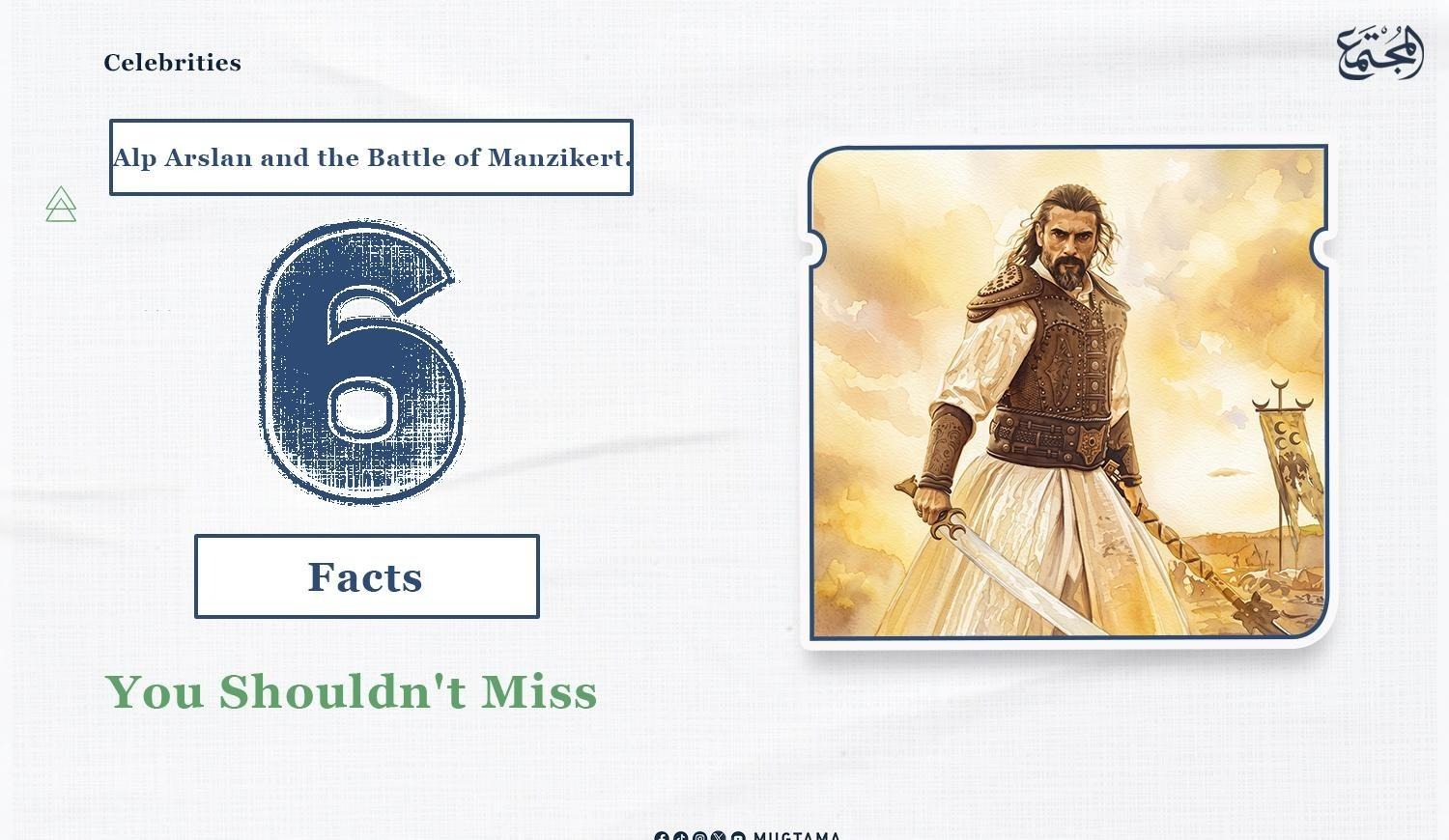
Alp Arslan and the Battle of Manzikert.. 6 Facts You Shouldn't Miss
The Abbasid era witnessed a
peak in science and learning never before seen by humanity; Baghdad was the
capital of science, the incubator of scholars, and the lighthouse that
illuminated the world with various fields of knowledge, translations, and
discoveries. However, from a political standpoint, the Caliphate went through
difficult periods as a result of the infiltration of regional powers that
attempted to impose their guardianship over the political decision in Baghdad.
At the forefront of these were the "Buyids," who seized the reins of
influence and restricted the Abbasid caliphs.
Here, the salvaging role of
the Seljuk state emerged; in the year 447 AH, the Seljuk leader "Tughril
Beg" responded to the call of the Abbasid Caliph "Al-Qa'im bi-Amr
Allah." He entered Baghdad and completely ended the expansion of Buyid
influence, which had lasted for more than a century. The Seljuks did not come
as occupiers, but rather as protectors of the legitimacy of the Abbasid
Caliphate; they restored the Caliph's status and prestige, and declared their
full loyalty to him as a spiritual symbol of the Islamic nation. When Sultan
Alp Arslan assumed power, he continued this policy based on respecting the
status of the Caliphate, and succeeded in unifying the Levant, Hejaz, and Iraq
under a single banner loyal to Baghdad. This restored political stability to
the nation, allowing the Seljuk army to later move towards Manzikert, supported
by the blessing and prayers of the Caliph and Muslims.
1. Who is Alp Arslan?
He is Muhammad bin Chaghri
Beg Dawud, known in history by his Turkish name "Alp Arslan," a word
meaning "the brave lion." He was born in the year 420 AH and assumed
the rule of the Seljuk state in the year 455 AH, to become the second powerful
sultan in its history after his uncle "Tughril Beg."
Imam Al-Dhahabi mentions in
his famous book "Siyar A'lam al-Nubala" (Biographies of the Nobles'
Eminent Figures) that the Sultan was given the title "Adud al-Dawla"
(Support of the State). He was not merely a brilliant military leader, but
rather a man who embodied the qualities of a just and ascetic ruler. The
historian Ibn al-Athir conveys to us in his book "Al-Kamil fi
al-Tarikh" (The Complete History) that Alp Arslan was extremely keen on
the religious devotion of his subjects and was known for his abundant
charities; he had a special registry where the names of the poor and needy
throughout his state were recorded to distribute money to them in Ramadan and
other times, alongside his rare military prestige that made him the ideal
leader to unify and defend the Islamic front.
2. Expansion in Asia Minor
Before the grand clash in
Manzikert, Sultan Alp Arslan led a vast and systematic movement of conquests in
the region of Asia Minor (Anatolia). This movement represented a strategic
shift that terrified the Byzantine Empire. The Sultan focused on securing the
Islamic borders and conquering historical fortresses that were used as centers
for launching attacks on Muslim lands.
The historian Ibn al-Athir
mentions in his book "Al-Kamil fi al-Tarikh" (The Complete History)
that the greatest of Alp Arslan's achievements at this stage was his conquest
of the city of "Ani" in the year 456 AH. It was the capital of the
Byzantine Armenian kingdom at the time, and was considered one of the most
fortified cities in the world, with the Silk Road passing through it; the
Romans believed its fall was impossible. Imam Al-Dhahabi conveys in "Siyar
A'lam al-Nubala" (Biographies of the Nobles' Eminent Figures) how European
and Byzantine capitals were shaken by the fall of this great fortress, and how
the Islamic world rejoiced over this victory to the extent that the Abbasid
Caliph sent Alp Arslan the robes of the Sultanate and honors. This caused the
Byzantine Emperor to feel an imminent danger on his borders and begin preparing
for the Manzikert campaign to reclaim these lands.
3. The Byzantine Mobilization
The movement of the Byzantine
Emperor "Romanos IV" was not merely a military reaction, but rather a
massive imperial project aiming to completely eliminate the Islamic presence in
the East. Romanos felt that the survival of his Constantinople was threatened
after the fall of the fortresses of Asia Minor; thus, he believed the solution
lay in a comprehensive invasion to eradicate the Seljuk power, followed by a
march to overthrow the Abbasid Caliphate in Baghdad, thereby restoring the
ancient glory of the Romans.
To achieve this, Romanos
carried out the largest military mobilization of the Middle Ages. The historian
Ibn al-Athir describes this army in his book "Al-Kamil fi al-Tarikh"
(The Complete History) as comprising a strange mixture of mercenaries; it
included the Franks, the Russians, the Georgians, and the Armenians, heavily
armed with the latest armor and siege engines, to the extent that some accounts
described his mobilization as the "million-man army" due to its
extreme vastness. Imam Al-Dhahabi conveys in "Siyar A'lam al-Nubala"
(Biographies of the Nobles' Eminent Figures) that out of his sheer confidence,
Romanos marched out while distributing Islamic provinces as fiefdoms to his
commanders before the battle even began, responding to the Sultan’s request for
peace with his arrogant phrase: "No truce except in Rayy."
However, this terrifying
mobilization carried within it the seeds of its own destruction; Ibn Khaldun
mentions in his "Tarikh" (History) and many historical sources that
this massive mixture completely lacked harmony and lines of communication due
to the multiplicity of languages and conflicting loyalties among the
mercenaries. More dangerous than that were the political conspiracies being
plotted against Romanos by his close commanders (at their forefront, Commander
Andronikos Doukas), who exploited the battle to settle their political scores.
As soon as Alp Arslan began executing his military plan based on flanking and
encirclement, the Byzantine army collapsed internally as a result of treason
and communication chaos, turning this giant mobilization into easy prey for the
Seljuks.
4. Time and Place (The Field of Manzikert and the Smart Timing of
the Battle)
The choice of the Manzikert
region (located in present-day eastern Turkey) was not accidental, but rather
an intentional geographical choice by Emperor Romanos IV. Based on his
intelligence reports, he believed that Sultan Alp Arslan was very far away in
the Levant, preoccupied with his siege of Aleppo and fighting the Fatimids.
Romanos viewed Manzikert as the vulnerable eastern gateway and the closest
route to penetrating the Seljuk territories without any significant resistance.
However, he was surprised by the genius of the Sultan, who canceled his plans
in the Levant, moved with extreme speed, and crossed vast distances with a
light army to precede the Romans to the very field they had chosen.
The historian Ibn al-Athir
conveys to us in his book "Al-Kamil fi al-Tarikh" (The Complete
History) that after both armies camped in this plain field, the Sultan resorted
to the weapon of spiritual and strategic timing to face the terrifying
numerical disparity. The army’s jurist and leader, "Abu Nasr Muhammad bin
Abdul-Malik Al-Hanafi," presented him with historical advice, saying:
"You are fighting for a religion that God has promised to grant victory
to, so meet them on Friday after midday, at the hour when the preachers are on
the pulpits praying for the mujahideen." According to what Imam Al-Dhahabi
mentions in "Siyar A'lam al-Nubala" (Biographies of the Nobles'
Eminent Figures), the Sultan immediately responded to this advice; he postponed
the start of the battle until after midday on Friday, so that his army would
move at the exact moment when the palms of millions of Muslims were raised in
prayer, which charged the soldiers' souls with a spiritual energy that decided
the battle.
5. Valor in the Battlefield
Alp
Arslan was not the type of leader who stirred his soldiers' enthusiasm from the
rear or sat in his tent managing the battle; rather, he fought in the front
lines like any martyrdom-seeking soldier, which was manifested in one of the
most dramatic scenes in Islamic history just prior to entering the epic clash.
The
historian Ibn al-Athir depicts this immortal moment in his book "Al-Kamil
fi al-Tarikh" (The Complete History); the Sultan dismounted from his
horse, dusted his face with dirt, and wept, humbly beseeching Almighty God for
prayer and victory. He then threw away his bow and arrows, picked up a sword
and a mace (a heavy combat club), and tied his horse's tail with his own hand
(a custom of Turkish knights when intending death or fighting to the end). He
then put on a white garment and said to his soldiers with steadfastness: "If
I die, this is my shroud, and if I am granted victory, that is what I hope for.
Whoever wishes to depart, let him depart, for here there is no sultan to
command or forbid."
Imam
Al-Dhahabi conveys in "Siyar A'lam al-Nubala" (Biographies of the
Nobles' Eminent Figures) how this stance inflamed the soldiers' emotions; not a
single man departed, but rather they wept at his weeping and embraced the
concept of victory or martyrdom. As the battle commenced, the Sultan charged
with his horse and with a torrent-like resolve into the Byzantine ranks,
leading the battle plan himself amidst the dust of battle. This rattled the
center of the Byzantine army and turned the numerical disparity into a point of
weakness for the Romans, after the Seljuks took control of the field's course
and fought valiantly behind their Sultan.
6. The Fall of Romanos IV: Between the
Captive's Pride and the Victor's Clemency
The epic
concluded with a result that shook the medieval world; for the first time in
Islamic history, a Byzantine emperor fell captive to a Muslim leader. Following
the collapse of the Byzantine army's ranks due to treason and linguistic chaos,
Emperor "Romanos IV" descended into the battlefield himself and
fought valiantly, but he found himself encircled until he fell into the hands
of a Seljuk soldier.
It did
not take long to uncover his identity; Sultan Alp Arslan hastened to verify and
recognize him immediately through his imperial appearance, his extremely
luxurious jewel-encrusted garments, and the testimony of the commanders and
servants who were captured with him.
The
historian Ibn al-Athir recounts the details of this unique historical meeting
inside the Sultan’s tent in his book "Al-Kamil fi al-Tarikh" (The
Complete History); Romanos was brought in, and Alp Arslan admonished him with
dignity, saying: "Did I not send to you requesting peace, yet you
refused?" A famous historical dialogue then took place between them; the
Sultan asked the defeated Emperor: "What would you have done with me had I
fallen captive into your hands?" Romanos answered with royal pride:
"Every hideous thing! I would have killed you or paraded you across my
lands." The Sultan replied: "So what do you think I will do with
you?" The Emperor said: "Either execution, or public humiliation, or
the distant third: pardon and accepting ransom."
Ibn
Khaldun conveys in his "Tarikh" (History) the manifestation of
Islamic ethics in Alp Arslan; he chose the distant third option, pardoning the
Emperor, entertaining him hospitably for several days, seating him by his side,
and releasing him after a peace treaty and a financial ransom. He even sent a
special guard with him to secure him until reaching the lands of the Romans,
crowning this great military victory with the finest images of magnanimity upon
capability.
The
Battle of Manzikert was not merely a passing military defeat for the Byzantine
Empire, but rather a geopolitical earthquake that reshaped the map of the
Middle East and Europe for long centuries. This overwhelming victory enabled
the Seljuks to rapidly expand and permanently settle deep within Asia Minor
(Anatolia), transforming it from an impregnable Byzantine fortress into an
authentic Islamic land where major Islamic states later sprouted.
Historians,
including Ibn Khaldun in his "Tarikh" (History), confirm that the
field and political loss inflicted by Alp Arslan upon the wall of the Byzantine
Empire pushed its new kings to feel individual military helplessness. This
subsequently led the Byzantine Emperor Alexios Komnenos to direct repeated
appeals for aid to the Pope of Rome and European kings to protect them from
Seljuk expansion. This plea for aid served as the direct pretext and the
initial spark upon which Europe relied to equip and launch the Crusades against
the Islamic world; making Manzikert truly the major turning point that
permanently redrew the history of the East and the West.