






The Life and Legacy of Abul Hasan An-Nadwi
Early Life and Noble Lineage
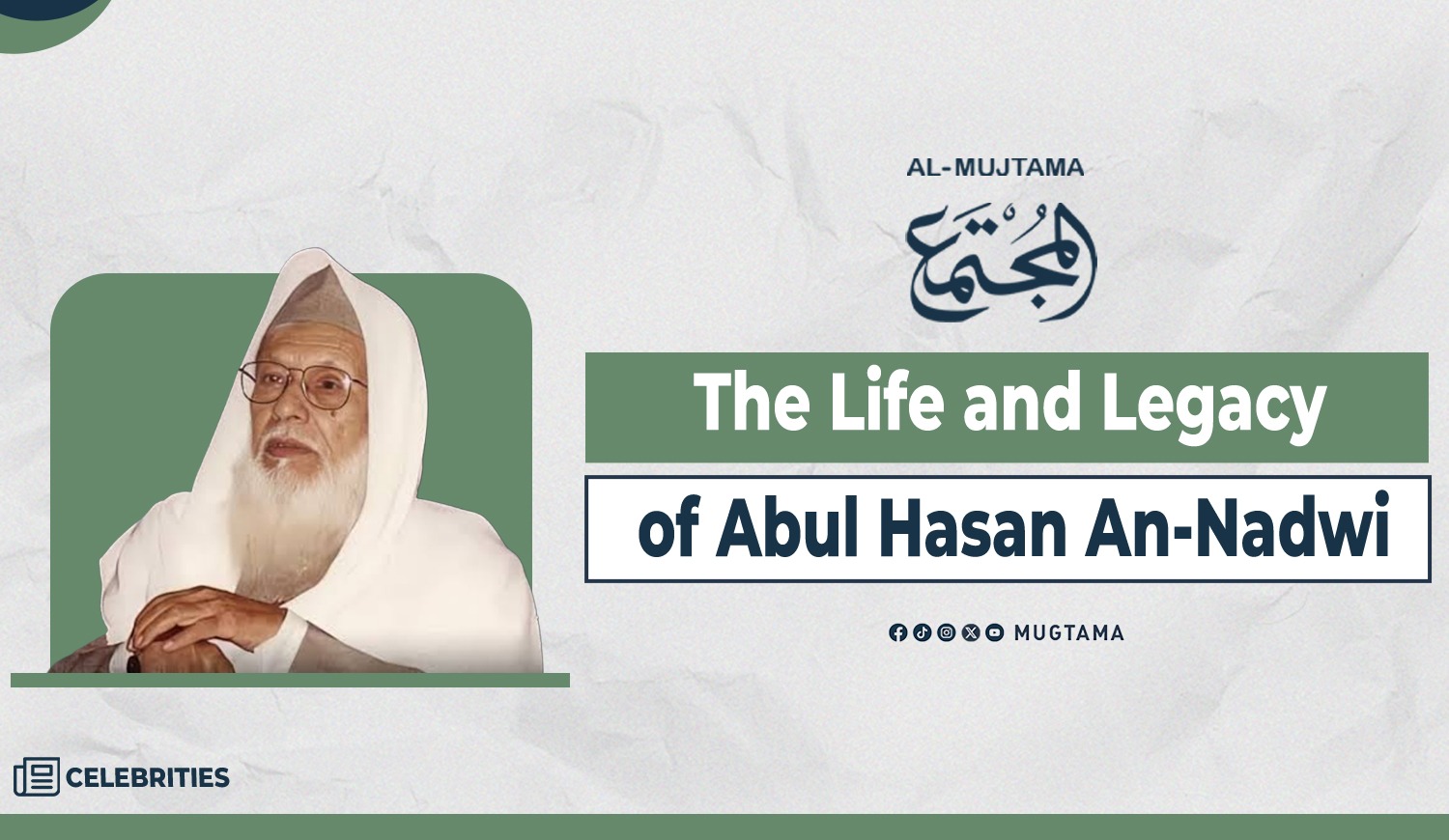
Abul
Hasan Ali An-Nadwi (1913–1999) was one of the most influential Islamic thinkers
and reformers of the 20th century. Born in the village of Takiya in Rae Bareli,
India, he belonged to a distinguished scholarly family tracing its lineage back
to Hasan Ibn Ali, the grandson of the Prophet Muhammad (peace be
upon him).
His
father, Abdul Hayy Al-Hasani, was a renowned historian of Indian Muslim
scholars, while his mother was a deeply learned and spiritually nurturing woman
who memorized the Quran and composed poetry in praise of the Prophet (peace be
upon him). After his father’s early death, his
mother and elder brother played a central role in shaping his education and
character.
Education and Intellectual Formation
An-Nadwi
began his education at home, memorizing the Quran and studying Urdu and
Persian. He later mastered Arabic under prominent scholars and pursued higher
studies at Lucknow University, where he specialized in Arabic language and
literature at a remarkably young age.
His
intellectual development was not limited to traditional Islamic sciences. He
also studied English, which allowed him to engage directly with Western
thought, history, and modern intellectual trends. This dual exposure later
enabled him to address contemporary challenges facing the Muslim world with
clarity and depth.
He
studied hadith, tafsir, and fiqh under leading scholars in India, including
periods of study in Lahore and Deoband. These formative years equipped him with
both scholarly depth and a broad intellectual horizon.
Teaching, Da`wah, and Institutional
Leadership
In 1934, An-Nadwi
began teaching at Nadwat Al-`Ulama’ in Lucknow, where he taught Quranic
exegesis, hadith, Arabic literature, and logic. His role there expanded over
time, eventually becoming its Secretary-General.
His
efforts extended far beyond teaching. He was deeply engaged in da`wah,
traveling extensively across India and the Muslim world. He emphasized
spiritual reform, moral revival, and reconnecting Muslims with the Quran and
Sunnah.
He
founded several important institutions, including:
- The Movement for
Human Message (1951)
- The Islamic Research
Academy in Lucknow (1959)
- Contributions to the
All India Muslim Personal Law Board (1972)
Through
these efforts, he sought to revive Islamic consciousness and strengthen the
internal fabric of Muslim society.
Intellectual Vision and Reformist
Thought
An-Nadwi’s
thought centered on reviving faith in an age dominated by materialism. He
strongly critiqued Western civilization’s moral shortcomings while calling Muslims to return to
authentic Islamic principles.
Key
themes of his intellectual project included:
- Strengthening faith
against materialistic ideologies
- Reconnecting with the
Quran and Prophetic tradition
- Reviving spiritual
consciousness
- Critiquing
nationalism and blind imitation of the West
- Reforming Muslim
society through individual transformation
He
believed that true change begins within individuals, echoing the Quranic
principle: {Indeed, Allah does not change the
condition of a people until they change what is in themselves.} [Ar-Ra`d 13:11]
Major Works and Literary Contributions
An-Nadwi
was a prolific writer in Arabic and Urdu. Among his most influential works are:
- What the World Has Lost
by the Decline of Muslims
(1947) — a powerful analysis of the global consequences of Muslim decline
- Saviours of Islamic
Spirit
- Conflict Between
Islamic Thought and Western Thought
- The Four Pillars
- Prophethood and the
Prophets in the Light of the Quran
He also
wrote extensively for children, recognizing the importance of nurturing future generations. His literary style combined eloquence, clarity, and
deep emotional appeal.
Global Recognition and Influence
An-Nadwi’s
influence was truly global. He lectured in universities across the Muslim
world, including Damascus and Madinah, and participated in international
Islamic organizations.
He
received numerous honors, including:
- King Faisal
International Prize for Service to Islam (1980)
- Honorary doctorate
from the University of Kashmir (1981)
- Leadership roles in
international Islamic and academic institutions
He also
played a key role in the establishment of the Muslim World League and served in
various scholarly councils.
Legacy and Final Years
Until his
final days, An-Nadwi remained committed to the mission of Islamic revival. He
passed away on December 31, 1999, in his hometown in India.
His
legacy lies not only in his writings but in his vision: a revival rooted in
faith, knowledge, spirituality, and a deep sense of responsibility toward
humanity. He lived for Islam, worked for it tirelessly, and called others to
its path with wisdom and sincerity.
A Scholar Who Lived for a Cause
Abul
Hasan Ali An-Nadwi was more than a scholar—he was a reformer, educator, and
global voice of Islamic revival. His life’s work continues to inspire those
seeking to understand Islam not merely as a tradition, but as a living force
capable of guiding humanity through modern crises.
His
message remains timeless: the revival of the Muslim world begins with the
revival of faith, character, and connection to divine guidance.
For Further Reading: