







Muhammad Asad: The Jewish Scholar Who Became One of Islam’s Great Thinkers
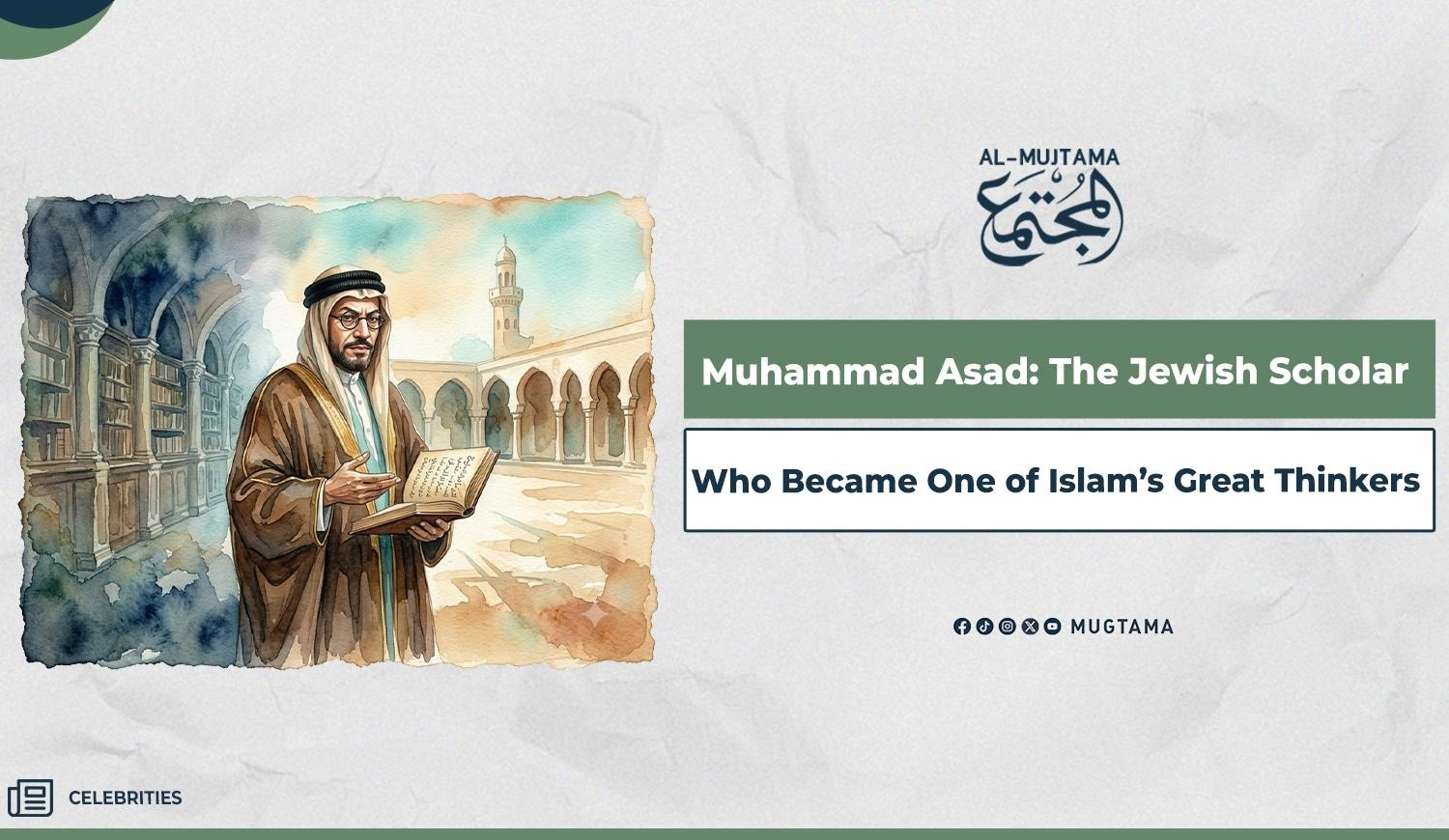
Few twentieth-century Muslim thinkers lived a life as
remarkable as Muhammad Asad.
Born Leopold Weiss in 1900 into a Jewish family in the
Austro-Hungarian Empire, he grew up immersed in European philosophy, Jewish
scholarship, and the intellectual culture of Central Europe. Yet the questions
that shaped his youth eventually led him far beyond Europe.
After embracing Islam in 1926, he adopted the name Muhammad
Asad and devoted the rest of his life to understanding, explaining, and
reviving the faith. His journey took him from the cafés of Vienna to the
deserts of Arabia, from conversations with Bedouins and scholars to the
founding years of Pakistan, where he later served as one of the country’s first
representatives to the United Nations.
More than a convert or traveler, Muhammad Asad became one of
the most original Muslim intellectuals of the modern era.
Searching for Meaning Beyond Modern Europe
Asad did not accept Islam because he rejected reason. Quite
the opposite—he believed Islam offered the intellectual and spiritual coherence
that modern Europe had lost after the First World War.
He viewed European civilization as increasingly dominated by
materialism, moral uncertainty, and spiritual emptiness. While many of his
contemporaries searched for answers in political ideologies or philosophical
movements, Asad found them in the Quran.
His conversion was therefore not an escape from modernity, but
a search for a civilization that united faith, reason, ethics, and public life.
Rather than trying to reconcile Islam with every modern trend,
Asad challenged Muslims to rediscover the intellectual confidence of their own
tradition.
Living Islam Instead of Simply Studying It
Unlike many Western scholars who observed Islam from a
distance, Asad immersed himself in Muslim life.
He spent years traveling across Arabia, living among Bedouin
tribes, learning classical Arabic, and studying with Muslim scholars. During
this period, he developed a close relationship with King Abdulaziz Al Saud and
witnessed the early formation of modern Saudi Arabia.
These experiences convinced him that Islam could not be
understood merely as a collection of rituals or historical events. It was a
complete civilization capable of shaping individuals, communities, and
political life.
His celebrated autobiography, The Road to Mecca,
remains one of the most compelling spiritual memoirs ever written by a Western
Muslim.
A Voice for Islamic Renewal
Muhammad Asad believed that Muslim decline was not caused by
Islam itself but by Muslims’ distance from its original teachings.
He argued that genuine renewal required returning directly to
the Quran and authentic Sunnah while engaging the modern world with confidence
rather than imitation. Blind imitation of either inherited traditions or
Western models would only deepen the crisis.
His influential book Islam at the Crossroads warned newly independent Muslim societies against
assuming that Europe’s secular path represented the only route to progress. For
Asad, a civilization could only flourish when its political and social
institutions reflected its own moral foundations.
This vision later shaped his involvement in the intellectual
foundations of Pakistan, where he contributed to discussions about the role of
Islam in public life.
Bringing the Quran to Modern Readers
Among Asad’s greatest achievements is The Message of the
Quran, an English translation and commentary that remains one of the most
widely respected modern Quranic translations.
Rather than producing a literal translation alone, Asad sought
to explain the Quran in language that educated modern readers—Muslim and
non-Muslim alike—could appreciate. Drawing on classical Islamic scholarship
while addressing contemporary questions, he emphasized that the Quran
consistently appeals to human reason, reflection, and moral responsibility.
His translation continues to influence students, scholars, and
converts around the world.
A Legacy That Deserves Greater Recognition
Despite his immense contributions, Muhammad Asad is still less
well known than many twentieth-century Muslim thinkers.
Yet his life speaks directly to many of today’s debates.
Questions about identity, belonging, faith, modernity, and the relationship
between Islam and the West all occupied Asad decades before they became global
conversations.
His story also challenges common assumptions about conversion.
Asad did not abandon his intellectual heritage when he embraced Islam; instead,
he brought the analytical discipline of European scholarship into dialogue with
the Islamic tradition, producing works that continue to inspire readers across
cultures.
Muhammad Asad is often described as a bridge between East and
West, but that description only captures part of his legacy.
He did not simply translate Islam for Western audiences. He
challenged both civilizations: urging the West to reconsider the spiritual
costs of modern materialism, while calling Muslims to recover the intellectual
vitality and moral confidence of their own faith.
His life reminds us that Islam has never been confined by
geography or ethnicity. It has always possessed the power to speak to sincere
seekers of truth—whether they begin their journey in the deserts of Arabia or
the streets of Vienna.
Today, nearly a century after his conversion, Muhammad Asad’s
writings continue to invite readers to rediscover Islam not as a relic of the
past, but as a living worldview capable of answering the deepest questions of
the human condition.