









Book Review: “Islam at Crossroads” By Muhammad Asad
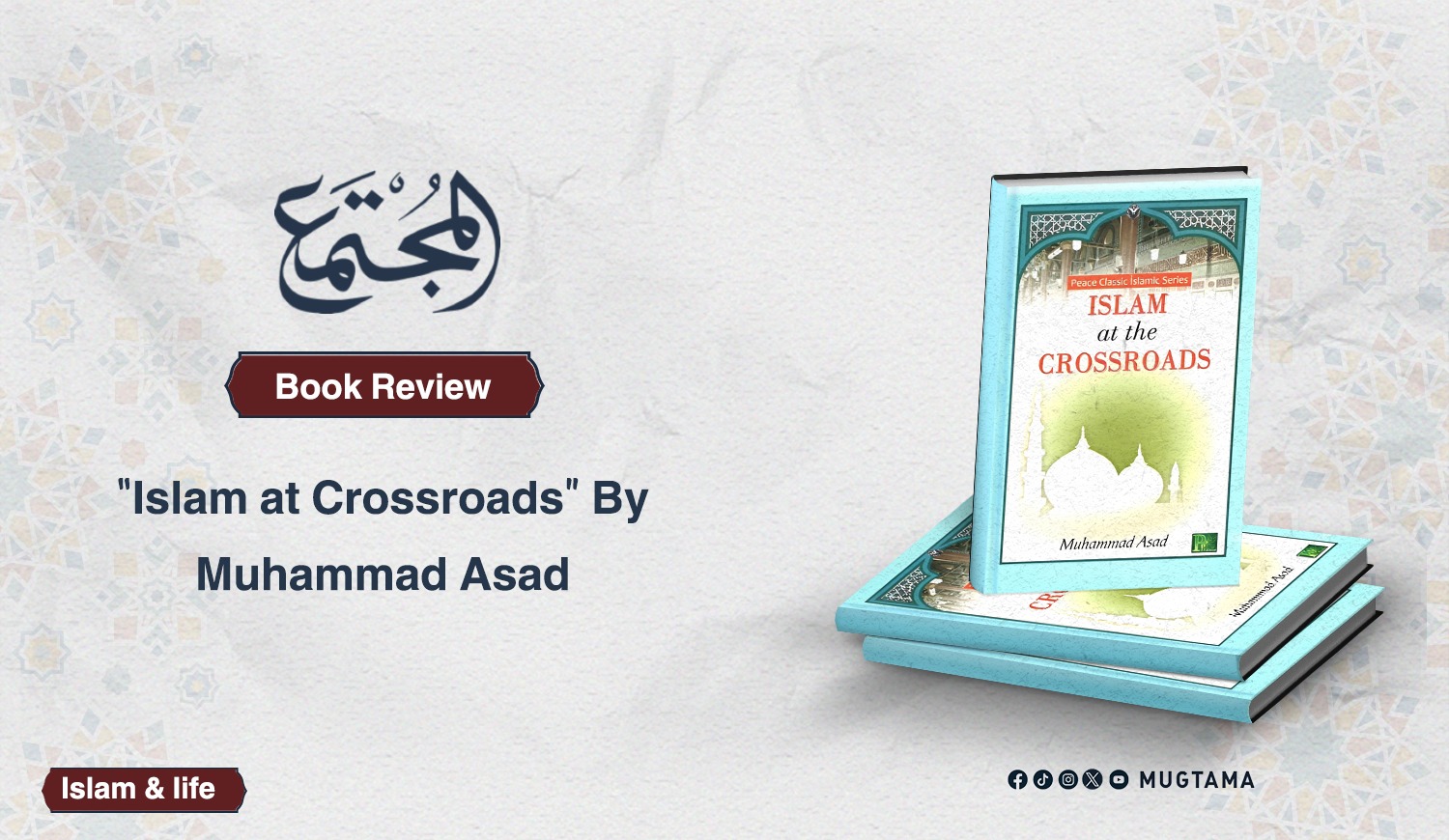
About the Book
Muhammad Asad starts his book edition of Islam at the
Crossroads reflecting on the book’s original purpose when it was first
published in 1934; a heartfelt plea to the Muslims of his time to resist the
blind imitation of Western values and to revive the intellectual and cultural
vitality of Islam through a return to the true spirit of the Qur’an and the
Sunnah. He laments that many misunderstood his message in the first edition,
mistaking his call for cultural renewal as a push toward rigid traditionalism
rooted in periods of Muslim decline. With this revised edition, he seeks to
clarify that his vision was never about retreating into the past, but about
reclaiming Islam’s original, creative potential to shape a dynamic and
independent civilization.
About the Author:
Muhammad Asad (1900–1992) was an Austrian-born thinker, traveler, and one of the most influential Muslim intellectuals of the 20th century. A former journalist who embraced Islam in 1926, he became a defender of Islamic thought, a close associate of Allama Iqbal in the vision for Pakistan, and later Pakistan’s representative to the UN. His works, including Islam at the Crossroads and The Road to Mecca, remain landmarks in bridging understanding between Islam and the West.
Introduction
In Islam at the Crossroads,
Muhammad Asad reflects on the Muslim world’s crisis in the face of Western
influence, urging a revival rooted not in imitation but in
the Qur’an and Sunnah. He identifies the true cause of stagnation as the loss
of connection with Islam’s essence and the failure to apply its teachings to
modern life.
Drawing
from his own journey—from European journalist to Muslim thinker—Asad presents
Islam as a faith of balance, coherence, and purpose. His conversion, shaped by
both reason and spiritual conviction, reinforces his call for Muslims to
rediscover the vitality of their tradition and reclaim its role as a
transformative force in today’s world.
The Open Road of
Islam
Asad critiques the Muslim world’s passive absorption of
Western ideas and technology, warning that cultural exchange has become
one-sided and stripped Muslims of their creative initiative. He argues that
Islam is not merely a religion but a complete socio-cultural system, capable of
guiding every aspect of life if Muslims return to its principles. True renewal
requires critical discernment, accepting what aligns with Islamic values while
rejecting what contradicts them, to preserve identity and restore Islam’s role
as a creative force in global civilization.
Asad highlights Islam’s unique integration of the spiritual
and material, where worship extends beyond rituals into every conscious act, uniting body and
soul under Allah’s will. Unlike Christianity’s pessimism or the West’s
materialism, Islam presents an optimistic view of human nature: each person is
born pure, responsible only for their own deeds, and capable of moral and
personal excellence within Allah’s guidance. This balance of faith and worldly
engagement makes Islam a dynamic force, calling Muslims to enjoin right, forbid
wrong, and actively shape a just society rooted in both spiritual and practical
harmony.
The Spirit of the West
Asad contrasts the Islamic worldview, centered on Divine Law
and spiritual development, with the materialistic orientation of modern Western
civilization. For Islam, true progress lies in the individual soul’s journey toward Allah, supported by a just and moral
society, whereas the West elevates material power and collective dominance
while disregarding transcendence. Unlike Rome’s power-driven empire which
collapsed suddenly, the Islamic Caliphate endured for centuries, rooted in its spiritual and ethical
mission. This resilience, even in the face of invasions and decline, reflected
Islam’s anchoring in the Qur’an and the Sunnah of Prophet Muhammad (peace be
upon him).
Asad also challenges the narrative of Western intellectual
independence by underscoring Islam’s decisive role in Europe’s revival. The
Renaissance was not a spontaneous European awakening but a product of Islamic
influence through Spain, Sicily, and scholarly exchange. By preserving and
expanding Greek knowledge, Muslims inspired Europe’s turn to science, reason,
and inquiry, enabling its eventual break from the Church’s intellectual
repression. While Christianity held spiritual depth, its anthropomorphic conception
of God, rigid dogmas, and ascetic view of human nature left little room for
intellectual and worldly progress, which the Church actively suppressed.
Tracing this trajectory further, he critiques the West’s
eventual rejection of religion and embrace of secular materialism, particularly
during the industrial era, where progress came to mean material comfort at the
expense of spiritual values. This shift eroded the family structure, traditional
morality, and transcendental ethics, leaving society governed by
utilitarianism. This makes Western civilization fundamentally incompatible with
Islam: while Muslims can adopt Western science and technology, embracing its
social and moral framework would undermine the very essence of the Islamic
worldview. Islam, rooted in spiritual and moral truth, cannot be reconciled
with a civilization that denies the soul’s central place in human life.
The Shadow of the Crusade
Asad explores the deep historical
animosity between the West and Islam, tracing it back to the Crusades, which forged Europe’s cultural identity in
opposition to Islam. Unlike its more balanced reception of Hinduism or
Buddhism, the West treated Islam not as a subject of genuine inquiry but as an
ideological rival, often misrepresented by Orientalist scholarship steeped in
bias and missionary zeal. The Crusades not only unleashed destruction across
Muslim lands but also imprinted lasting prejudices, framing Islam as violent
and sensual. These distortions persisted for centuries, shaping Europe’s
intellectual traditions and poisoning relations even as Western civilization
benefited immensely from the scientific and cultural contributions of Islam.
He argues
that while modern scholarship has begun to shed some of these prejudices, the
psychological remnants of this hostility endure, keeping Islam misunderstood in
the Western imagination. Western engagement with Islam today is largely
superficial, motivated by political and economic interests rather than sincere
openness to its teachings. Conversions to Islam in the West, though notable,
remain individual exceptions rather than signs of a wider cultural shift.
Ultimately, only a profound crisis of confidence in Western materialism could
open the way for a genuine re-engagement with Islam’s spiritual vision. Until
then, centuries of inherited bias will continue to obscure its true message.
About Education
Asad criticizes the uncritical
adoption of Western-style education in Muslim societies, arguing that it often
erodes faith and identity rather than strengthening them. He explains that
Western education carries with it a worldview largely indifferent or even
hostile to religion, which can leave Muslim students disconnected from their
heritage. The decline of belief among Western-educated Muslims is not the
result of rational arguments against Islam but rather the cultural atmosphere
that dulls spiritual sensibilities. Families, schools, and societies together
shape a child’s worldview, and when education is framed through Western
assumptions, it risks alienating youth from the values of Islam.
At the
same time, Islam has never opposed knowledge or scientific progress. The
Qur’an and Sunnah strongly encourage learning, and historically, Muslim
civilization led the world in intellectual advancement. The problem lies not in
science itself, which is universal, but in the materialist philosophy that
often accompanies it in the West. Therefore, Muslims must reclaim their
intellectual tradition, adopting modern sciences without absorbing the
ideological assumptions behind them. He emphasizes the need for Muslim scholars
to integrate knowledge within an Islamic framework, ensuring that reason,
spirituality, and revelation remain in harmony.
About Imitation
Asad warns that the uncritical adoption of Western ways poses
one of the greatest dangers to the survival of authentic Islamic civilization. He argues that many Muslims, out of a sense of
inferiority and despair, have mistaken Westernization for progress, while
neglecting the true sources of renewal (the Qur’an and Sunnah). Even seemingly
minor imitations, such as fashion and social customs, carry deeper cultural and
spiritual implications that gradually reshape Muslim identity and weaken core
values.
He insists that genuine revival cannot come through mimicry or
compromise but through a confident return to Islam’s foundations. Muslims must
engage with the modern world without abandoning their distinct identity, much as Europe once benefited from Islamic knowledge while
preserving its own cultural character. The only path forward is to reawaken the
spirit of Islam as a complete and self-sustaining way of life, rather than
borrowing from a worldview that is fundamentally secular and hostile to
religion.
Hadith and Sunnah
Asad emphasizes that the Sunnah of Prophet Muhammad (peace be
upon him) is inseparable from Islam’s survival, serving as the living
interpretation of the Qur’an and the second foundation of Islamic law. The
Prophet’s example harmonized the spiritual and material dimensions of life,
offering Muslims a complete model for both personal conduct and social order.
Neglecting or dismissing the Sunnah as outdated, undermines Islam’s holistic
vision and opens the door to arbitrary interpretations of revelation. Following
the Sunnah is not optional but a condition of true submission to Allah,
preserving Islam as a unified and practical way of life.
Additionally, he defends the reliability of hadith, noting
that early Muslim scholars developed a rigorous science of verification
unmatched in historical studies, ensuring that only the most authentic reports
were preserved. Modern skepticism toward hadith often stems less from
scholarship than from an attempt to reconcile Islam with Western values or to
justify departures from its moral framework. In this light, rejecting the
Sunnah amounts to eroding the very foundations of the faith, while adherence to
it ensures the continuity and integrity of Islam.
Conclusion
Muhammad Asad concludes his book by rejecting the idea that
Islam is a “spent force” destined to decline like other civilizations. While
Muslim societies today appear stagnant and overwhelmed by Western influences,
this decay does not reflect a failure of Islam itself but rather the weakness, apathy, and loss of faith within Muslims. Unlike
human-made cultures, Islam is not bound by the cycles of rise and fall because
it is rooted in divine revelation and offers a timeless framework for ethics,
social harmony, and human dignity. No civilization has yet produced a system
superior to Islam’s vision of justice, unity, and spiritual fulfillment, making
the claim that Islam is “outdated” baseless.
The path to true regeneration comes not from reforming Islam, which is already
perfect, but from reforming ourselves, by overcoming defeatism, rejecting
apologetics, and re-centering life on the Qur’an and Sunnah. Thus, he calls for
freeing Islamic law from rigid, outdated interpretations and returning to
original sources for guidance suited to modern life. Renewal requires
self-confidence, critical engagement with tradition, and avoiding blind
imitation of other civilizations. As the Qur’an reminds: “Verily, in the Messenger of Allah you have a good
example for everyone who looks forward to Allah and the Last Day” (33:21).
You Can Also Read:
- Muslims' Contributions to Chemistry
- A Call to the Youth of Islam
- What Made the Companions Generation Special?
--------------------------------------------------