









The Roots of the Hadawi Imamate in Yemen
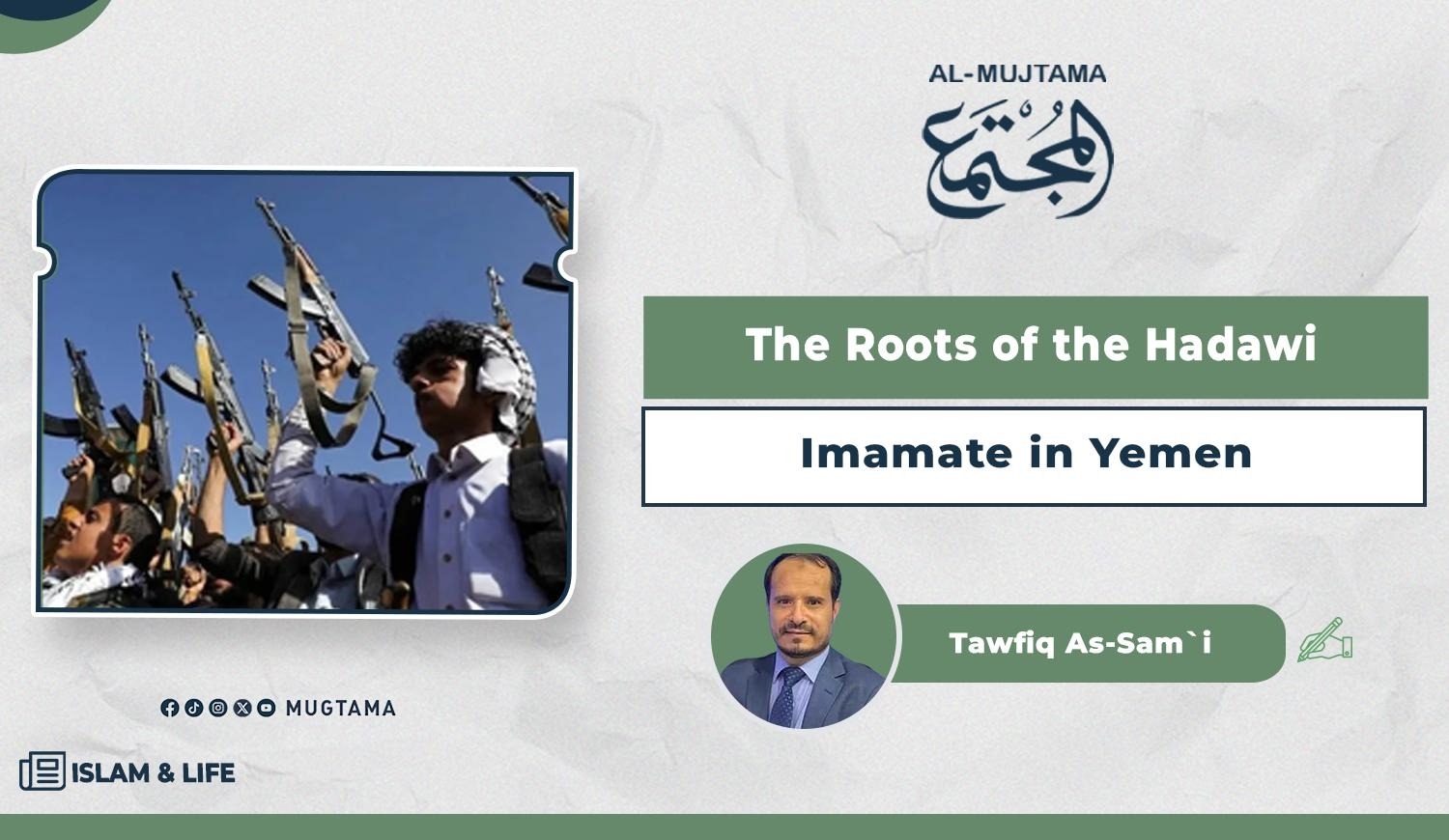
The roots of the Zaidiya-Hadawiya Imamate in Yemen date back to the
arrival of Yahya Ibn Al-Husayn Ibn Al-Hadi in the country in 284 AH. He worked
to establish a religious and political conception of the Imamate and founded a
system closely associated with governance and the struggle for power.
Over the centuries, successive
experiments and leaders affiliated with this project emerged, eventually
leading to the Houthi movement, which appeared later within the context of the
struggle over the Imamate in Yemen and ultimately staged a coup against the
state in 2014.
The Zaidiya school of thought theoretically
traces its origins to Zayd Ibn Ali Ibn Al-Husayn (76–122 AH). What concerns us
here, however, is its presence in Yemen, which began with the arrival of one of
its adherents two centuries later: Yahya Ibn Al-Husayn Ibn Al-Hadi, in 284 AH.
He reorganized the Zaidis affiliated with the descendants of Abu Talib, this
time establishing for them theoretical, economic, political, and military
foundations. He also developed the Hadawi doctrine, building upon the earlier
Zaidi theory.
Yahya Ibn Al-Husayn and the Establishment of
the Hadawi Imamate
Yahya Ibn Al-Husayn succeeded in
bringing together the various branches of the Zaidi movement, including the
Jarudiyyah, Kamiliyyah, Salihiyyah, Sulaymaniyyah, Ismailis, Mu`tazilites, and
even the Twelve Imamis. He then formulated the Hadawi theory, whose devastating
consequences Yemen continues to suffer to this day, with the same system
reemerging every century.
He also fabricated hadiths and falsely
attributed them to the Prophet, peace and blessings be upon him, and resorted
to every possible method of interpreting and distorting Quranic texts to serve
his doctrine and theory.
The Hadawi Imamate theory states: “Once
a person has established his recognition of the authority of the two (Al-Hasan
and Al-Husayn), acknowledged their superiority and their status as Imams, he
must then recognize those vested with authority from among their descendants,
whose obedience all people have been commanded to observe. He must understand
that authority, command and prohibition, wisdom, and the Imamate after them
belong exclusively to their descendants and to no one else. The Imamate can
neither be granted to anyone outside their lineage nor transferred to anyone
other than them.”
“The Imam who succeeds them must be
one of their descendants who follows their path, resembles them, and emulates
their example: one who inspires fear in oppressors and provides security for
believers, but does not grant security to the wicked, nor do they feel secure
from him. Rather, he pursues them as they pursue him. He separates himself from
them as they separate themselves from him, opposes them as they oppose him, and
they fear him and strive to destroy him. He seeks to inflict harm upon them and
calls upon the tribes to fight them, while remaining in exile and fearing them.”
“Whoever among the descendants of the
two grandsons, Al-Hasan and Al-Husayn, possesses these characteristics is the
Imam whose obedience is obligatory and whom the Muslim community is obligated
to support.”
The Foundations of the Hadawi Imamate and
Its Religious and Political Principles
The crimes committed by
the advocates of the Imamate continued from one era and century to another, to
the extent that Yemen never experienced security or stability under their rule.
Obedience to such an Imam, migration
to join him, and remaining alongside him are therefore obligatory upon the
Muslim Ummah. Whoever among the community does so, after the Imam has made his
position clear, directed himself toward his Lord, drawn his sword, and openly
declared his opposition to the oppressors, has fulfilled his duty before Allah.
Whoever falls short in this regard
will have the evidence against him established clearly and conclusively before
Allah: {So Allah may establish what He had destined—that those who were to
perish and those who were to survive might do so after the truth had been made
clear to both.} [Al-Anfal 8:42]
Following the establishment of this
theory, its proponents assembled everything necessary to reinforce it and
ensure its continued existence. They established a set of fundamental pillars
designed to preserve it from one generation to the next, right up to the
present day.
These pillars include:
- The one-fifth levy and additional tithes on
wealth
- The Abrahamic blessings during the tashahud in
prayer
- The interpretation of Quranic verses concerning
love for the Prophet’s relatives in a way that makes supporting them
obligatory and grants them a sacred social status comparable to that of
the Prophets.
- The exclusive claim to religious knowledge that
knowledge can only be obtained through them, and that any knowledge
acquired through other sources is falsehood, disbelief, and heresy.
- The granting of special privileges, giving them
all the distinctions that Muslims traditionally reserve for the Prophet,
peace and blessings be upon him, to the point of imposing hereditary
supremacy and racial discrimination upon their followers.
As a result, everyone else became
subservient and obedient. Anyone who objected, questioned their authority, or
resisted them was accused of being an enemy of the Prophet’s family. Such
individuals were subjected to the harshest forms of terror and punishment,
including killing, crucifixion, the enslavement of women, the burning of crops,
the looting of property, the destruction of homes, the poisoning of wells, and
the forced displacement of people from their homes and homelands.
Those who rebelled against them were
classified as disbelievers on the basis of their interpretation, while their
lands were treated as territories subject to taxation and considered open to
invasion, bloodshed, and forced displacement.
These were the foundations upon which
the Hadawi system was established. In every century, a group or family emerged
claiming a connection to this lineage and to the Prophet, peace and blessings
be upon him. Each group or family committed acts of terror, oppression, and
destruction against its opponents that were even more severe than those of the
preceding faction. They treated the actions of their predecessors as religious
legislation and followed their example, thereby deeming the blood of their
contemporaries lawful to shed.
Abdullah Ibn Hamzah: Another Example of the
Imamate in Yemen
Let us consider an example of this
pattern. Two centuries after the actions and crimes committed by Al-Hadi Ar-Rassi
against Yemen and its people, another Imam claiming affiliation with him
emerged: Imam Abdullah Ibn Hamzah (February 24, 1166 – April 21, 1217 CE).
His crimes, oppression, terror,
looting, accusations of disbelief, justification of bloodshed, enslavement of
women, and forced displacement of civilians surpassed even those of his
predecessor, Ar-Rassi.
The September 26, 1962
Revolution overthrew the Imamate and established the republic, which lasted only
50 years.
Imam Abdullah Ibn Hamzah cited the
actions of Imam Al-Hadi in support of his own conduct. In his book Al-Muhadhdhab,
he stated: “Al-Hadi Ilal-Haqq (who guides to truth), peace be upon him, did the
same in Najran and `Alaf. He demolished houses, cut down palm trees and
grapevines, and permitted the tribes to seize property. He confiscated the
wealth of the Madhahir and divided it into fifths. He also took a vast quantity
of furniture, weapons, and possessions from the fortress of An-Numays.”
“His son, An-Nasir, did likewise. He
demolished the city of Bari, which was a large city, as well as the cities of
Al-Kalaij and Qatabah. He seized all the wealth of Qudam without distinguishing
the property of orphans and widows from that of others.”
“Abdullah Ibn Al-Husayn, peace be upon
him, did the same to Banul Harith, taking their property and distributing it
among those who participated in the conquest. Ibrahim Ibn Musa Ibn Ja`far,
peace be upon them, also destroyed the Al-Khaniq Dam in Sa`adah, which had been
surrounded by extensive orchards. Those orchards have remained ruined ever
since, right up to our present time.”
This is how the crimes of the Imams
continued in Yemen from one era and century to another, leaving the country
without security or stability. Yemen remained trapped in continuous wars for
1,200 years.
All the destruction and
underdevelopment that Yemen has experienced is because of these criminal Imams,
who would descend upon cities and villages and destroy them completely, just as
the Houthis are doing today.
The September 26 Revolution of 1962 and the
End of Imamate Rule in Yemen
The Yemenis made numerous attempts,
through various revolutions, to rid themselves of this oppressive burden that
had devastated their country. Several uprisings preceded the September 26, 1962
Revolution, which Yemenis regard as the revolution that finally brought an end
to a thousand years of Imamate rule.
This revolution overthrew the Imamate
and established the republic, under which Yemenis lived for only 50 years.
Today, the Houthis have staged a coup
against that republic and gradually undermined it through their secret Imamate
organization. This process began after the Arab world recognized the Yemen Arab
Republic and a reconciliation agreement was reached between the republicans and
the Imamate supporters in 1970, under Arab and Saudi sponsorship.
However, despite participating in the
republican government, these Imamate supporters continued to pledge their
allegiance to the Imamate in secret. They swore allegiance to a hidden Imam,
Majd Ad-Din Al-Mu’ayyidi. Later, Badr Ad-Din Al-Houthi, the father of Hussein,
the founder of the Houthi movement, emerged
in opposition to him.
The advocates of the Imamate cannot be
trusted, as they are treacherous. Treachery is an established doctrine within
their system, known as “At-Taqiyyah As-Siyasiyah (political dissimulation).”
From the Imamate to the Emergence of the
Houthi Movement
Hussein emerged under the influence of
the aforementioned theory, rebelling against the republic on the grounds that
he was rising as a revolutionary, openly drawing his sword. However, he did so
with the support of the Iranian Imamate establishment. He claimed that his
authority came directly from Allah and that he had a greater right to rule than
all other Yemenis.
The Houthis established a secret
organization known as the “Believing Youth.” Its formation began in the early
1980s, and it came into the open with the introduction of political pluralism
in Yemen in the early 1990s.
Ali Abdullah Saleh exploited this
organization to manage conflicts and maintain a balance between himself and the
other political forces, particularly to confront the Yemeni Congregation for
Reform, an Islamic party that was then the strongest opposition party.
However, these advocates of the
Imamate cannot be trusted, as they are treacherous, with treachery forming part
of their doctrine under what they call political dissimulation.
As soon as they had strengthened their
position, they launched an insurgency in Sa`dah in 2004 and fought six wars
against the state. During the first war, the group’s leader and founder of the
armed rebellion, Hussein Badr Ad-Din Al-Houthi, was killed. His brother, Abdul Malik
Al-Houthi, subsequently inherited the leadership of this rebellious
organization.
The Houthis’ 2014 Coup Against the Yemeni
State
Following the events and revolution of
February 11, 2011, President Saleh left office under the terms of the Gulf
Initiative on November 23, 2011. Abd Rabbuh Mansur Hadi was then elected as a
consensual transitional president of the country.
President Saleh subsequently revived
his alliance with the Houthis, paving the way for a rebellion against Hadi and
the National Reconciliation Government. This culminated in the coup against the
state on September 21, 2014.
Since then, Yemen has been plunged
into a succession of wars that have devastated the country, destroying
everything in their path, as the world can see and knows today.
-------------------------------------------------------------
