








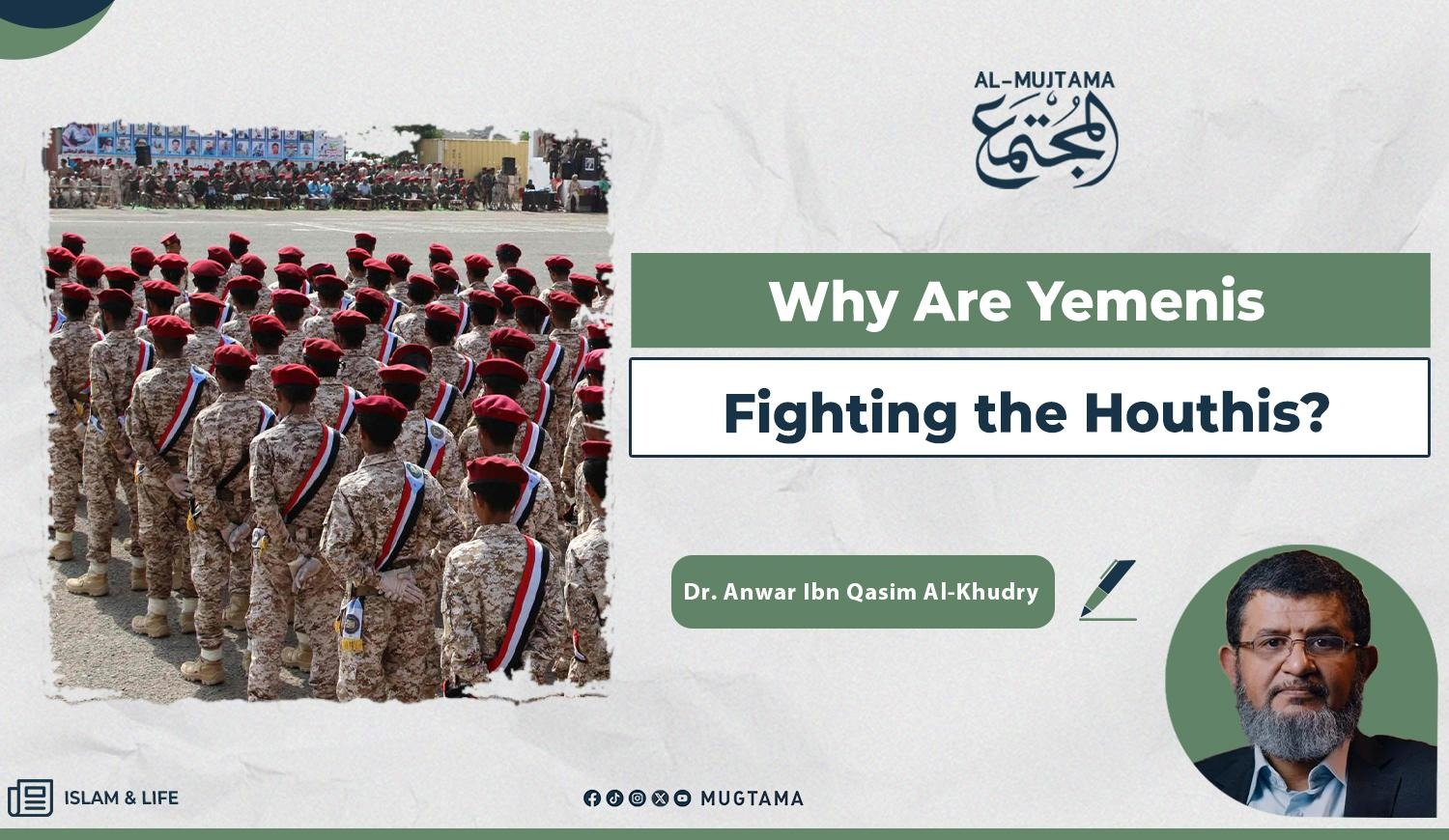
Why Are Yemenis Fighting the Houthis?
Many members of the Muslim Ummah
wonder why the Yemeni people are fighting the Houthi movement. This is
largely due to their lack of understanding of the realities in Yemen and the
events that led to this tragic situation, which forced Yemenis to take up arms
against the group. Understanding this conflict requires examining the nature of
the Houthi project in Yemen and its consequences.
The Houthi Project in Yemen: From Political
Consensus to Armed Confrontation
To begin with, the fundamental
principle governing the various groups, sects, and schools of thought within
the Muslim Ummah should be peaceful coexistence,
prioritizing their shared religious foundations. These commonalities should
serve as a basis for preventing aggression and transgression against one
another and as a reference point for resolving disputes and disagreements.
Furthermore, living in the same
homeland and under the same state requires a people to accommodate the
diversity and differences among their social, religious, political, and
cultural components. All parties must abide by the constitution and laws they
have mutually agreed upon, provided that rights and freedoms are guaranteed and
protected.
In Yemen, all components of Yemeni
society reached an agreement during the National Dialogue Conference, held in
2013 and 2014, including the Houthi group, which participated in the conference
and presented its demands and vision for Yemen’s future.
The conference concluded with a
document containing proposed solutions and measures to address Yemen’s various
crises and problems, including the Sa`dah issue and the
country’s sectarian diversity.
Following this, a national committee
was formed to draft a constitution based on the conference’s recommendations.
The committee prepared a proposed constitution for President Abd Rabbuh Mansur
Hadi, and its draft was issued on January 17, 2014. It contained 446 articles
and aimed to establish a federal state.
This consensus marked the culmination
of the first phase of the roadmap outlined in the Gulf Initiative, which was
sponsored by the Gulf states.
The Houthis’ Coup Against Yemen’s Political
and Constitutional Consensus
All political parties and social and
religious forces welcomed the National Dialogue Conference document and the
draft of the new constitution. However, Yemenis were taken by surprise on
September 21, 2014, when the Houthi movement, in an armed operation conducted
in alliance with forces loyal to former President Ali Abdullah Saleh, stormed
the capital, San`a.
The operation resulted in the seizure
of sovereign institutions and government ministries, overturning the national
agreement and consensus.
Despite the conclusion of a new
agreement, brokered by UN envoy Jamal Benomar at President Hadi’s residence, to
restore the situation to its pre-September 21 state and include the Houthis in
the government, the movement continued pursuing its project to overthrow both
the government and the state.
It began threatening state officials
after besieging and targeting them. This prompted President Hadi, on March 25,
2015, to send a message to the leaders of the Gulf Cooperation Council, calling
for Yemen to be rescued from Houthi aggression and coup, calling for the
restoration of the state.
Despite repeated appeals and mediation
efforts, both domestic and international, as well as United Nations efforts to
resolve the crisis and persuade the movement to reverse its unilateral
decisions, the Houthis rejected these appeals, mediation initiatives, and
international efforts and resolutions. This remained the case despite the
various United Nations Security Council resolutions concerning Yemen.
Why Are Yemenis Fighting the Houthis?
Consequently, Yemenis began taking up
arms and fighting the Houthi movement. The reasons that drove them to fight can
be divided into two broad categories, reflecting both the official government
perspective and the popular national perspective:
1.
Constitutional
and legal reasons: These arise from provisions
in Yemen’s constitution and laws and provide the legal framework for the Yemeni
government and its military and security institutions.
2. Religious and social reasons: These are based on religious texts and legal rulings,
as well as tribal customs and traditions.
This division is not intended to
suggest that the two categories contradict one another. Rather, the reasons are
interconnected and mutually reinforcing. The difference lies in the perspective
from which they are examined, depending on legal responsibilities and
operational considerations.
Administrative structures and military
and security plans require a particular organization of combat operations.
However, this arrangement may not adequately address the needs of communities
confronting the Houthi movement’s aggression and transgressions, whether
because of financial constraints, logistical support limitations, or political
pressure.
As a result, Yemeni communities were
compelled to take up arms through their own efforts, establishing tribal frameworks
and popular resistance movements across several governorates after 2015.
The Constitutional and Legal Basis for
Fighting the Houthis
From a constitutional and legal
perspective, the Houthi movement is regarded as a group rebelling against the
state, operating outside the law, and constituting a coup movement. It is also
described as a terrorist organization responsible for numerous terrorist
crimes.
These characterizations are based on
the constitutional and legal framework of the Republic of Yemen, including the
following legislation:
- Armed Forces Law No. 67 of 1991.
- Military Penal Code No. 21 of 2006.
- Anti-Money Laundering and Counter-Terrorism
Financing Law No. 1 of 2010.
- Crimes and Penalties Law, Decree-Law No. 12 of
1994.
- Law No. 24 of 1998 on Combating Kidnapping and
Highway Robbery Crimes.
The Yemeni Government’s Official Position on
the Houthis
The Yemeni government classified the
Houthi movement as a group that was “rebellious and outside the established
system and law” during the six rounds of war that took place between 2004 and
2010.
This position was reflected in
official statements issued by the president and prime minister, executive
decisions made by the ministries of defense and interior, and statements
released by the House of Representatives.
In August 2009, when the sixth war
began, the Yemeni government, through the Council of Ministers in coordination
with the National Defense Council and the presidency, issued a decision
describing the Houthi movement as a rebellious group acting outside the
constitution, established order, and law.
The House of Representatives also
issued several statements supporting the government’s and military’s decisions
and efforts during the confrontations.
In September 2009, the House
authorized the government to confront what it described as the “destructive
Houthi rebellion in Sa`dah.” Its statement characterized the movement’s actions
as an armed uprising against the constitution, national unity, and the
legitimate institutions of the state.
Yemeni Constitutional and Legal Provisions
Concerning the Houthis
Under Yemen’s constitution and laws,
the actions attributed to the Houthi movement are classified as follows:
- Undermining sovereignty and the territorial unity
of Yemen: A violation of Article
1 of the Constitution.
- Usurping the will and authority of the people: A violation of Article 4.
- Threatening national security by establishing
parallel and prohibited armed formations: A violation of Article 36.
- Engaging in armed rebellion and resisting the
armed forces: A violation of
Article 37 of the Constitution and the Military Penal Code No. 21.
- Staging a coup against the government: An offense under Article 121 of Yemen’s Crimes
and Penalties Law, Decree-Law No. 12 of 1994.
- Committing high treason and colluding with a
foreign state: Offenses under
Articles 122, 127, and 128 of Yemen’s Crimes and Penalties Law.
- Committing highway robbery and inciting civil
war: Offenses under Article 133 of
the same law.
In 2022, the National Defense Council
officially designated the Houthi movement as a “terrorist organization.” This
classification was based on the Anti-Money Laundering and Counter-Terrorism
Financing Law No. 1 of 2010 and its amendments, the 1998 Arab Convention for
the Suppression of Terrorism, to which Yemen is a party, and international
laws.
Court Judgments Against Houthi Leaders
The issue of the Houthi movement has
not remained merely a matter of theoretical legal classification. It has also
resulted in judicial rulings issued by competent courts.
In 2021, the Military Court in the
Third Military Region, based in Ma’rib, convicted movement officials, including
Abdul Malik Al-Houthi and 70 others.
The charges included establishing an
armed terrorist organization with assistance from experts affiliated with
Hezbollah and Iran, staging a military coup, kidnapping officials, and
committing war crimes.
The court sentenced them to death and
ordered the confiscation of all their assets.
Furthermore, the Yemeni Public Prosecution
issued compulsory arrest warrants for the movement’s leaders, identifying them
as fugitives from justice and criminal suspects wanted in cases involving state
security, intentional killing, and sabotage.
The Religious Grounds for Fighting the
Houthis
An examination of the religious
rulings issued by Yemeni scholars and preachers, together with the scholarly
debates and discussions among them, reveals several grounds on which they have
argued for the necessity of fighting the movement.
These perspectives can be summarized
as follows:
1.
One
view holds that fighting the Houthis falls under the category of fighting a
group that refuses to comply with the obligations of Islam, whether by
abandoning religious duties or committing acts explicitly prohibited by the
religion.
2.
Another
view classifies the fighting as a confrontation with Al-Khawarij. According to
this perspective, the Houthis consider the blood of Yemenis lawful to shed on
the basis of principles they have established and use to declare those who disagree
with them unbelievers. They allegedly treat the doctrines of religious
leadership, political authority, and devotion to the Prophet’s family—as they
understand them—as fundamental elements of faith. They declare those who reject
or fail to adhere to these principles unbelievers and regard their blood,
honor, and property as permissible to violate.
3.
A
third view holds that the Houthis should be fought because they have rebelled
against the state and challenged its authority without legitimate
justification. The Prophet Muhammad, peace and blessings be upon him, said: “If anyone comes to you when you are united under one man
desiring to split you or cause parties in your community, kill him.”
(Narrated by Muslim)
According to this interpretation, the issue is not
their religious creed but their rebellion against the authority of a state
whose legitimacy has been accepted by the community.
4.
Another
view classifies the conflict as fighting an oppressive faction that, even if it
is not considered disbelievers, has transgressed against Yemenis and fought
them without justification. According to this position, the movement has
refused reconciliation and violated agreements and covenants since 2004 and
continues to do so.
5.
A
fifth view regards fighting the Houthis as a confrontation with those who
engage in violent robbery, obstruct roads, and spread corruption throughout the
land. This position is based on the crimes and offenses attributed to the
movement, which are said to terrorize civilians, threaten social peace, and
harm people’s everyday interests through roadblocks, restrictions on movement
and trade, the storming of homes and shops, looting, and assaults on their
occupants and owners.
6.
A
sixth view considers the fighting an act of repelling an aggressor in order to
protect life, honor, and property. Those
who hold this position focus on the individual dimension of the conflict, given
what they describe as ongoing attacks against individuals.
7.
Another
view holds that the Houthis should be fought because they are regarded as
traitors, agents, and soldiers serving a foreign power seeking to dominate the
region through an imported ideology and illegitimate agendas.
8.
A
final view maintains that the reasons for fighting the Houthis encompass all
the preceding categories, arguing that the movement exhibits elements of each
of them.
These factors explain why Yemenis
remain prepared to fight the Houthi movement. However, their ability to do so
is constrained by regional and international circumstances that continue to
shape the course of the Yemeni conflict and determine the trajectory of the
issue.
-------------------------------------------------------------
