





Who Benefits from the Fragmentation of Arab States?
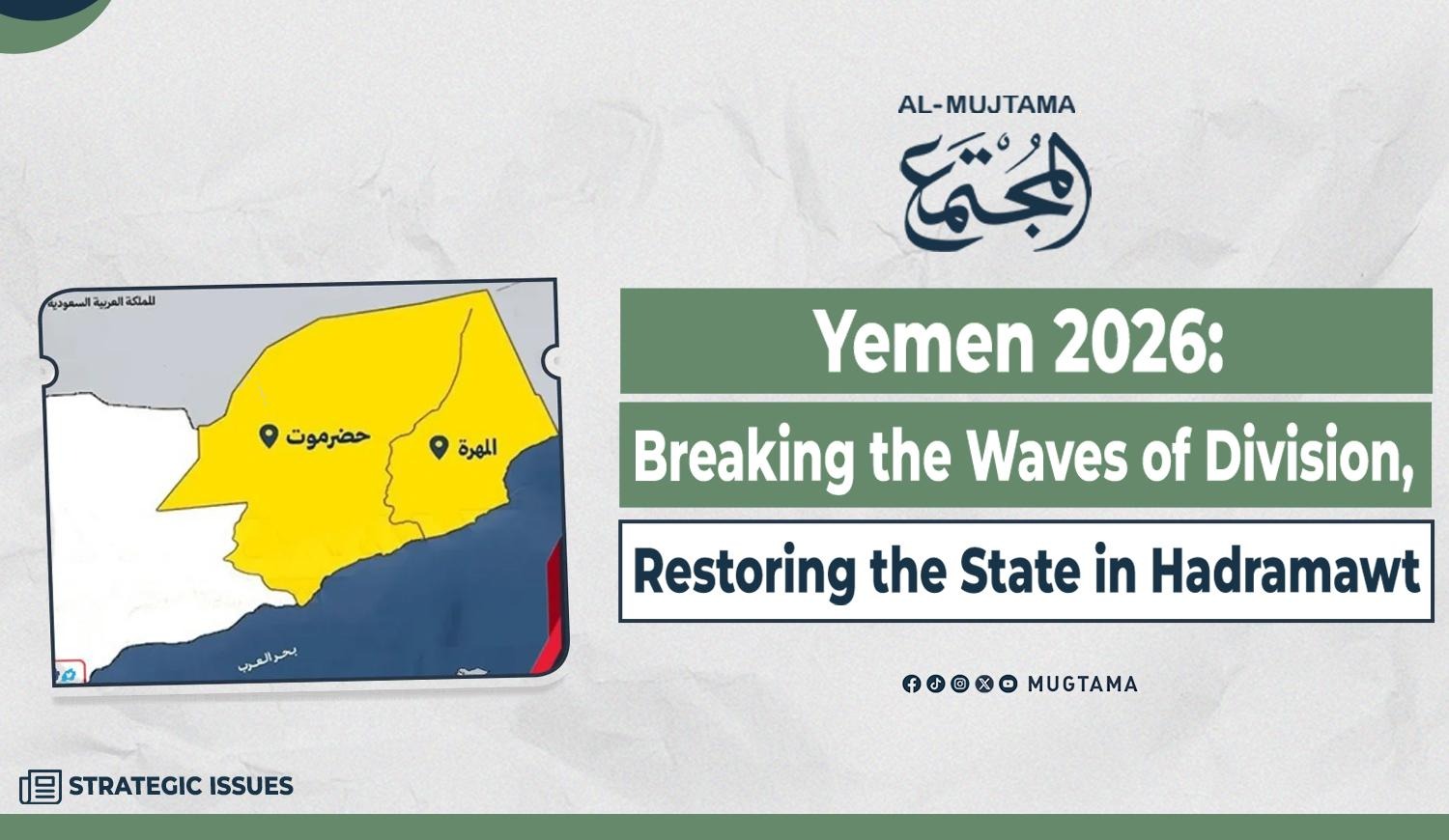
Yemen 2026: Breaking the Waves of Division, Restoring the State in Hadramawt
Between December 3, 2025, and January 3, 2026, Yemen witnessed two of the most dramatic turning points in the long crisis that has plagued the country since the fall of its capital into the hands of the Houthi movement in September 2014.
Escalation of the Southern Transitional Council: Roots of the Crisis
At the beginning of December 2025, the
Southern Transitional Council (STC) decided to escalate in a reckless and
unprecedented manner. This regional political entity, born in 2017, carries a
project to divide Yemen into two states, claiming to restore the southern
borders as they were before the unification of Yemen in mid-1990.
The STC is a mixture of groups and
figures opposed to the regime of the late ousted president Ali Abdullah Saleh.
Its leadership includes remnants of the socialist left that ruled Aden before
the collapse of the Soviet Union, as well as pockets linked by training and
funding to the “Southern Suburb” camp and its wider project of “Imamate
Guardianship,” which had Yemen in its sights from an early stage.
Political Division and Projects of Fragmentation
When popular protests erupted in 2011
demanding Saleh’s departure, leading to a Gulf initiative sponsored by Saudi Arabia that offered him safe exit, factions tied to the guardianship project
diverged in their paths but agreed on one principle: distancing themselves from
broad popular choices. They exploited the confusion and weakness of the
transitional state to pursue destructive options.
- In the North: The Houthi movement, from its stronghold in Saada, transformed into
a parallel state, waging expansionist wars until it seized Sana’a by force
in late 2014.
- In the South: From the outset of the uprising, the Suburb faction insisted on
separate tracks in rural areas and cities, mobilizing for secession and
treating anti-Saleh forces as indistinguishable from those who had risen
against him.
To many Yemenis, these behaviors
seemed like free services to remnants of the old regime. Later, it became clear
that all the chaotic shouting ended in alliances with the very regime they had
accused the people of colluding with.
“Operation Decisive Storm”: The Night That Changed the Equation
The Houthis advanced madly, swallowing
territory, exploiting the vacuum left by most actors. They toppled the capital,
moved toward other provinces, reached Aden, and besieged the elected president,
confining him in his home in Sana’a. The Arab neighborhood and international
community exhausted diplomatic options, but the Houthis pressed forward
recklessly.
Resistance emerged—tribal, social,
civil, and institutional. The strongest organized resistance was in Marib, east
of Sana’a, alongside pockets in Aden and Taiz.
On March 26, 2015, the unexpected
happened: Saudi Arabia launched a broad military intervention, forming an
Arab-Islamic coalition to restore the Yemeni state from its captors.
Alliances of Opposites and the Fall of Sana’a
In Sana’a, a rapid alliance formed
between the Houthis and ousted president Saleh. It was a pact of revenge
between two opposites, united only by hostility toward the people who had
revolted against one three years earlier and against the other half a century
before. Their target was also Saudi Arabia, the solid rock blocking their
reckless adventures. Saleh gave them his party’s bases, state weapons, media,
tribes, and influence. They gave him temporary safety and recognition.
Meanwhile, in Aden, resistance
intensified. Society mobilized in unprecedented unity. A local council of
popular resistance was formed, recognized by the coalition leadership, becoming
the foundation for liberation and the rebuilding of the national army.
Parallel Entities and Internal Struggles
Like all wars, Yemen’s crisis
experienced ebb and flow. Whenever danger receded, private projects re-emerged
at the expense of the national project. In the South, figures previously linked
to the guardianship project or to Saleh’s regime allied with the Houthis began
speaking on behalf of the street. Secessionist movements grew louder, armed,
and dominant in provinces.
In May 2017, Aden witnessed the
declaration of the so-called Southern Transitional Council. By December of that
year, the revenge alliance collapsed when Saleh was killed by his Houthi allies
after two days of street battles.
Shifting Alliances: Revenge Reunited
Saleh’s relatives and associates fled
Sana’a, becoming victims of personal vendettas with the Houthis. They settled
in Aden and areas under STC control.
This new scene seemed impossible but
became reality. Yemenis remembered how the STC, obsessed with southern
secession, had once refused to allow President Hadi and Prime Minister Ahmed
bin Dagher—both southerners—to land in Aden and Socotra, branding them as
former Saleh loyalists.
On the ground, the STC sought to
monopolize Aden and its surroundings. Its ally, Saleh’s camp, positioned itself
westward in areas it had recently fought against the Houthis. Both appeared as
parallel entities outside state authority, exercising powers and stripping the
government of its prerogatives.
Presidential Transformation in 2022
In mid-2022, Riyadh hosted broad
Yemeni consultations, producing a new formula and radical change in governance.
President Hadi delegated his powers to a council of one president and seven
deputies, including STC leader Aidarous al-Zubaidi and Tariq Saleh, nephew of
the late president.
Thus, parallel entities formally
reached the top of the presidency, holding half the seats. This produced
relative calm in Aden, enabling it to host the leadership council and cabinet.
Yet stability remained fragile, subject to regional winds and interventions.
A Month That Reversed a Decade
Without prior indicators, sudden
tension erupted in STC rhetoric calling for southern secession, echoed by Tariq
Saleh from Mocha. Escalation—military, media, and political—coincided with the
presence of Presidential Council head Rashad al-Alimi in Aden.
The Hadramawt Offensive and Reactions
The STC escalated militarily,
launching an armed advance from Aden toward Hadramawt, over 800 kilometers
east. The declared goal was to expel remaining non-southern units from
Hadramawt’s valley and desert, bordering Saudi Arabia, and from al-Mahra,
bordering Saudi Arabia and Oman.
Its militias clashed with military
units in Hadramawt valley. Others withdrew to avoid escalation toward Marib.
President al-Alimi remained silent in his Aden palace. The militias then
escalated against Hadrami tribes, attacking homes of tribal leader Amr bin
Habreesh, who held official status as deputy governor and head of two major
political blocs.
Al-Alimi and his government fled Aden
to Riyadh. Silence turned into a fireball. For Hadramawt and al-Mahra
communities, bin Habreesh described the forces as “invading tribal groups.” The
governor declared: “Hadramawt will not accept secession. Either we are an
active region in greater Yemen, or we will choose to be an independent state.”
Saudi Resolution and Restoration of the State
Once al-Alimi left Aden for Riyadh,
positions crystallized. The Yemeni government issued angry statements. Saudi
Arabia responded with high-level mediation, meeting STC leaders in Aden, then
moving to Hadramawt. Mediation failed. The Saudi Foreign Ministry issued a
statement explaining the problem, receiving unprecedented international
support. The Defense Minister followed with a stern declaration.
The crisis escalated further when the
Yemeni government demanded the UAE leave Yemen within 24 hours. Saudi Arabia’s
cabinet, chaired by King Salman, affirmed the need to meet this demand.
The four-member bloc in the
Presidential Council issued a defiant statement rejecting the government’s
demand. Yet within an hour, their ally announced unilateral withdrawal.
Instead of restraint, the STC
threatened to declare secession, providing justification for military action.
Within four days, the legitimate government regained control of all
Hadramawt—coast, valley, and desert—and al-Mahra, extending into Shabwa and Abyan.
The militias left Hadramawt before a
month passed, facing social rejection and isolation. They deliberately left
weapons depots open to looting, creating deadly security vacuums.
Saudi Arabia Regains Trust
Once again, Saudi Arabia regained the
trust of Yemenis across factions. Even those who had resisted now welcomed
dialogue hosted in Riyadh. Within two days, they flocked to talks, abandoning a
decade of rhetoric describing Saudi Arabia as aggressor, occupier, or invader.
The events of December 2025–January
2026 revealed the fragility of fragmentation projects. They showed that
secessionist adventures, however loud, collapse when confronted by unified
social rejection and decisive regional intervention. The restoration of
Hadramawt and al-Mahra marked not only a military victory but a political
turning point.
The question remains: Fragmenting Arab states—whose interest does it serve? The Yemeni case demonstrates that
such projects serve neither local communities nor national aspirations. They
serve only external agendas, prolong chaos, and weaken sovereignty. The
Hadramawt episode may be remembered as the moment Yemen began to break the
waves of division and reclaim its