









Who Really Controls the Game in Yemen?

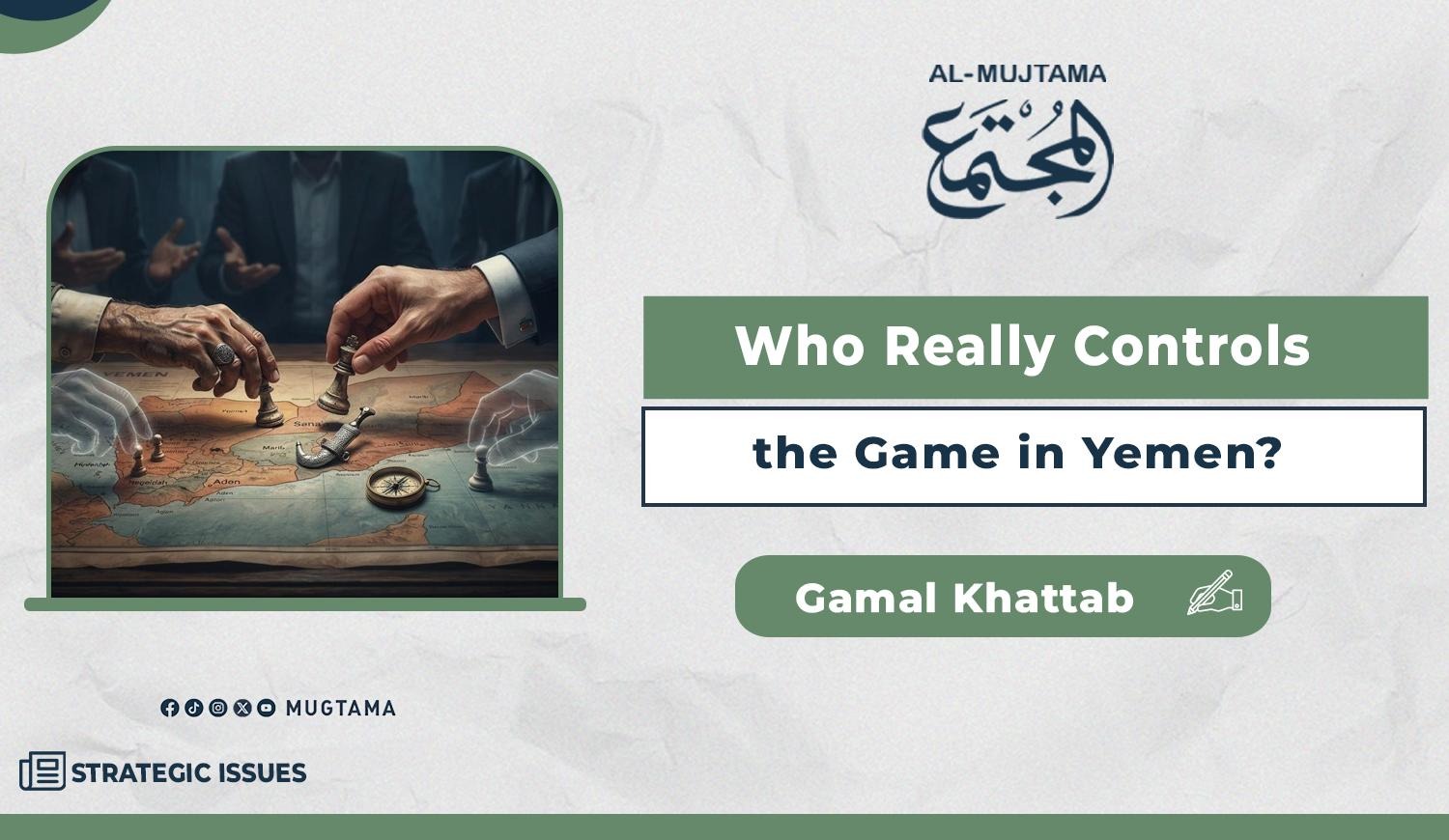
When the Prophet (pbuh) sent his messengers to Yemen near the end of his life, and when the Rightly Guided Caliphs subsequently strove to consolidate their authority over it and link it to the central Islamic state, it was not merely a matter of geographical expansion or political growth. The Prophet (pbuh) and his successors recognized early on what centuries of history would later prove: Yemen is no ordinary land on the margins of the world; rather, it is one of the most vital geopolitical nodes in history. Whoever controls Yemen approaches dominance over the southern gateway to the Red Sea, influences the flow of trade between Asia, Africa, and Europe, and commands an exceptional ability to impact regional and international security and economic equations.
For this reason, Yemen has never been outside the calculations
of major empires. The Persians and Romans competed over it prior to Islam, it
was later targeted by the Abyssinians, and European colonial powers—led by
Portugal and Britain—subsequently sought to establish a presence in or near it.
Today, more than 1,400 years later, the fundamental equation remains largely
unchanged. Yemen's geography is the same, Bab al-Mandab remains identical, and
international powers still understand that possessing influence in this region
grants an invaluable strategic card.
Hence, reducing the Yemeni crisis to a mere civil war or
humanitarian catastrophe constitutes a flawed oversimplification of reality.
The war that has ravaged the country for over a decade is not simply a conflict
between competing Yemeni factions; it is the product of a complex interplay
between local, regional, and international factors that transformed Yemen into
an open arena for competing wills, influence, and interests.
Why the World Competes over Yemen
It is impossible to understand Yemen without understanding Bab
al-Mandab. This narrow strait separating the Arabian Peninsula from the Horn of
Africa serves as one of the world's most critical maritime chokepoints.
According to data from the U.S. Energy Information Administration,
approximately 8.7 million barrels of crude oil and petroleum products passed
through Bab al-Mandab daily during 2023, prior to a sharp decline
resulting from security tensions in the Red Sea.
In his book The Revenge of Geography, American thinker
Robert Kaplan describes narrow maritime passageways as "keys to global
political influence." No example illustrates this concept more vividly
than Bab al-Mandab. Through this strait flows trade between East and West, and
through it pass vessels heading toward the Suez Canal, which itself
represents one of the primary arteries of the global economy.
Meanwhile, American naval historian Alfred Mahan, author of
the famous sea power doctrine, summarized the formula by stating: "Whoever
controls the seas controls the trade; whoever controls the trade controls the
wealth of the world." Thus, the conflict over Yemen is not a struggle over
mountains, cities, or villages, so much as it is a contest for a geographical
location that serves as a key to global influence.
Who Makes the Real Decisions in Yemen?
Despite the multiplicity of local actors in Yemen—from the
internationally recognized government to the Houthis, the Southern Transitional
Council, and tribal and political forces—the trajectory of the conflict reveals
that Yemeni decisions are no longer made entirely inside Sanaa, Aden, or Marib.
Instead, they have come to be influenced in varying degrees by numerous
regional and international capitals. Saudi Arabia views Yemen as its first line
of defense along its southern border and a primary determinant of Gulf
security. The United Arab Emirates regards it as part of an equation of
maritime and commercial influence extending from the Arabian Gulf through the
Gulf of Aden and the Red Sea to the Indian Ocean. Yemen also holds strategic
importance for Egypt, as the security of Bab al-Mandab directly impacts the
security of the Suez Canal, upon which Cairo relies economically and
geopolitically. In contrast, Israel considers the Red Sea and Bab al-Mandab
vital to its maritime security and trade routes originating from Asia.
For the United States and Western powers, Yemen is handled as
a crucial link in the security architecture of global maritime
corridors—specifically within the strategic triangle extending from the Strait
of Hormuz to Bab al-Mandab and the Suez Canal. China, possessing the world's
largest export network, views stability in Yemen as necessary for safeguarding
global supply chains and its Belt and Road projects, which depend on safe
navigation across the Indian Ocean and the Red Sea.
In this complex landscape, Iran exploited years of
chaos to build influence that grants it an extraordinary capacity for leverage
and impact. Indirectly, Tehran acquired bargaining chips near the Strait of
Hormuz to the east and Bab al-Mandab to the west—two of the world's most dangerous
and critical maritime chokepoints. Thus, Yemen transformed from an internal
crisis into an arena where calculations of global security, energy, and trade
intersect, making it impossible to comprehend any political or military
decision there without examining the web of international interests operating
behind the scenes.
How the Arabs Lost Yemen
After more than a decade since the outbreak of the Yemeni
crisis, a fundamental question emerges: why has the war not been resolved
despite numerous international and regional initiatives and interventions?
Several researchers argue that keeping Yemen in a state of
"semi-chaos" serves the interests of multiple powers. It justifies a
continued foreign military presence in the Red Sea and the Gulf of Aden,
provides regional and international actors with additional levers of influence
by supporting competing local parties, and leaves any political solution
contingent upon external balances rather than internal Yemeni will.
Conversely, the collective Arab absence stands out as one of
the primary factors worsening the crisis. The Arab League failed to establish
an effective Arab framework to contain the conflict or prevent its
internationalization, allowing the file to slip gradually into the corridors of
the United Nations and regional and international capitals. Observers consider
this strategic vacuum to have permitted non-Arab powers to expand their
influence in one of the most vital zones for Arab national security.
The Gulf Cooperation Council (GCC) maintained the most
prominent presence through the Gulf Initiative in 2011 and subsequent political
and military efforts; however, while it succeeded in containing certain risks,
it was unable to rebuild the Yemeni state or sustainably end the existing
division.
Regarding Egypt, although the security of Bab al-Mandab
connects directly to that of the Suez Canal, Cairo favored a cautious policy
focused on maritime stability. Nevertheless, Red Sea disruptions cost Egypt
significant losses, as revenues from the Suez Canal dropped sharply from
approximately $10.2 billion in 2023 to around $4 billion in 2024, according to
statements by the head of the Suez Canal Authority, Admiral Osama Rabie.
Ultimately, the absence of a unified Arab strategy turned
Yemen from an Arab strategic depth into an open arena for regional and
international rivalries, leaving the Yemeni people and the Arab economy as the
primary casualties of ongoing attrition and chaos.
How Iran Exploited the Arab Inattention
It is difficult to understand Iranian expansion in Yemen in
isolation from the major transformations that swept the Arab world over the
past two decades. Tehran did not create these crises, but it demonstrated a
remarkable ability to exploit them and turn them into strategic opportunities.
Following the U.S. invasion of Iraq in 2003 and the subsequent global war on
terror, Iran successfully built broad political and military influence within
Iraq through allied parties and factions, to the point where Baghdad became one
of Tehran's most critical arenas of external power projection.
With the outbreak of the Arab Spring uprisings in 2011, Arab
states grew preoccupied with internal crises and security concerns, whereas
Iran moved swiftly to protect and consolidate its spheres of influence. In
Syria, Tehran backed the regime of Bashar al-Assad with its full political and
military weight, capitalizing on the Gulf's preoccupation with managing the
fallout of the Arab Spring. In Lebanon, it invested in regional chaos to
reinforce Hezbollah's military and political presence. In Yemen, Iran discovered
in the gradual collapse of the state a rare opportunity to forge a strategic
relationship with the Houthi movement, securing influence along the western
flank of the Arabian Peninsula.
Consequently, Iran came to hold cards of influence stretching
from Iraq to Syria, Lebanon, and down to Yemen, enabling it to affect global
energy and trade routes by approaching both the Strait of Hormuz and Bab
al-Mandab simultaneously. From a strategic perspective, this outcome represents
one of Tehran's greatest geopolitical gains in recent decades, achieved by
capitalizing on Arab chaos far more than relying on its own direct strength.
The Curse of Geography
Through Arab inattention, international intrigue, sectarian
malice, and narrow self-interests, Yemen's geographical location transformed
from a blessing into a curse. The Yemeni people remain the greatest losers in a
conflict that far exceeds their borders; over 22 million individuals require
humanitarian assistance, while the economy faces severe collapse and state
institutions remain fragmented. Yet the loss is not confined to Yemenis alone.
The Arab world lost a critical portion of its ability to secure its southern
gateway, while Egypt suffered economic harm from Bab al-Mandab disruptions and
a sharp drop in Suez Canal revenues. As non-Arab regional and international
forces expanded their presence around one of the world's most critical maritime
corridors, Yemen shifted from being a cornerstone of Arab national security
into an open battlefield. Such is the curse of geography when a nation fails to
safeguard a location whose value others comprehend far better than its owners.
A Matter of Arab National Security
The Prophet (pbuh) and the Rightly Guided Caliphs recognized
this truth more than fourteen centuries ago when they viewed Yemen as a pillar
of stability and economic security for the Islamic state.
The paramount lesson presented by Yemen today is that geography abhors a vacuum. Whoever neglects a strategic position of this magnitude inevitably surrenders it to other forces that fill it to their own advantage. Therefore, restoring stability to Yemen is not merely an internal Yemeni affair; it is an Arab and Islamic strategic imperative that directly touches the security of the Gulf, the future of the Suez Canal, the stability of the Red Sea, and the safety of global commerce as a whole.