








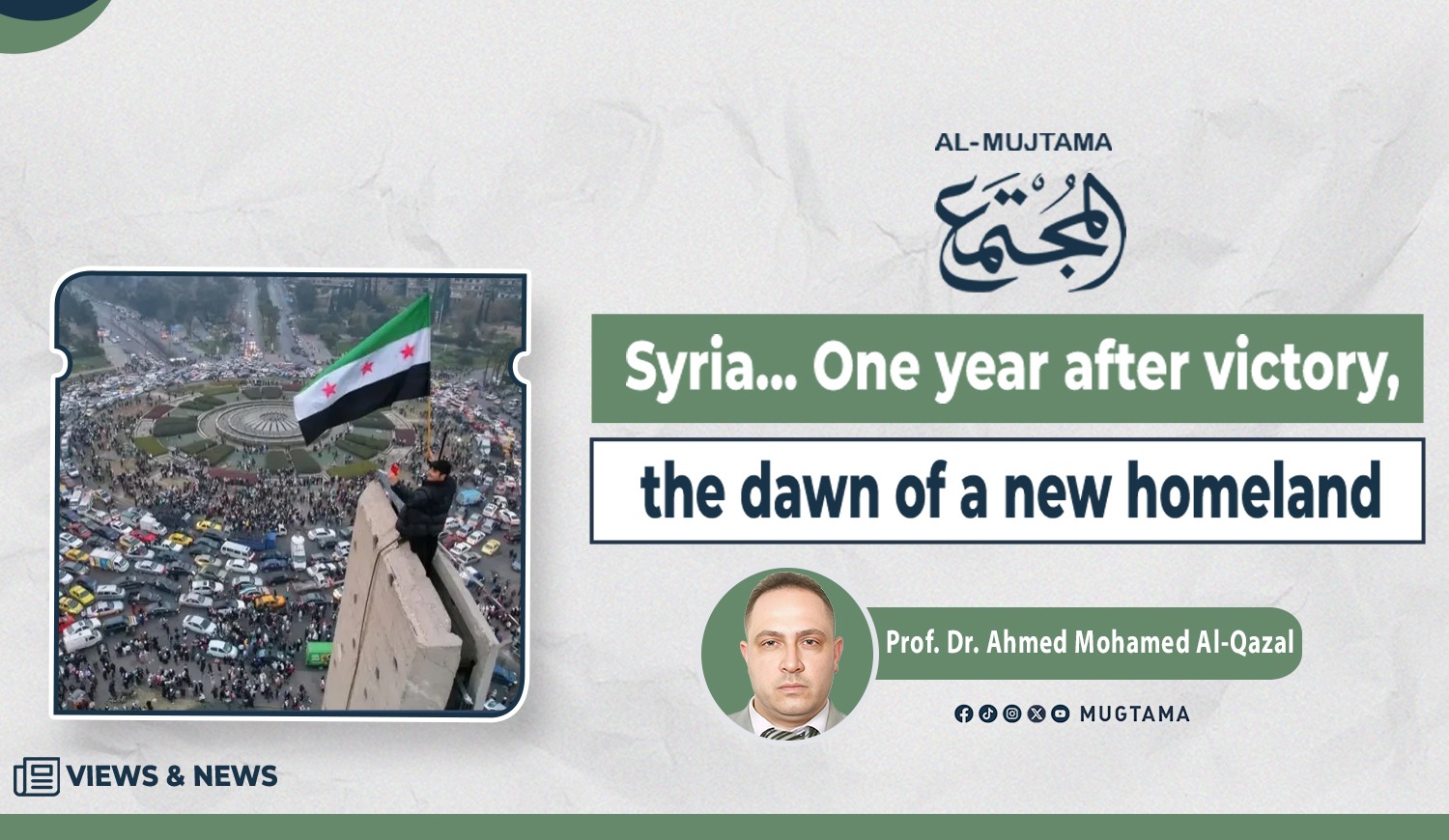
Syria: The Dawn of a New Homeland

On
the first anniversary of Syria’s revolution, the country seems
to awaken from a long night, opening its eyes to a morning it has not known for
decades a morning carrying in its air the scent of freedom after the cloud of
fear has lifted. This is no ordinary year; it is a year in which Syrians test
their ability to turn dreams into foundations, pain into meaning, and blood
into new life. The era of a regime that weighed heavily on people’s chests has
ended, and Syria begins to write its first line in a new notebook one that does
not inherit the past so much as reinterpret it, extracting from it what can
serve to build a homeland worthy of life.
The land is scarred with wounds… but the
collapse will not last long
After
years of a war that seemed endless, Syrians today stand on land scarred with
wounds yet not dead, amid ruins that do not frighten them, for they resemble chapters
of history their ancestors overcame time and again. The people who carried the
revolution to victory were not seeking a fleeting change, but a restoration of
dignity and a homeland that treats its sons and daughters as human beings, not
subjects. Now, a year after the great turning point, Syrians look ahead to
building a state founded on justice, equality, and respect for human beings not
on the balances of repression and fear.
Syrians
have proven through the ages that defeat never dwells in them for long, and
that the life of cities is measured by how they rise again, not by what falls
upon them. Their deep-rooted skills in trade, industry, agriculture, and
science did not fade during the war; they became clearer as necessity turned
into drive and hardship into opportunity. History still bears witness that this
land has never known despair, and that its people have always come together
whenever tyranny struck just as they united against every form of occupation
and reclaimed their homeland. Today, they stand once more on the threshold of
that same moment, though the times and faces have changed.
National
unity is no longer a hollow slogan, but a condition for existence itself.
Syria, where cultures, religions, and languages flow together, is not a state
that can be reduced to a single color or opinion, but a mosaic whose beauty is
complete only when all its pieces come together. From this arises national
reconciliation as the most sensitive step in the post-revolution stage a
reconciliation not built on forgetting, but on justice that vindicates the
oppressed without seeking revenge, opening the door to the future without
closing the account of memory.
Syrians are the makers of civilization
It is
nothing new for Syrians to be makers of civilization. Since the Ugaritic
alphabet first inscribed its letters on clay tablets, a new language for the
world was born from this land, a language that made knowledge possible and
shortened the distance between mind and writing. The Aramean, Phoenician, and
Assyrian civilizations were not merely pages in history’s book but deep roots
of a voice that still resonates today. With the advent of the Islamic era,
Damascus became the capital of the greatest state of its time, where politics
blended with thought and architecture with science. From the womb of this land
emerged great scholars such as Ibn al-Nafis, who rediscovered the secrets of the human body
as if he were rediscovering the meaning of life itself.
In
modern times, Syrians once again proved themselves to be the sons of freedom.
They faced French colonialism with unyielding resolve and wrested their
independence at great cost, reclaiming their existence with their own hands.
Today, Syrians continue to make their mark in thought, art, entrepreneurship,
and science as if their enduring history guards them against extinction.
Victory is the beginning of work
But victory is not an ending it is the
beginning of a harder chapter. The challenges facing Syria a year after its
revolution’s triumph are far from few. Foremost among them is the
reconstruction of a homeland exhausted by war, where shattered cities demand
comprehensive plans rather than superficial repairs. Roads, hospitals, and
schools are not mere stones, but incubators of the new life meant to return.
Rebuilding the collapsed economy requires a long-term vision that encourages
investment, supports local production, and creates jobs for a generation that
has carried the heaviest burden of the revolution: waiting.
Among the most urgent priorities is
achieving political stability through the establishment of a just system of
governance that derives its legitimacy from law, not from arms. Such a system
must ensure transparent accountability for crimes and violations within a
judiciary that is fair one that neither erases rights nor exploits pain.
Equally vital is the return of refugees and the displaced, for the homeland
itself cannot return without its people. Syria has no meaning without its sons
and daughters, and the nation has no meaning if half of it remains outside its
borders. This requires a safe environment, realistic guarantees, and
compensation that restores life to those who lost everything except their faith
in returning.
Education and the years lost by Syria’s
children
Here is Syria, after the guns
have fallen silent, discovering that the most dangerous battles were never
fought in the squares, but in the minds that stopped dreaming for long years.
Education is not a book to be opened and closed, but time planted in memory.
And when time is lost, countless energies vanish with it - energies that could
have become light.
The years of war that
swallowed the childhoods of millions were not stolen only from notebooks, but
from the very contours of the future from the laughter of schools that turned
into heavy silence, and from classrooms left without desks or teachers.
The bitterest truth carries
within it the greatest hope: humanity can reclaim what it has lost if someone
extends the path. Education in Syria today is not merely a reform program, but
a moral and spiritual rescue project that goes beyond compensating for missed
lessons to rebuilding trust between the child and the world around them. The
new curricula will not be neutral pages, but bridges that lead the mind from
fear to initiative, from division to dialogue, from rote learning to discovery for
a nation that reproduces the past remains imprisoned within its walls, no
matter how much it repairs them.
This renaissance will succeed
only when it is understood that a school is not a building, but a philosophy
that recognizes the dignity of the student and grants them the right to
question before memorizing the answer. As the country opens to its Arab,
regional, and international surroundings, the task is not to import ready-made
models, but to build partnerships based on mutual respect where Syria learns as
it teaches, and benefits without losing its identity. Nations are not measured
by what they have lost, but by what they decide to do after loss. Today, Syria
stands before a rare opportunity to turn its wounds into a new beginning, where
childhood is no longer a postponed margin, but the center around which the
story is rewritten.
It all ends with a touch of grace
The
vision Syrians await today is not complicated: a state governed by law, where
no one is subject to any standard other than citizenship. In such a state,
freedoms are safeguarded, and human dignity is respected because freedom, for
which such a heavy price was paid, must not be reduced to an annual
celebration. The revolution that triumphed a year ago was not built merely to
topple a regime, but to establish a new meaning for shared life among the sons
and daughters of one homeland.
Thus,
hope remains steadfast in the hearts of Syrians, embodied in work and
determination. This land, which gifted history its first alphabet, is capable
of gifting the future a new lesson in rising again. With the passing of the
first year since victory, the promise is renewed that Syria will return not as
it once was, but as it deserves to be: a homeland worthy of its children, a
people worthy of its history, and a new page written by those who lived through
pain and turned it into a beginning, not an end.
___________________________________________
You may also like:
Israeli Media, US Ambitions, and Damascus Denials
Post-Sanctions Syria: Opportunities and Obstacles
Syria and the Zionist Entity: Constants of Stance and Limits of Possible Relations
Mohammed Yassin Saleh, the Architect of Syria’s Renewed Cultural Vision.
Assad Unforgivable Crimes in Syrian Prisons
______________________________________
