









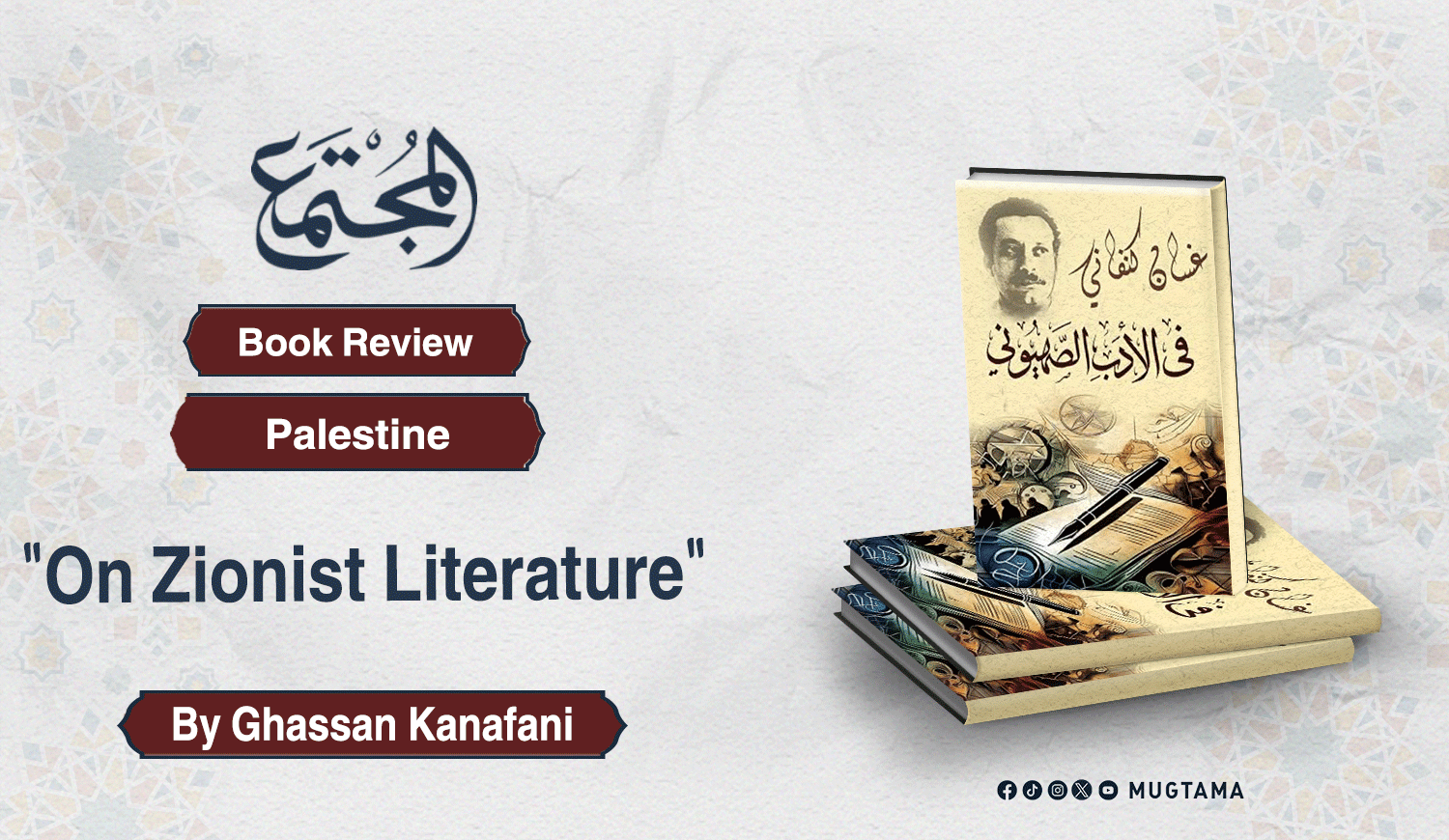
Book review On Zionist Literature By Ghassan Kanafani
A
Novel Precedes the Bullet: Ghassan Kanafani Exposes Zionism's Cultural Machine
Before Its Cannons Fire
Introduction
In his seminal and profoundly
impactful study, On Zionist Literature, the writer and thinker Ghassan Kanafani takes his scalpel to an exceptionally
perilous and influential battleground where Zionism waged its fiercest wars: 'the front of the
pen and the imagination.' Kanafani does not treat fiction, poetry, and texts as
innocent artistic outputs; rather, he exposes them as 'preparatory weapons'
that preceded the political and military project and paved its path. In doing
so, he draws the reader behind the scenes of modern history's most massive
operation of cultural deception and collective brainwashing—one that sought to
transmute myth and persecution into a project of settler-colonial conquest.
Plot and Core Ideas
Literary Zionism Preceded Political Zionism":
The Pen as an Operational Blueprint for Conquest
Kanafani demonstrates that this movement of directed
literature was not merely an echo of the political movement that crystallized
at the Basel Congress of 1897, but rather the very womb that gave birth to it.
By invoking early works of fiction—such as George Eliot’s Daniel Deronda
and Benjamin Disraeli’s David Alroy—literature drafted the detailed
blueprint for the idea of the state and the gathering of the colonial diaspora
long before diplomatic conferences ever formulated it.
The Language Front and the Transmutation of
"Religion" into "Ethno-Nationalism"
The book traces the relentless campaign waged by Zionism to
revive Hebrew and enforce it as a political, national language after centuries
of being confined to sacred prayer and religious ritual. It elucidates how
Zionism combated calls for the social integration of Jews within their native
societies, substituting it with an artificial conflation of race and religion
to entrench a superiority complex and the notion of the 'Chosen People' in
service of political ambitions.
The Metamorphosis of Myth: The "Wandering Jew's"
Journey from Atonement to Military Supremacy
Kanafani masterfully dissects the dramatic evolution of the
'Wandering Jew' (Ahasuerus) across centuries of European literature. Once a
religious archetype of the tormented sinner seeking expiation and social
justice, the figure was gradually politicized and weaponized, culminating in
the twentieth century as a militant hero and infallible conqueror taking up
arms to hold the world to account.
Fabricating the "Infallible Hero" vs. Demonizing and
Dehumanizing the Victim
The book exposes the uniform formula adopted by major Zionist
novels (such as Leon Uris’s Exodus), wherein the Jewish protagonist is
cast as morally and physically superior—an 'infallible hero.' Conversely, the
Palestinian Arab is stripped of humanity and native rights, depicted as
backward or as an incidental passerby with no just cause. This stark
juxtaposition served to rationalize the uprooting of an entire people and
whitewash the crimes of occupation before the Western conscience.
Key Symbols and Meanings
The core significance pulsating through the book lies in the
concept of 'deception through colonial humanization.' Zionist literature
successfully exploited Western guilt over Nazi atrocities, turning it into a
blank check to usurp Palestine. Literature was thus transformed from an
instrument of enlightenment and truth-seeking into a 'smokescreen' that
falsifies history—shifting from a protest against racism into the practice of
an inverted racism against the rightful indigenous owners of the land.
The Zionist
movement fought with the weapon of literature no less fiercely than it did with
political weapons... and all this study aspires to do is to shed further light
on that challenging maxim: Know your enemy.
The study On Zionist Literature remains an exceptional and
profoundly timely work. Kanafani did not merely critique novels as literary
texts; rather, he dismantled the propagandistic codes that continue to direct
international narratives and media machineries to this very day. It is a book
that powerfully reminds us that the battle of consciousness and the word is no
less fierce, nor less decisive, than the battle on the ground.
