








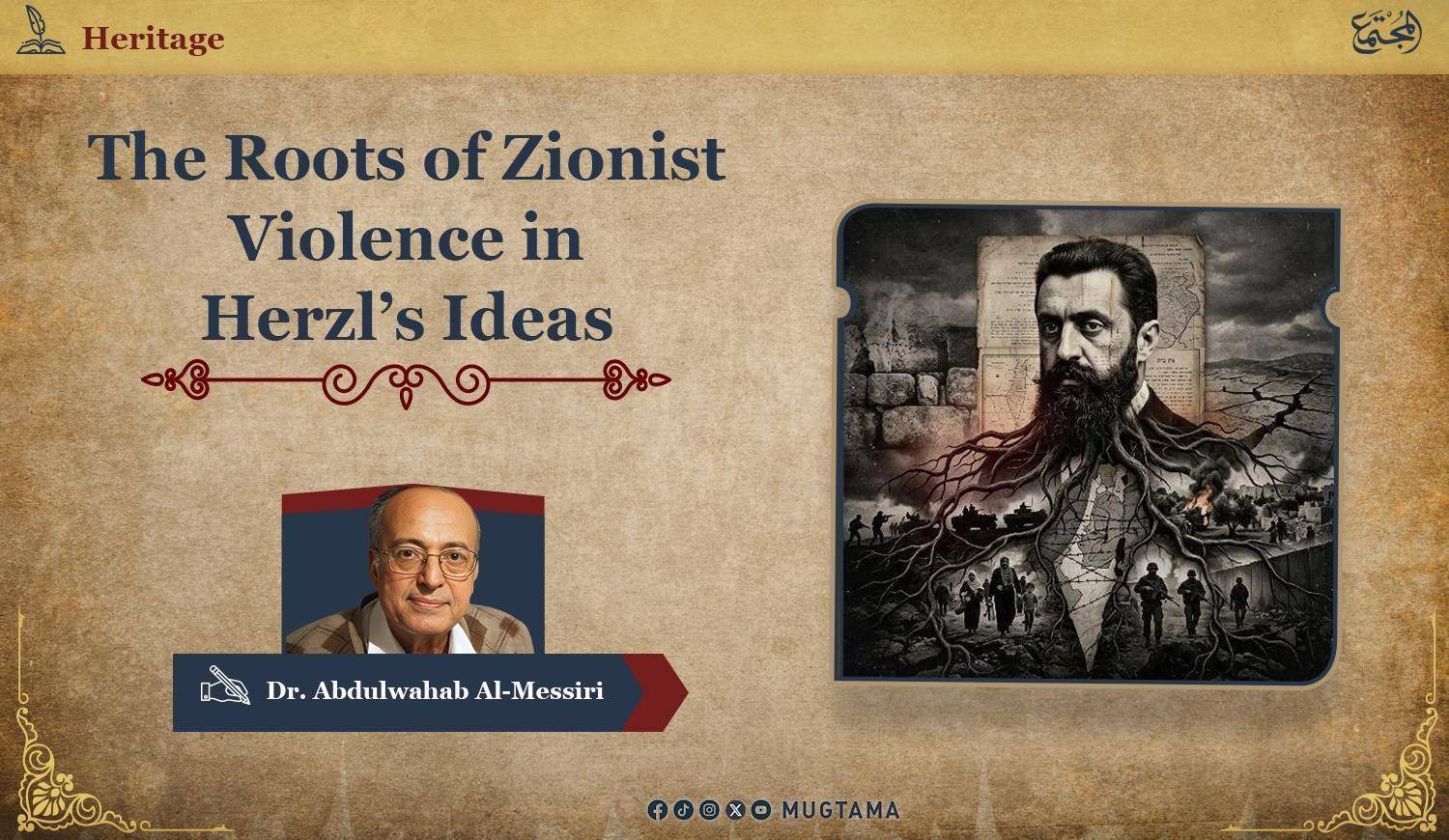
The Roots of Zionist Violence in Herzl’s Ideas
Herzl developed a evasive discourse, calling upon
all parties (the Western world, as well as both Western and Eastern Jewry) to
sign the 'silent contract' between Western civilization and the Zionist
movement.
However, there was one party that was never
invited to sign, despite being the one to suffer the consequences once the
contract was put into effect: the Arabs. Herzl mentioned this party only
fleetingly, occasionally within the context of his critique of 'infiltrative
Zionism.' He argued that early Zionists failed to realize that the indigenous inhabitants
(the Arabs, and perhaps the Native Americans in Argentina) would feel
threatened, subsequently pressuring their respective governments, which would
then be forced to halt the infiltration.
The Zionist Perception of the Arabs:
Arabs are
not mentioned in The Jewish State (Der Judenstaat) or in the
address Herzl delivered before the First Zionist Congress (1897)—that is, in
the documents specifically addressed to Zionists. However, other documents
directed at general public opinion, such as The Old New Land (Altneuland),
present a rosy picture of the future of Arab citizens in the Jewish state,
claiming they would enjoy increased prosperity and blissful lives.
In 1899,
Herzl wrote a letter to a Palestinian leader, promising widespread welfare and
increasing wealth. Yet, regardless of any perceived benevolence on Herzl's
part, the Arabs and the indigenous inhabitants were never invited to sign the
contract. The sovereignty of the Jewish state derived its legitimacy from the
West, and while the relevant governments could cause complications, the
indigenous population itself was deemed of no consequence. Herzl was not unique
in this regard; Western modernization, executed through a colonial lens,
routinely presumed that the East would foot the bill for Western progress.
Consequently,
the indigenous inhabitants are not part of the modernization process; rather,
they fall entirely outside of it. Thus, omission and erasure are inherent parts
of the modern Western perceptual framework regarding the 'Other.' Out of this,
violence emerges as the pure mechanism for implementing projects that operate
within the framework of public international law—which is, in essence, Western
colonial law.
Yet,
through his characteristic evasion, Herzl never speaks of violence in his
public documents, save for a fleeting reference to the Maccabees in The
Jewish State (Der Judenstaat). This reference can be interpreted as
an attempt to revive a martial spirit rather than an explicit incitement to
violence against the Arabs. The same interpretation applies to his letter to
Baron de Hirsch, where he detailed his plan to transform the educated Jewish
proletariat (the average intellectuals he discusses in The Jewish State)
into something useful: 'soldiers and army cadres who will search for the land,
discover it, and then seize it
In any
case, violence rears its head in the words 'discover' and 'seize.' The
'discovery' of America, after all, meant the annihilation of its indigenous
population and the seizure of their land. The matter is slightly different in
Herzl's Diaries, where admiration for Prussian militarism intermingles
with discussions on how to expropriate the private property of the indigenous
inhabitants, and how to utilize them to clear the land of snakes before
securing employment for them in other countries (as he recorded in his journals
in 1895).
In 1902,
Herzl wrote to Chamberlain regarding the fate of the native population of
Cyprus should it fall into the lethal Zionist orbit: 'The Muslims will move
away, and the Greeks will gladly sell their lands at a good price and migrate
to Athens or Crete.' This indicates that the seizure of land and its evacuation
of inhabitants was the latent assumption embedded throughout his writings.
Violence, thus, lies dormant between the lines, awaiting the opportunity to
manifest, and biding its time for the bullets to rain and the napalm to fall
It is
worth noting that Herzl did not rule out the use of violence against Jews
themselves (should they refuse to submit to the Zionist vision), as evidenced
by his concept of the 'Conquest of the Communities'.
Herzl's
opponents labeled his proposed Zionist state as 'Zion without Zionism.' This
was a term utilized by ethnic Zionists (both religious and secular) to describe
the vision held by Herzl and other Zionists regarding the Jewish state; to
them, it was a state that merely served as a framework to absorb the Jewish
demographic surplus, completely devoid of any distinct Jewish characteristics
or features. To some extent, the ethnic Zionists were justified in their
stance. Prior to the Balfour Declaration, territorial Zionists were preoccupied
with a single objective: to rid Europe of the 'Yiddish' Jewish human surplus as
quickly as possible by depositing them in any available territory.
However,
they were not entirely correct. Herzl’s amorphous framing left the door wide
open for all potential Zionist discourses; it did not outright reject ethnic
Zionism, but was simply indifferent to it.
Source: The History of Zionist Thought: Its Roots, Trajectory, and Crisis.