









Beyond the Numbers: The Real Scope of Al-Aqsa Incursions
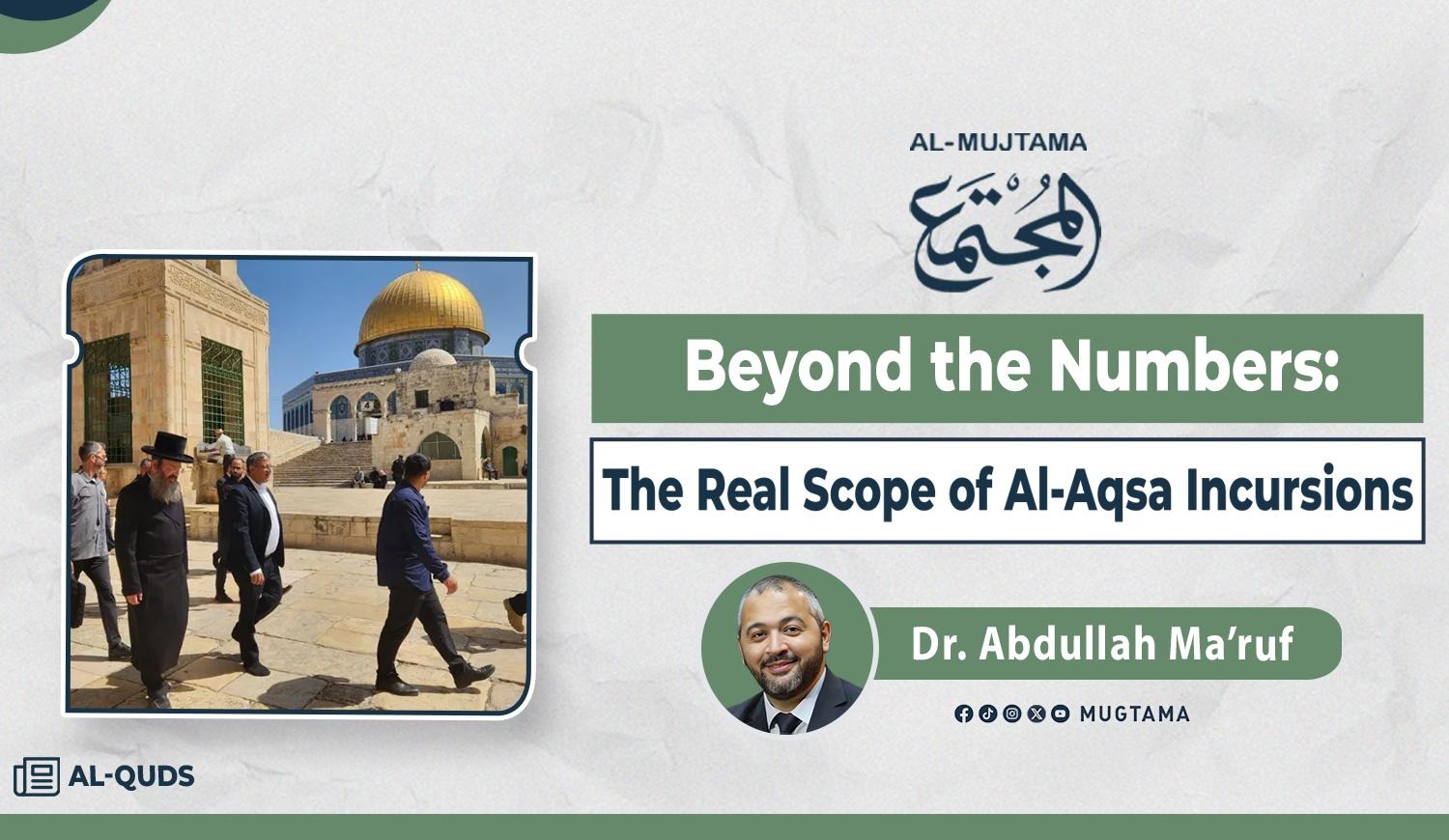
Less than two weeks after the
end of the Jewish holiday season, extremist Temple groups, backed by
Israeli occupation forces, began widening the entrance of the settler pathway
to the blessed Al-Aqsa Mosque outside the Mughrabi Gate (Bab
al-Maghariba). The Israeli occupation has retained the keys to this gate since
seizing East Jerusalem in 1967, and has used it to facilitate settler entries
into the compound since 2003.
This is no passing
development, nor should it be treated as one. The immediate assumption
following such news is that the expansion aims to accommodate larger waves of
intruders in upcoming seasons. While partially true—given that this year’s Sukkot
recorded a historic high of over 9,000 settlers storming the site, up from
around 7,000 last year—the full picture goes deeper. In total, the number of
incursions across Rosh Hashanah, Yom Kippur, and Sukkot combined surged past
11,400 settlers, according to documented reports.
Yet these figures—vital as
they are—do not tell the whole story. In fact, fixating on the headcount alone,
as much of the media coverage surrounding the mosque often does, obscures the
season’s most dangerous shift: not how many broke in, but what they did once
inside.
Al-Aqsa Incursions: Rituals
Eclipse Settler Numbers
This year, the intruders did
not wait to reach the mosque's eastern sector—which has evolved into their
primary focal point in recent years. Instead, they initiated open communal
prayers from the very moment they set foot inside. Collective prayers and
gatherings spread along the entire incursion route and across the stone
terraces (mastabas), reaching the perimeter of the Bab al-Rahma prayer
hall. Settlers staged singing and dancing circles, entered the compound
carrying prayer books, clad in religious vestments and shirts emblazoned with
Temple movement slogans, and smuggled in phylacteries (tefillin). They
even left the botanical offerings associated with Sukkot resting on the
mosque's stones in the eastern area. As for the shofar (ram's horn), it
was blown inside the sacred compound 30 times on September 13 alone.
The sheer provocation of this
spectacle is undeniable: settlers openly performing the full suite of their
festival rituals inside the holy site as though it were already a standing
temple, turning the eastern sector of Al-Aqsa into a de facto synagogue.
This directly aligns with the priorities outlined ahead of the holiday season
by National Security Minister Itamar Ben-Gvir—who explicitly targeted
the blowing of the shofar, the donning of tefillin, opening the
compound to incursions on Saturdays, and the ultimate restoration of the Temple
as the end goal. In this season alone, two of those objectives have already
materialized: the shofar and the tefillin.
Extremist Temple groups
understand this reality all too well, viewing it as a tangible triumph. This
sentiment was voiced plainly by Elisha Wolfson, the self-styled rabbi of the
so-called 'Temple Mount Yeshiva'—which effectively operates from within
Al-Aqsa. In a recent video address, Wolfson proclaimed that the 'real victory'
lies inside the compound itself through constructing the Temple and
establishing a synagogue there. This is the very same figure who boasted
roughly three months ago that the site now witnesses communal singing, prayers,
and prostration—whereas just six years ago, even silent prayer was ground for
immediate detention.
This rhetoric exposes the
core doctrine of these factions. While they certainly do not discount sheer
numbers—settler saturation carries ideological weight as a theological 'sign'
to hasten divine promises—headcounts serve merely as a vehicle to saturate the
grounds with rituals. These rituals, in turn, function to treat Al-Aqsa as a
functioning temple in the present day, long before any physical structure is
erected on the ground. In essence, the objective at this stage is the
non-physical, ideological consecration of the Temple—and precisely therein lies
the danger.
Mughrabi Gate: Why the Incursion Pathway Is Being Expanded
It is precisely through this lens that the widening of the Mughrabi Gate pathway must be understood. Sukkot is one of the three biblical
pilgrimage festivals tied to the Temple, and the sanctuary being ideologically
revived today demands unhindered access for its 'pilgrims.' It is hardly a
coincidence that Temple groups have had this infrastructure project on their
agenda since at least 2022, when they announced discussions with Israeli
officials to dismantle the earthen ramp and wooden bridge at Mughrabi Gate,
replacing them with a permanent, wide bridge tailored to accommodate the surging
scale of incursions.
Herein lies the critical blind spot of the media, which still
largely covers developments at Al-Aqsa through a daily numerical tally. This
metric inadvertently plays directly into the hands of Temple groups. Headcounts
fluctuate; a lull in numbers could easily dupe the public into believing the
danger has receded, even as the rituals themselves become permanently
entrenched inside the mosque.
Compounding the crisis, the occupation has engineered an
information blackout this season by barring journalists and activists from
entering the compound. As a result, settler-generated footage and self-reported
statistics have largely supplanted the ground-level documentation of
Palestinian Mourabiteen, the Islamic Waqf, and other institutions now
systematically prevented from monitoring the reality on the ground.
Al-Aqsa and Jerusalemites: Crackdowns Beyond the Incursions
The Israeli occupation government is advancing this same
trajectory from another angle, systematically coercing Jerusalemites into
accommodating a new reality imposed by force and incremental encroachment. This
policy was laid bare on Sunday, October 11, when occupation authorities barred
the family of Ibrahim Hassan Shalabi—a young Jerusalemite killed in a traffic
accident—from holding his funeral prayer inside Al-Aqsa Mosque. Authorities
conditioned the proceedings on holding the prayer elsewhere, forcing the family
to relocate it to the Shuman Mosque in Beit Hanina, while still permitting his
burial at the Bab al-Rahma cemetery adjacent to the mosque's eastern wall. This
represents a perilous precedent that will yield severe repercussions if allowed
to pass unchallenged as the occupation intends.
This incident may seem like a minor footnote against the
backdrop of thousands of intruders and sensational headlines of ritual
incursions, yet it is no less dangerous. The blessed Al-Aqsa Mosque—spanning
its entire 144-dunam compound, encompassing the Qibli Mosque, the Dome of the
Rock, and all its courtyards—has historically served as the social and
spiritual epicenter of Palestinian life in Jerusalem: a sanctuary where they
pray, learn, and bid farewell to their deceased. By stripping the mosque of
funerals, having already gutted it of study circles (halaqat) and its
steadfast defenders (Mourabiteen), the occupation seeks to reduce
Al-Aqsa to a sterile venue for detached devotional rituals—permitted strictly
on its own terms and at times of its choosing.
Equally telling, Israeli occupation police ordered several
worshippers following the dawn (Fajr) prayer during the holiday season
not to return before 3:30 PM. Furthermore, those permitted entry were strictly
confined to seated areas inside the roofed prayer halls, while the sprawling
open-air courtyards were left entirely cleared for settler incursions.
The endgame pursued by the occupation state is unmistakable:
an Al-Aqsa where Muslims are granted entry solely for prayers during designated
hours, while settlers are ushered in at other times to perform their full suite
of rituals—transforming it into a de facto shared holy site until total
control can be seized, mirroring the blueprint deployed at Hebron's Ibrahimi Mosque, with all its well-known consequences.
Temple groups understand
only too well that what truly matters is the indelible imprint left behind
inside the sanctuary once the intruders depart, not the raw headcount on any
given day. It is on this calculation that they operate. The question remains:
will our media and the wider Muslim world grasp this reality before awakening
to the irreversible catastrophe of a fully realized temple standing inside the
blessed Al-Aqsa Mosque?
