







What Are the Occupation's Current Plans for Al-Aqsa Mosque?
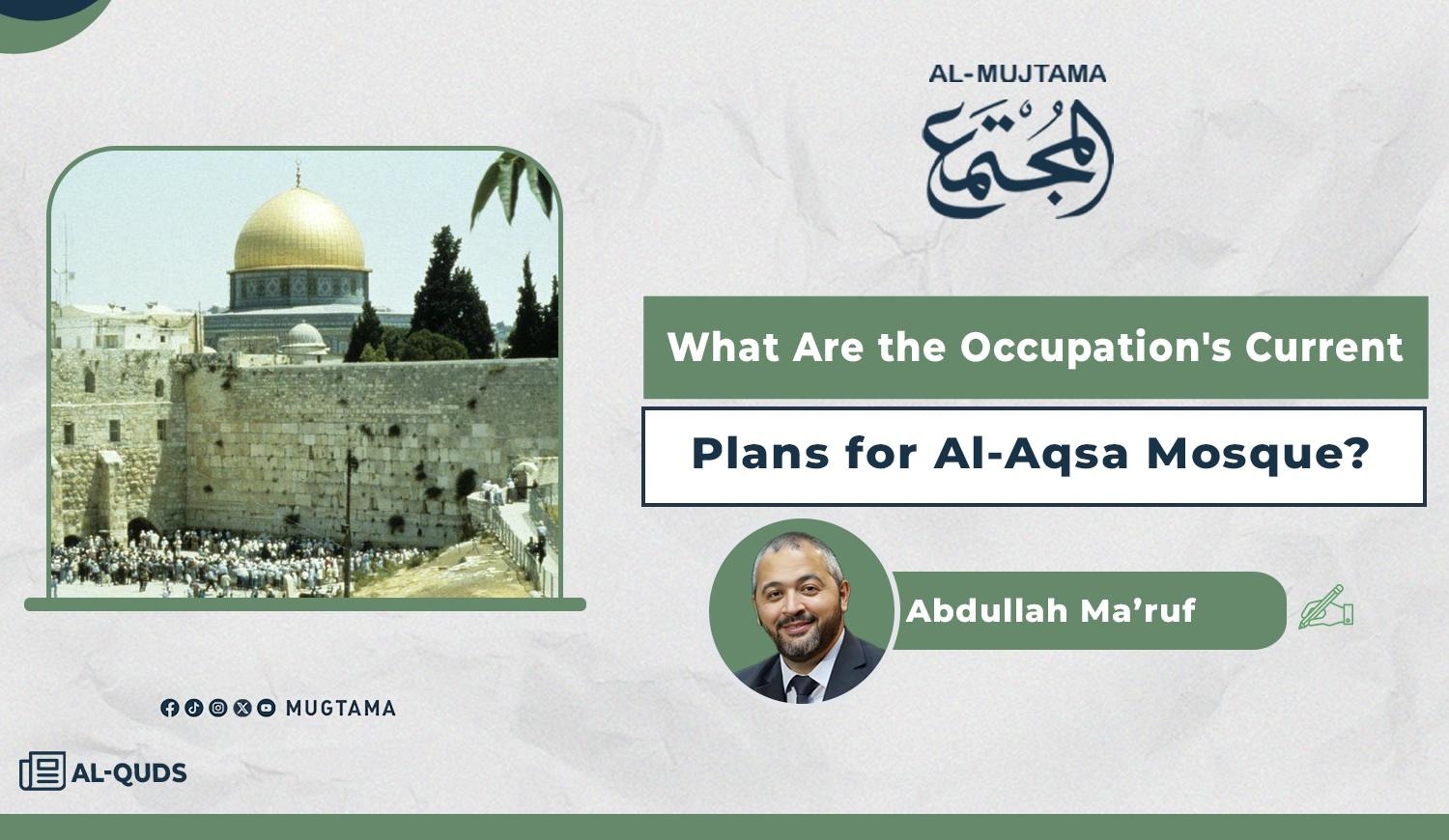
During his 19th incursion
into the blessed Al-Aqsa Mosque ahead of the Jewish New Year holiday season, extremist Zionist
National Security Minister Itamar Ben-Gvir outlined his agenda for the site through three immediate
tactical priorities and one final strategic objective. He stated that his
current focus is on the 'Shofar', 'Tefillin', and 'Shabbat'. However, he
declared that his ultimate strategic goal is the 'Temple'—signifying the
establishment of the alleged 'Third Temple' in place of Al-Aqsa.
Ben-Gvir and the Ministry of National Security
The speaker here is not a
social activist or merely a social media influencer—although he is mockingly
dubbed the 'TikTok Minister' within the occupation state due to his boundless
populism, rivaled only by that of US President Donald Trump on social media.
Rather, he is a minister at the helm of one of the most critical sovereign
ministries in the occupation state: the Ministry of National Security, which
controls one of the country's most dangerous security apparatuses—the police
force.
Consequently, when such a
statement is made by Ben-Gvir, it inevitably translates into the official
policy of the ministry he heads. This is because the administrative structure
of ministries within the occupation state grants the minister substantial
leverage to dictate the direction and output of his department. He can mold its
operations to serve his personal vision and electoral ambitions, regardless of
whether the occupation state is in the midst of an election cycle or not.
This is precisely why
far-right parties, for instance, are deeply invested in securing control over
key ministries. A prime example is the Interior Ministry, which the Haredi Shas
party views as the ultimate vehicle to serve its ultra-Orthodox constituency,
or the Finance Ministry, which Smotrich adamantly demanded, leveraging it as a
conduit to fund his Religious Zionism party’s projects in the West Bank.
The Shofar at Al-Aqsa Mosque
In the thick of this holiday
season, it is evident that Ben-Gvir has already moved to fulfill his pledge
regarding his first objective; the Shofar was indeed sounded at Al-Aqsa during
the incursions marking the so-called Jewish New Year on Sunday, September 13.
Gravely, Arab media coverage of the incident was entirely absent, stifled by
the occupation's draconian security clampdown on the mosque and the outright
ban on Muslim entry that day. Consequently, it took a full two days—waiting
until the religious settlers concluded their Monday fast and subsequently
published corroborating evidence—for the news to surface. This reality alone
exposes the profound depth of the crisis at Al-Aqsa: Muslims are now
incapacitated from even reporting on unfolding events, living under the constant
threat of banishment, expulsion, imprisonment, and torture.
What Do the 'Tefillin' Rituals Mean?
As for the 'Tefillin'—the leather straps and boxes worn by
settlers during their prayers and religious rituals—Ben-Gvir has already
tacitly permitted their use in recent periods. On multiple occasions, he has instructed
the police to turn a blind eye to the practice, even if he has not yet
sanctioned it as explicitly as he previously did with the act of prayer inside
the mosque itself. In 2024, he publicly and brazenly declared open prayer at
the site to be permitted. This policy was put into actual practice during the
incursions marking the so-called 'Yom Kippur' on the 20th of this month, albeit
without a formal declaration from the occupation authorities.
Opening Al-Aqsa on Saturdays
The objective of opening Al-Aqsa Mosque on Saturdays remains
pending, standing as the immediate priority for extremist Temple groups. On
September 8, these groups filed an urgent petition to the occupation state’s
Supreme Court, demanding that the mosque be opened for incursions on Saturdays
(the site is currently closed to settlers on both Fridays and Saturdays). This
move aims to practically and comprehensively enforce the temporal division of
Al-Aqsa—designating Fridays for Muslims and Saturdays for Jews—which
constitutes a foundational pillar of the broader scheme to temporally divide
the mosque.
However, the Public Prosecution—operating under the Justice
Ministry—remains wary of the repercussions, prompting it to request a
postponement in issuing a ruling. This comes despite Ben-Gvir submitting a
formal letter on behalf of his ministry to the Supreme Court, demanding it
declare Al-Aqsa open to settlers on Saturdays, a move likely aimed at
fulfilling pledges to his base. This dynamic reveals two crucial realities:
The first is that the concept of designating Al-Aqsa for Jews
on Saturdays—essentially enforcing a complete temporal division of the
mosque—is not fundamentally rejected across the occupation state’s political
spectrum, encompassing the left, right, and center. The dispute is purely a matter
of timing. While Ben-Gvir and his right-wing allies believe the current climate
is ripe for such a decision, the state's entrenched official establishment
remains apprehensive about a potential Islamic backlash. Consequently, it
prefers to tread carefully and delay enacting such a measure.
Al-Aqsa: The Security Obsession
The second point is that despite the prevailing apathy across
the Islamic world regarding the Al-Aqsa cause, and the overarching malaise
defining our contemporary reality, the mosque remains a profound security and
existential obsession for the 'pragmatists' within the occupation state. Today,
these actors are represented by those who control the judiciary and the
intertwined deep state, which largely shares this cautious mindset.
In this context, it is imperative to assert that we are
presented with a historic opportunity to reinforce this apprehension. This is
achieved by sending an unequivocal message to the occupation that encroachments
on Al-Aqsa Mosque will not pass uncontested. The occupation must realize that
it will exact an exceptionally heavy toll for any aggression against the site—a
price the occupation state simply cannot endure. This is a deterrence equation
the Palestinian people have already successfully cemented in the Zionist
consciousness across multiple major junctures and events over the past decade.
Conversely, the persistence of this pervasive apathy and
deafening silence will lead the occupation to interpret the situation as tacit consent
for seizing total control of the mosque, or at the very least, partitioning
it—without fearing any repercussions. This was precisely the sentiment
articulated in Ben-Gvir’s letter to the Supreme Court, where he claimed that
recent events prove that fears of an Arab or Islamic backlash are, in his view,
pure fiction.
Therefore, the ball is
once again in the court of the Muslim masses. They must realize that defending
their religious red lines should know no bounds or constraints. Ultimately,
this issue transcends any single nation, ethnicity, or culture. Quite frankly,
it has unequivocally become a cause that concerns every believer in the Holy
Quran and the Messenger of Allah (peace be upon him). It is as stark and simple
as that.