






Anniversary of the Al-Aqsa Arson and the Role of Muslim Scholars Today

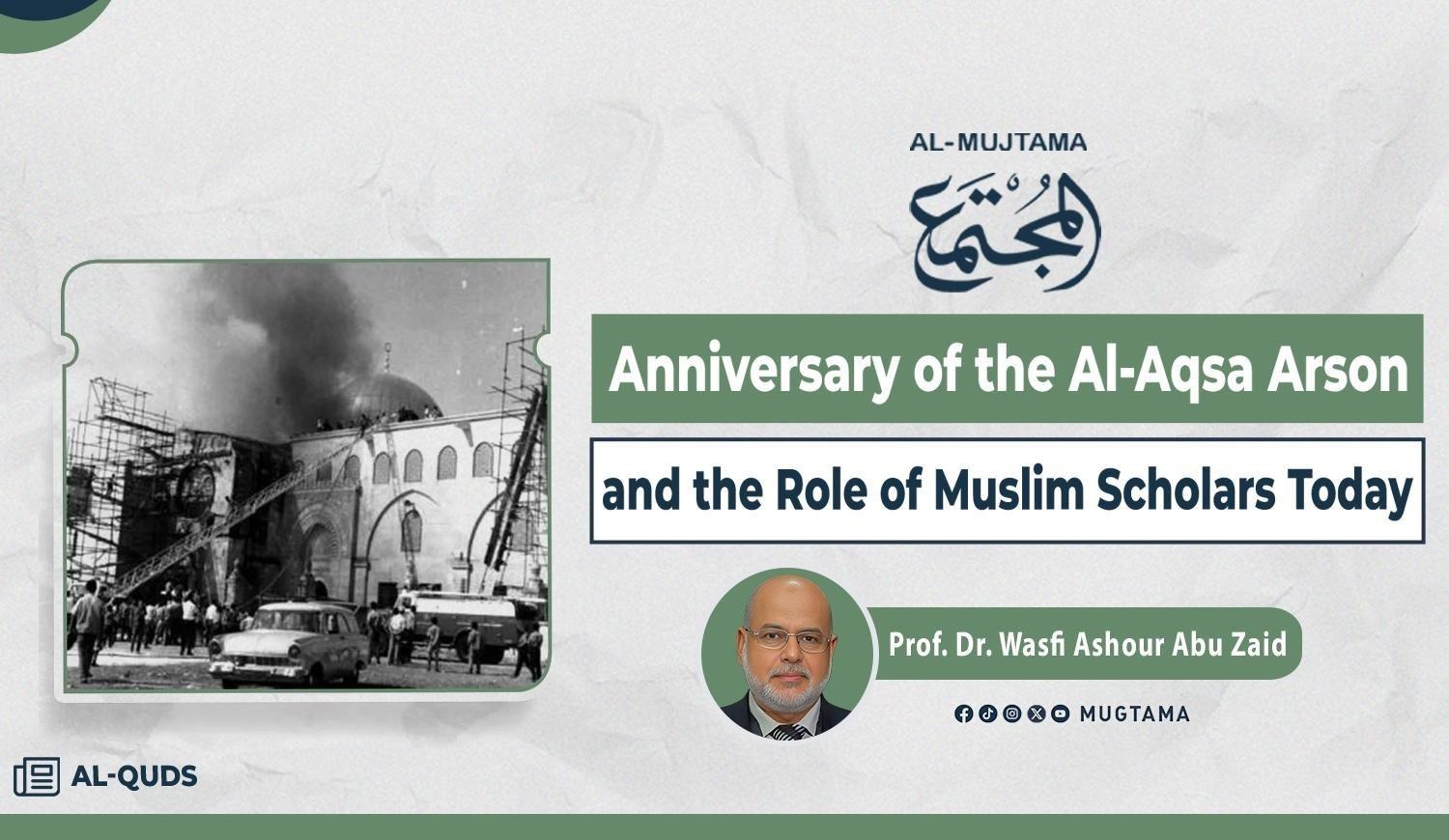
As the 57th anniversary of
the arson attack on Al-Aqsa Mosque is marked, it does not merely recall a
bygone incident, but rather evokes an early chapter in the ongoing targeting of
the holy site and its identity. On the morning of August 21, 1969—nearly two
years into the occupation of East Jerusalem—Australian national Denis Michael
Rohan entered the compound, headed toward the southern prayer hall (al-Musalla
al-Qibli), and set fire to the historic pulpit (minbar) of Saladin.
The flames quickly tore through vast sections of the mosque, destroying the
iconic pulpit and causing severe damage to the ceilings, walls, ornamentation,
and the prayer niche (mihrab). The blaze came dangerously close to
engulfing the dome, stopped only by the desperate efforts of Jerusalemites who
rushed to extinguish it.
The pulpit (minbar) of
Saladin was far more than an ancient relic; it stood as a testament to the
legacy of liberation. Commissioned years prior to the conquest of Jerusalem by
Nur al-Din Zengi specifically for Al-Aqsa, it was later installed inside the
mosque by Saladin following the city’s liberation in 1187 CE (583 AH). When the
blaze consumed it in 1969, the irony was devastating: the very symbol that
bridged the strategic vision of liberation with its actual realization was
reduced to ashes.
The perpetrator was arrested
shortly after the attack and confessed to the crime. However, his trial
concluded with him being declared mentally unfit, leading to his eventual
deportation from occupied Palestine. The arson sent shockwaves across the Muslim
world, igniting widespread protests and political outcry, and serving as a key
catalyst for convening the first Islamic Summit in Rabat in September 1969.
A Fire Not Yet Extinguished
Fifty-seven years later, the
pressing question is no longer who set fire to Al-Aqsa back then, but
rather: has that fire truly been put out?
While the flames that
consumed the woodwork were extinguished, the battle over the mosque’s identity
and status remains ablaze. Indeed, the current reality poses a far greater threat
than an overt fire. Today, the holy site faces systematic efforts to alter its
historical and legal status quo—normalizing daily incursions and religious
rituals, restricting Muslim worshippers, undermining the Islamic Waqf
authorities, and gradually turning the exception into a habit, the habit into a
reality, and that reality into an asserted right.
For this reason, the
anniversary of the blaze must not be reduced to mere mourning over a 1969
crime. Al-Aqsa demands far less commemoration and far more comprehension of how
this fire has mutated. Yesterday’s blaze was physical, consuming timber and
stone; today’s fire targets meaning, identity, collective memory, and
sovereignty. The gravest danger is that sheer normalization might numb public
consciousness—until incursions become ordinary routine, violations turn into
passing headlines, and erasing the site's identity becomes an open, debatable
question.
Al-Aqsa: A Sacred Trust upon the Muslim Ummah
First and foremost, scholars
must recognize that the bond between Al-Aqsa and the Muslim Ummah was neither
fabricated by politics nor forged by modern conflict. Rather, it is an enduring
covenant sealed by the Quran, as God Almighty states: (Glory to Him who made His servant travel by
night from the sacred place of worship to the furthest place of worship, whose
surroundings We have blessed) (Al-Isra:1)
It is divine revelation
itself that linked the Sacred Mosque to the Furthest Mosque; thus, no political
borders can sever what the Quran has united.
The prophetic tradition
firmly reinforced this sacred status. The Prophet Muhammad (peace be upon him)
declared: “Do not set out on
a journey except for three Mosques i.e. Al-Masjid-AI-Haram, the Mosque of
Allah's Messenger (peace be upon him) , and the Mosque of Al-Aqsa, (Mosque of
Jerusalem)..1
Hence, the Al-Aqsa Mosque
belongs to no single generation, no single Muslim people, and no individual
Muslim state; it remains the collective trust of the entire Ummah, passed down
through generations. While the people of Palestine and the residents of
Jerusalem stand on the front lines of its defense, their presence does not
reduce a universal Islamic mandate to an exclusively Palestinian affair. As the
Prophet Muhammad (peace be upon him) said: “The believers in their mutual kindness,
compassion and sympathy are just like one body. When one of the limbs suffers,
the whole body responds to it with wakefulness and fever.” 2
The Responsibilities of Muslim Scholars Today
At the forefront of those
entrusted with this mandate are Muslim scholars. In times of crisis, a
scholar’s role is not confined to issuing reactionary rulings in the aftermath
of an event; rather, it begins with cultivating the very consciousness through
which the Ummah perceives and understands the reality of what has transpired.
As God Almighty states: (God took a
pledge from those who were given the Scripture—‘Make it known to people; do not
conceal it)( Ali 'Imran:187)
The foremost duty of scholars
today is to decolonize the collective consciousness regarding Al-Aqsa and
reaffirm its centrality within the conscience of the Ummah. It must not be
reduced from an overarching Islamic cause into a distant political file, nor
from a sacred religious trust into a localized dispute. A scholar guards the
spiritual meaning before the physical structure, affirming to future
generations that a prolonged occupation creates no legitimacy, and that the
passage of time can never transform falsehood into truth.
The second duty is to call
things by their true names, for pivotal battles are won or lost in the arena of
language long before they are decided on the ground. Military occupation must
never be rebranded as mere 'reality,' incursions must not be diluted into 'visits,'
the forceful imposition of rituals cannot be framed as 'freedom of worship,'
nor should Judaization be trivialized as a mere 'administrative dispute.'
Altering terminology is the gateway to shifting judgments, and shifting
judgments paves the way for compromising fundamental stances.
The third duty is formulating
an active jurisprudence for Al-Aqsa—one that moves beyond reciting its virtues
to delineating the Ummah’s tangible obligations toward it. We must transition
from the 'virtues of Al-Aqsa' to the 'jurisprudence of Al-Aqsa': a legal
framework governing the protection of sacred sites, sustained support, and
resisting Judaization, alongside defining the responsibilities of governments,
institutions, and individuals. This includes the jurisprudence of education,
media advocacy, financial backing, strategic priorities, and anticipated
outcomes. Unless emotional attachment is translated into a binding duty, and
revered virtue into actionable responsibility, public sentiment will remain
purely seasonal.
Here, the higher objectives
of Islamic law clearly manifest: preserving Al-Aqsa is not merely the
safeguarding of stone, but the protection of faith, identity, collective
memory, the dignity of the Ummah, and its civilizational resolve. A
purpose-driven jurist does not wait for a fait accompli before issuing a
ruling; rather, they read early indicators and warn against impending
consequences before they become irreversible.
The fourth duty is
confronting both psychological and cognitive normalization with the continuous
assaults on Al-Aqsa. Nothing is more perilous than for daily reports of
incursions to pass by without stirring a single conscience. Therefore, scholars
must integrate the cause of Al-Aqsa into curricula, Friday sermons, academic
research, and media discourse—ensuring that desensitization and routine do not
erode the Ummah’s vigilance over its sacred sites.
The fifth duty is for
scholars to transition from seasonal reactivity to sustained institutional
action. It is no longer sufficient to issue a statement during a major
incursion or organize a seminar on the anniversary of the 1969 arson, only for
the cause to be shelved once again. What is urgently needed is an organized
scholarly apparatus that monitors ongoing developments, provides rigorous theological
and political analysis, delivers timely stances, produces scholarly curricula
and sermons, and nurtures a generation grounded in the jurisprudence of
Jerusalem, rather than mere transient sentiment.
Ultimately, a scholar's duty
is not to mourn Al-Aqsa alongside the Ummah, but to channel its sorrow into
consciousness, that consciousness into a principled ruling, that ruling into a
steadfast stance, and that stance into sustained, enduring action. As the
Prophet Muhammad (peace be upon him) declared: Whosoever of you sees an evil, let him change it
with his hand; and if he is not able to do so, then [let him change it] with
his tongue; and if he is not able to do so, then with his heart — and that is
the weakest of faith.”(33)
Therefore, on this fifty-seventh
anniversary of the arson, the question scholars must confront is not merely: 'Where
is Saladin?' Rather, the more foundational questions are: Where are the
scholars capable of cultivating the intellectual and moral climate in which a
Saladin can emerge? Where is the jurisprudence that guides and restrains power?
And where is the education that nurtures the generation of liberation?
The very history of Jerusalem
offers the definitive answer: liberation was never the solitary act of a single
commander. The Battle of Hattin was not born out of a vacuum, nor was the
victory at Ain Jalut achieved without rigorous preparation. Behind these
historic triumphs stood scholars, jurists, educators, and state administrators
who shaped collective consciousness, anchored leadership, held power
accountable to divine law, and nurtured generations. In this context, three
pivotal historical precedents demand our attention: al-Qadi al-Fadil alongside
Saladin, al-Izz ibn Abd al-Salam on the eve of Ain Jalut, and the Jerusalemite
Al Qudamah family in their scholarly and liberating mission. We revisit them
not merely to recount history, but to confront a vital question: What do
these figures say to the scholars of the Ummah today?
Scholars on the Path to Liberation
If the duty of scholars today
is to safeguard the consciousness of the Ummah, construct an active
jurisprudence for Al-Aqsa, and confront the normalization of its Judaization,
the history of Jerusalem offers living precedents proving that liberation was
never the fruit of the sword alone. The victory at Hattin did not emerge
overnight, nor was the triumph at Ain Jalut an isolated military engagement;
both were preceded by decades of scholarly revival, disciplined education,
state-building, and the cultivation of collective awareness.
For this reason, the question
so frequently echoed in times of crisis—‘Where is Saladin?’—demands a
far more foundational inquiry: Where are the scholars who cultivate the very
environment in which a Saladin can emerge? Where is the jurisprudence that
guides and restrains power, the education that nurtures the generation of
liberation, and the unifying discourse that rallies the Ummah around its
foremost cause?
God Almighty commands: (You who believe, be God’s helpers)( As-Saff,
14). The Prophet Muhammad (peace
be upon him) likewise declared: “A believer to another believer is like a building whose
different parts enforce each other.4 This
was the enduring formula behind the Ummah's greatest historical triumphs: a
profound synergy between the scholar and the warrior, the jurist and the
commander, the pen and the sword.
Al-Qadi al-Fadil: The Scholarly Mind Behind the Liberation Project
Al-Qadi al-Fadil Abd al-Rahim
al-Baysani was among the most prominent statesmen of Saladin’s court. Far from
being a mere scribe or epistolary clerk, he served as a strategic counselor,
chief administrator, and influential policy architect—one of the foundational
minds that built a state capable of confronting the Crusader enterprise.
Though physically absent from
the battlefield at Hattin—recovering from illness in Damascus when word of
victory arrived—his presence was woven into the very fabric of the campaign
that led to it: in governance, high-stakes diplomacy, mass mobilization,
anchoring leadership, and aligning political strategy with the overarching goal
of liberation.
Herein lies a profound lesson
for scholars today: being an architect of liberation does not necessitate
standing on the front lines of an army. A scholar may well operate from within
a university, a mosque, a think tank, a media organization, or a consultative
council. The true measure of their position is defined solely by how
effectively they harness their intellect, their pen, and their spheres of
influence in service of the Ummah’s vital causes.
Today, Al-Aqsa demands a
modern 'Qadi al-Fadil' across every domain: in academia directing
rigorous research, in the media shaping public discourse, in religious bodies
transforming sympathy into actionable initiatives, and within decision-making
circles anchoring raw power to justice and the public interest.
Al-Izz ibn Abd al-Salam: The Scholar’s Conscience Confronting Power
Al-Izz ibn Abd al-Salam
presents another defining model amid the existential peril of the Mongol
invasion. When Sultan Qutuz required funding to mobilize the army and proposed
levying taxes on the populace, al-Izz neither granted the ruling authority a
blank check under the pretext of 'necessity,' nor did he obstruct the military
defense under the guise of protecting public wealth.
The essence of his stance was
clear: confronting the enemy was an absolute obligation, and requisitioning
public funds was permissible in times of dire need—but only after the state
treasury had been completely exhausted, and after the Sultan and the ruling
emirs had surrendered their own personal wealth and luxuries, ensuring that
those in power bore their fair share of the burden before the common people.
This was far more than a
technical fiscal ruling; it established a foundational principle of
distributive justice in sacrifice: the ruling elite cannot demand that the
nation pay the price of liberation while hoarding its own wealth and
privileges.
In this regard, al-Izz stood
as an enduring archetype of the scholar who is neither a subservient instrument
of political authority nor an absolute adversary to it; rather, he remained an
independent theological conscience. He supported power when it aligned with
justice, rectified it when it deviated, and unequivocally rejected the
exploitation of sacred causes to justify oppression or force the vulnerable to
shoulder the costs of fateful decisions alone. As God Almighty commands: (You who believe, uphold justice and bear witness
to God)( An-Nisa:135) For a scholar does not merely
guard the legitimacy of the noble end—they rigorously safeguard the moral
legitimacy of the means used to achieve it.
The Al Qudamah Family: Scholarship, Moral Cultivation, and Struggle
The third model is the most
intimately tied to Palestine: the Jerusalemite Al Qudamah family. Displaced
from the village of Jamma'il near Nablus under the weight of Crusader
occupation, they settled in Damascus and became instrumental in cultivating the
scholarly and intellectual environment of the al-Salihiyya district.
From this lineage emerged
towering scholars, notably Muwaffaq al-Din Ibn Qudamah—author of the seminal
compendium Al-Mughni—and his brother, Abu Umar Muhammad ibn Ahmad ibn
Qudamah. Their forced exile did not devolve into a retreat from the Palestinian
cause; rather, it was transformed into a multi-generational project of
scholarship, moral cultivation, and institution-building. They established
learning centers and circles of knowledge, nurtured generations, and
subsequently joined Saladin’s campaigns and the broader endeavor to liberate
Jerusalem.
Here lies the most profound
takeaway: a family forcibly uprooted from Palestine by an occupying power
refused to let displacement write their final chapter. In exile, they built an
intellectual powerhouse; that powerhouse produced scholars; and those very
scholars returned alongside the liberation campaign.
An occupation may dispossess
people of their land, but it can never uproot the land from their consciousness
unless it colonizes their minds. Educating generations, safeguarding memory,
and forging an intellectual vanguard are not marginal cultural pursuits—they
are foundational battlegrounds of liberation itself.
A Strategic Roadmap for Scholars Today
Synthesizing these three
historical archetypes yields a definitive roadmap for the scholars of today:
1. Al-Qadi
al-Fadil exemplifies the scholar’s intellect within statecraft: strategizing,
administering, mobilizing resources, and articulating a coherent strategic
vision.
2. Al-Izz
ibn Abd al-Salam represents the scholar’s moral conscience confronting power:
championing justice, restraining oppression, and safeguarding equity in fateful
governance decisions.
3. The
Al Qudamah family embodies the institution-building educator: preserving
civilizational identity, establishing enduring institutions, nurturing human
character, and standing resilient when the hour of confrontation arrives.
These three integrated roles
remain precisely what Al-Aqsa demands today: an intellect that strategizes, a
conscience that holds power accountable, and an educator who builds.
Consequently, before asking 'Where is Saladin?', a far more responsible
and foundational question must be posed: Where is Al-Qadi al-Fadil? Where is
Al-Izz ibn Abd al-Salam? And where is the house of Al Qudamah?
Saladin was not born out of a
vacuum, nor did he liberate Jerusalem alone. Behind him stood decades of
cumulative scholarship, moral renewal, civic education, statecraft, and active
struggle. Passively awaiting a savior-commander without cultivating the
conditions that produce one is not an anticipation of history—it is an
abdication of our own responsibility in shaping it.
The Duty of Scholars Does Not End with Liberation
Even so, the responsibility
of scholars toward Al-Aqsa Mosque does not cease on the day of its liberation;
rather, that very day may mark the dawn of an entirely new phase of duty.
Liberation reclaims the land, but sustaining it demands knowledge, justice,
robust institutions, and heightened consciousness. Following the demise of the
occupation—an event near at hand, by God’s will—scholars will bear the enduring
duty of safeguarding Jerusalem’s civilizational identity, restoring what the
occupation degraded, codifying the jurisprudence governing its sanctities and
diverse inhabitants, guarding justice, and preventing triumph from devolving
into new forms of inequity. As God Almighty states: (Those who, when We establish them in the land,
keep up the prayer, pay the prescribed alms, command what is right, and forbid
what is wrong) (Al-Hajj:22) Thus, in the Quranic worldview, empowerment (Tamkeen)
is never the culmination of the journey, but rather the inception of a
weightier responsibility. Hence, the mission of scholars unfolds across three
vital phases: before liberation, cultivating its prerequisites; during
liberation, guiding its moral trajectory; and after liberation, safeguarding
its higher objectives and enduring fruits.
Perhaps the most poignant
closing reflection is that the historic pulpit of Saladin—destroyed by arson in
1969—was actually commissioned by Nur al-Din Zengi years prior to the
liberation of Jerusalem. It was as though he was crafting the very symbol of
triumph long before the triumph itself arrived. This is precisely what scholars
must do today: construct the 'pulpit of liberation' before liberation comes—in
the mind of the child, the conscience of the student, the university
curriculum, the Friday sermon, academic research, formal jurisprudence, media
discourse, and institutional policy.
If the 1969 arson consumed a
pulpit of wood, the duty of scholars today is to prevent a far more devastating
fire: the extinguishing of Al-Aqsa’s awareness within the heart of the Ummah.
Thus, the scholarly mandate toward Al-Aqsa Mosque begins by guarding its sacred
meaning prior to liberation, extends to steering the moral path of its liberation,
and endures long after liberation—because Al-Aqsa is not merely land to be
reclaimed, but a sacred trust we must remain worthy of bearing.