









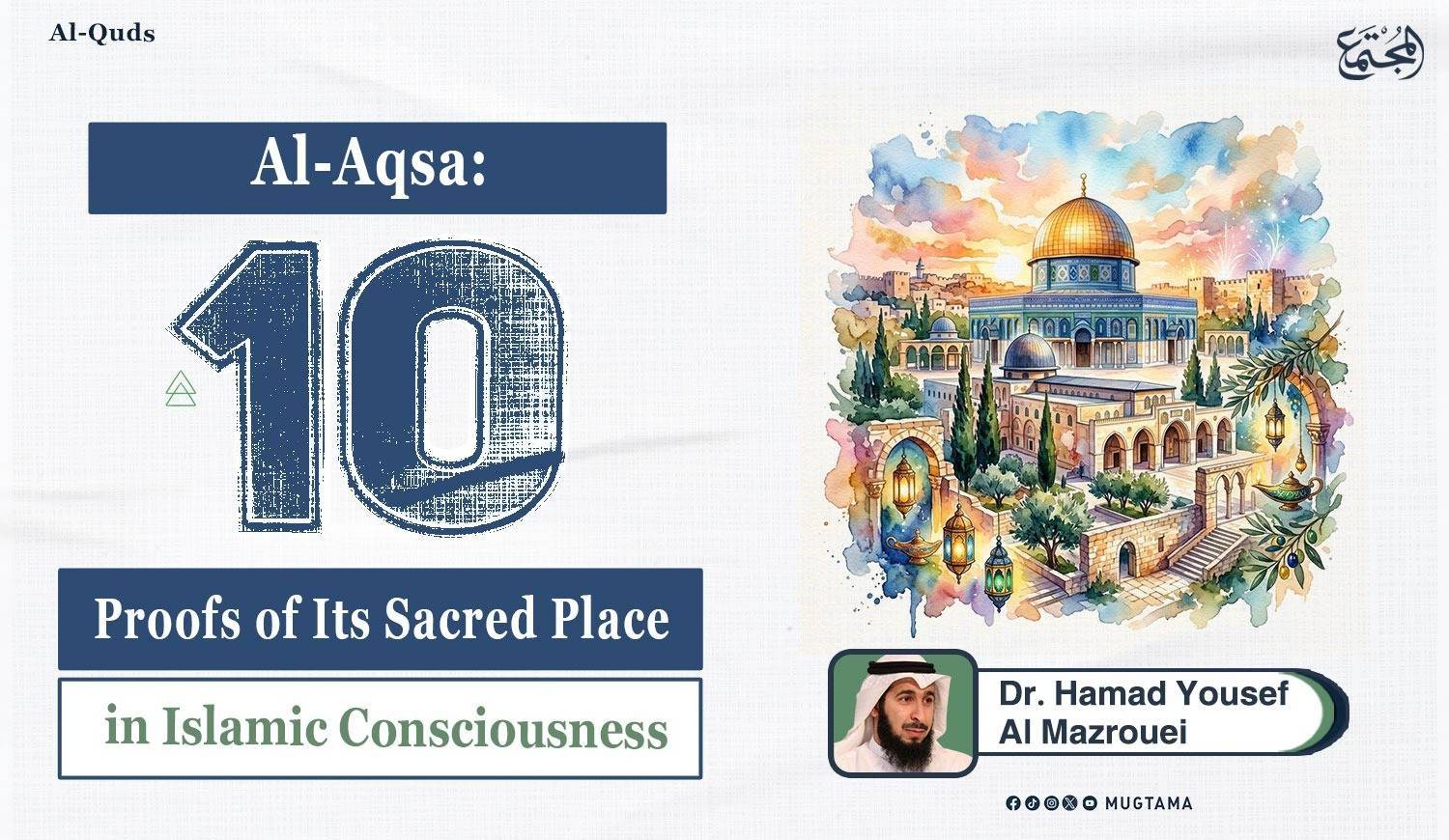
Al-Aqsa: 10 Proofs of Its Sacred Place in Islamic Consciousness
While the Grand Mosque in
Mecca stands as Islam’s holiest sanctuary, the direction of prayer, and the
anchor of Muslim devotion worldwide, Al-Aqsa Mosque commands a singular
place in Islamic faith and memory. It is the first Qibla, the third of the holy
sites to which pilgrimage is called, and the destination of the Prophet’s
Miraculous Night Journey. For Muslims, this bond transcends mere history and
geography; it is rooted in theology, an enduring duty woven into the soul of
the Ummah that defies the passage of time and rejects compromise. It is through
this lens that ten defining truths emerge, revealing why Al-Aqsa remains an
unyielding cause at the very heart of the Muslim world.
1. A Sanctity Chosen by God
The foremost bond tying us to Al-Aqsa Mosque
is grounded in Divine Will and sacred selection. God chose this mosque and this
blessed land as a cradle of revelation and a sanctuary for divine messages,
bestowing upon it a sanctity that transcends the bounds of time and space. As
the Quran states (Glory to Him who made His servant
travel by night from the sacred place of worship to the furthest place of
worship, whose surroundings We have blessed ((Al-Isra: 1)
This is where the connection
takes root: conceived in divine text before historical record, and authored by
revelation before physical terrain.
2. The Confluence of Faith and Prophethood
During the Miraculous Night Journey and Ascension (Al-Isra and Al-Mir’aj), the profound depth of
this theological bond was powerfully revealed. There, the Almighty gathered all
His prophets and messengers behind the Seal of the Prophets, our Prophet Muhammad (peace be upon him), to lead them in prayer at Al-Aqsa Mosque.
This prayer was no passing moment; it stood as a profound proclamation marking
the transfer of stewardship over this blessed sanctuary—and the banner of pure
monotheism it represents—from earlier nations to the final Ummah of Islam.
3. A Sanctuary Whose
Surroundings God Blessed
The Quran did not merely
describe Al-Aqsa as a solitary monument; rather, God proclaimed it as the
sanctuary "whose surroundings (We have blessed.) This is a land indelibly linked to divine grace in the holy text—a
sacred ground that embraced the footsteps of countless prophets and messengers,
and set the stage for some of the Quran’s most momentous narratives. Attachment
to Al-Aqsa, therefore, is not born of passing sentiment, but is anchored in a
legacy steeped in scripture and timeless history.
4. The Heritage of the Muslim Ummah
When God sealed all divine messages with that
of Muhammad (peace be upon him), his Ummah inherited the legacy of the prophets
in faith, monotheism, and the call to the Divine. It is from this succession
that the Muslim bond with Al-Aqsa Mosque was forged, standing as one of the
most prominent monuments of that sacred inheritance. It is a sanctuary where
the prophets bowed in prayer, the direction toward which Muslims first turned
their faces in worship, and one of only three mosques to which pilgrimage is
ordained.
The Prophet (peace be upon him) said: (Do not undertake a journey except to three mosques: the Sacred
Mosque (Al-Masjid Al-Haram), the Mosque of the Messenger, and Al-Aqsa Mosque)(Narrated by Al-Bukhari). It is an
intrinsic part of the Ummah's heritage, and preserving this trust is a
responsibility that must never fade from the conscience of generations.
5. The Prophet’s Sacred Trust
Al-Aqsa Mosque is inextricably bound to the
life and mission of the Prophet (peace be upon him). It stood at the heart of
the miraculous Night Journey and Ascension (Al-Isra and Al-Mi'raj); thus,
cherishing Al-Aqsa and defending its sanctity is fundamentally an act of
fidelity to what the Messenger of God revered, and a veneration of that which
divine law holds sacred.
Such a trust cannot be honored through
slogans alone. It is safeguarded by enshrining its reverence in people's
hearts, educating generations about the true nature of the cause, and standing
up for justice through all legitimate and accessible means.
6. The Legacy of Umar’s Covenant
When Muslims entered Jerusalem during the
reign of the Rightly Guided Caliph, Umar ibn al-Khattab (may God be pleased
with him), Umar walked in with profound humility—affirming the gravity of the
responsibility and the sacred trust the Ummah had shouldered toward this holy
land.
That era etched an enduring blueprint for how
sacred places should be stewarded: anchored in justice, mercy, and the
protection of rights, far removed from the impulses of vengeance and tyranny.
Thus, Al-Aqsa Mosque is no mere relic of
history; it is an inheritance passed down through generations, carried in the
collective mind and conscience of the Ummah—a living covenant renewed in the
trust of every Muslim.
7. A Compass in the Battle Between Truth and Falsehood
In times of adversity and fierce struggle
between truth and falsehood, Al-Aqsa Mosque stands as a discerning compass that
lays bare the reality of souls and sifts through the ranks. Through it, the
vile is distinguished from the pure, and the sincere believer from the
hypocrite.
When the hearts of believers are overwhelmed
with joy at the steadfastness and victories of the defenders and stationed
guardians (Murabitun), the hallmarks of genuine faith are
reaffirmed—standing in stark contrast to the weakness and betrayal that expose
the true nature of the hesitant.
8. A Barometer of the Muslim
World’s Dignity
Living nations do not surrender their sacred
sanctuaries, nor do they allow their memory to be erased or their ties to
history severed. In this enduring light, Al-Aqsa Mosque stands as a defining
test of the Ummah's consciousness.
The true stature of a civilization is never
measured solely by its material power, but by its resolve to preserve its
identity, hold fast to its core values, and fulfill its moral and
civilizational responsibilities. It is in direct proportion to how fiercely a
nation champions its foundational causes that its true weight and dignity among
nations are forged.
9. The Measure of the Ummah’s Moral Excellence
In sacred texts, the land of the Levant is
adorned with countless virtues and distinct honors. Numerous prophetic
traditions extol its spiritual stature and its people, foremost among them the
renowned hadith: "If the people of the Levant
fall into corruption, then there is no good left in you" (Narrated by Al-Tirmidhi with an authentic chain).
Hence, the moral excellence of the Islamic
Ummah is inextricably tethered to Al-Aqsa Mosque and the broader land of the
Levant. Guarding this sanctuary is, in truth, safeguarding the very soul and
virtue of the entire Ummah. Whatever trials befall this land and its people can
never be treated with indifference; they must remain at the forefront of every
Muslim’s conscience—commanding their active awareness, earnest prayers, and
unwavering support for justice through all legitimate avenues.
10. The Cause of the Ummah, the Duty of Every Muslim
In light of these profound truths, the true
stature of Al-Aqsa Mosque emerges in full clarity: a pan-Islamic cause anchored
in the Quran, sanctified by the Miraculous Night Journey, revered as the first
Qibla, consecrated by the congregation of all prophets, elevated among the
three holiest sanctuaries, and eternally woven into the history and living
heritage of the Ummah.
Al-Aqsa is not a regional dispute, the burden
of a single generation, or a fleeting historical episode. It is an immovable
pillar of the Islamic conscience—a moral and theological covenant safeguarding
the Ummah's core identity.
When a Muslim
awakens to this duty toward Al-Aqsa and the land of Palestine, they realize
that defending it transcends passing political stances. It is an act of fidelity
to one's creed, a safeguarding of historical memory, an adherence to the
Prophet’s legacy, and the fulfillment of a sacred trust toward the Ummah’s holy
sites. Ultimately, as long as Al-Aqsa remains alive in our collective awareness
and shared concerns, the Ummah will remain vibrant, resilient, and unyielding
in safeguarding its trusts and defending its identity.
