


Muslims Beyond Memory (5)
China and Turkestan Muslims Under Communist Yoke


The Muslims of China and Turkestan (East and West) are distributed across Chinese and Soviet territories before the dissolution of the Soviet Union, and in adjacent and nearby areas. They exist in multiple population components and gatherings that collectively represent a significant Islamic geographical, demographic, economic, and social weight, totaling more than 138 million people according to the 2022 census. Had Turkestan remained united without division, it would have become a major power with great influence in international politics and the global economy, making Muslims in the world a major power rivaling the United States, the old Soviet Union, and current China. However, the communist Soviet Union and China hijacked this power and divided it after uniting against it, launching successive colonial campaigns on its lands. This resulted in China and the Soviet Union—before the dissolution—partitioning these Muslim lands after tearing them into two parts: East Turkestan, which fell into the grip of China, and West Turkestan, which the Soviet Union occupied and tore into five states: Kazakhstan, Uzbekistan, Turkmenistan, Kyrgyzstan, and Tajikistan—currently called the Central Asian states—to which are added the adjacent areas such as Hong Kong and Taiwan.
Thus, the communist empire, represented by China and
the Soviet Union, was able to devour these Islamic lands since ancient times,
including their huge wealth, strong economy, and large population mass. They
made them fuel for building their new empire and practiced fierce and
continuous campaigns of oppression, killing, fragmentation, assimilation, and
displacement within the Soviet empire and within Chinese territories to weaken
them and make them suitable only for serving the construction of the Chinese state
and the Soviet empire, without enabling them to build any self-power or a
unified independent state that looks after their interests. Instead, they
turned them into a broken-winged minority, huddling them into forced labor
after depriving them of education, economic ownership, and any tools for
state-building.
I will analyze the conditions of these forgotten Muslims in these countries, and in this article, I will address their
affairs and conditions inside Chinese territories and in East Turkestan, which
is under Chinese occupation. In a future article—God willing—we will analyze
the conditions of Muslims in West Turkestan (Central Asian states).
East Turkestan...
Looking at the map of China and inside Chinese
territories, we find that there is a large Muslim component whose population
reaches eight million people, born and raised inside China and holding its
nationality. The great media figure Dr. Abdul Qadir Tash—may God have
mercy on him—founder of the Iqraa channel and former editor-in-chief of Al-Muslimoon
newspaper, drew our attention to the fact that the file dedicated by International
Politics magazine, published by the Egyptian Al-Ahram Foundation, issue
(April 1998), titled: "China: Problems of Transition and Consequences of
Reform," addressed an integrated axis on religious minorities in China,
especially regarding the reality and future of Muslims. This axis included two
articles, one by Mr. Ahmed Menisi, in which he talked about attempts to search
for identity among religious minorities inside China, saying: "The
Muslims in China belong to three races: a race with Arab blood, another race in
whose veins Uyghur blood flows, and a third race in which Mongol blood flows,
and these races include ten ethnicities."
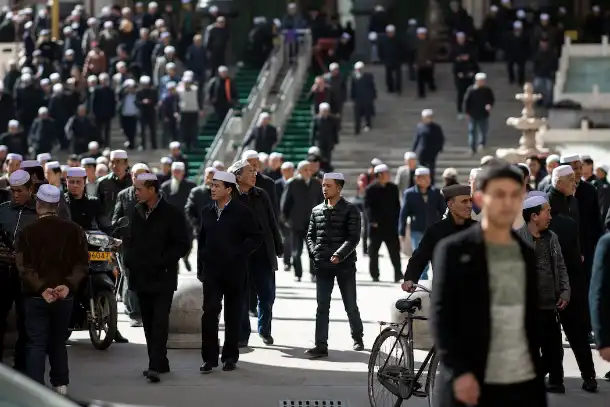
The Chinese Muslims who grew up inside China and lived
on its land belong to the "Hui" or "Khui" ethnicity, which
is of Chinese origin, and their number is estimated at more than eight million.
These people strongly resisted the movement of fusion, or rather the
"forced melting" movement into the Chinese national state, out of
adherence to their religion and civilizational specificity, and they always
distinguished themselves—as Muslims—from others of their own kind. There is a
second gathering of Muslims whose country was forcibly annexed to China, who
are the people of "East Turkestan" and other Muslim peoples
whose countries were occupied and forcibly annexed to the Chinese map.
The Arrival of Islam
Mr. Menisi pointed out that Islam reached China via two
axes: the first is a land axis that came from the west, represented by the
conquest of East Turkestan adjacent to China's western borders, and the second
is a sea axis that transported Islam to eastern China via the journeys of
Muslim traders. He said: the first Muslim envoy reached China in the year 31
AH, during the reign of Caliph Uthman ibn Affan—may God be pleased with
him—then Islamic missions followed, reaching twenty-eight missions during 53
years, in the period between 31 and 184 AH.
Since the arrival of Islam in China in 651 AD, it was
exposed to waves of ups and downs in the era of the Tang Dynasty, then began to
spread slowly in the era of the Song Dynasty, which became extinct in 1267 AD.
Then Islam grew stronger and flourished in the era of the Yuan Dynasty, or what
is called the era of Mongol rule, in the period from 1277 AD to 1367 AD. It is
enough to know that some documented sources, such as the book Jami'
al-Tawarikh by Rashid al-Din Fadlullah, mentioned that eight provinces out
of twelve provinces in China in that era had Muslim rulers, in contrast to the
Minister of Finance who was called Shams al-Din, nicknamed "Al-Sayyid
al-Ajal," and the Minister of War, Ali Yahya the Uyghur.
But the renaissance witnessed by Islam in that era had
many of its fruits dissipated in the following era, the Manchu era. With the
outbreak of the National Revolution in 1911 and the founding of modern China,
Muslims enjoyed freedom to practice their religious rituals and participated in
the war for the unification of China. But with the beginning of communist rule,
Muslims were subjected to new waves of persecution because of communism's known
position on religion, and this state of suppression continued until
approximately the late 1970s, then the era of openness began, and Muslims
breathed a sigh of relief.
The First Mosque in China
The first mosque for Muslims was established there in
742 AD, in the city of "Chang'an," the capital of China at the time.
The number of mosques increased until it reached about 23,000 mosques today,
including 55 mosques in the capital, Beijing.
Ahmed Menisi touched upon the conditions of Muslims in
the regions neighboring China, addressing the Muslim minority in both Taiwan
and Hong Kong, saying: Islam reached Taiwan recently when 20,000 Muslims
migrated to it from communist China in 1949. The number of Muslims there
increased until it reached more than 50,000. The Muslims of Taiwan enjoyed a
better status compared to their brothers in China and contributed to the
management of political life in Taiwan through membership in legislative
councils, the Council of Ministers, and the army.
There is a third gathering of Muslims in this region on
the island of Hong Kong, which returned to Chinese sovereignty, and
which Islam reached early in the first Hijri century through communication with
neighboring Islamic components. The migration of Muslims to the region
continued, as Muslims migrated to it from the East Indies and Malaya. Hong Kong
was also a refuge for Chinese Muslims who fled there from communist oppression.
The number of Muslims on the island is about 35,000, and several Islamic
associations look after their affairs.
The Islamic presence in China is not limited to the
Chinese ethnicity; there are other ethnicities that do not belong racially to
the Chinese race, inhabiting the East Turkestan region, which was forcibly
annexed to the Chinese state. Many Turkic ethnicities live there, headed by the
Uyghur ethnicity, then the Kazakhs, Kyrgyz, Uzbeks, Tajiks, and Tatars.
West Turkestan
There is another gathering of Turkic Muslims
concentrated in West Turkestan, which became known as Central Asia. International
Politics magazine dedicated an excellent article in the same file to talk
about "The Sino-Turkestan Conflict and the Future of East Turkestan,"
written by Professor Dr. Muhammad Harb, Professor of Turkish Studies at Turkish
universities, who is a specialized researcher in this field. He confirms that
East Turkestan is a "Turkish state occupied by People's China in the
eighteenth century AD and forcibly named Xinjiang, a Chinese word meaning the
'New Colony,' by an official decree that stipulated converting it into a
Chinese province on November 14, 1884."
Dr. Harb analyzes the issue of the conflict between
China and Turkestan since the first Chinese invasion of Turkestan lands in
1759, which lasted about a full century, until the Turkestani people
were able to win the independence of their country in 1865. Ten years later,
China returned and occupied East Turkestan, but the Turkestanis were able once
again to expel Chinese forces from their country in 1933. However, the
ambitions of the large neighbor Russia (the time of the Soviet Union:
1917-1991) led to the fall of Turkestan under Russian occupation one year after
independence.
During World War II, Russia weakened, so China
seized the opportunity and occupied Turkestan again. In 1944, a massive
revolution broke out, ending with the declaration of independence. Then Russia
and China, both having communist orientation and ideology, allied and toppled
the independence government. In 1949, Chinese communist forces swept through
the lands of East Turkestan, and those lands remain in their grip to this day.
Dr. Muhammad Harb examined the terrible "Sinicization" plan
implemented by China there, aimed at settling tens of millions of Chinese in
the East Turkestan region to erase its Islamic identity and convert it into a
Chinese province by force.
Campaigns of Oppression and Arrest
If the Muslims of China who live on its lands enjoy
some freedom today in practicing their religious rituals, the Muslims of East
Turkestan suffer from persecution that has intensified under communist rule in
recent years, due to China's fears of the growing independence tendency among
Muslims in general there. Therefore, the Chinese communist authorities impose
an iron cordon on East Turkestan, and inside this large cordon, they launch
wide campaigns of oppression and arrest against Muslims there, to bring back to
memory—according to what researcher Muhammad Awad says in an article about
"The Roots of Chinese Persecution of the Muslims of East Turkestan"—a
bitter history lived and still lived by this province inhabited by a Muslim
majority and groaning under Chinese occupation.
The Chinese regime's refusal to allow Muslims to
perform their religious rituals on their Eid day was one of the clearest forms
of persecution. When Muslims tried to perform the rituals of Eid al-Adha,
the Chinese authorities responded by using force to prevent them and killed
more than three hundred Muslims—according to local estimates—and arrested
thousands of them, leading them to unknown locations. They cut off telephone
communications between East Turkestan and the outside world, imposed a complete
siege on the main city of Binying, and imposed a curfew on several other
cities.
These repeated brutal practices by the Chinese
authorities against Muslims have attracted the world's attention, and a file of
folded pages of these people's struggle for independence has been opened, which
has lasted seventy-six years since the Chinese communist forces swept
their country in 1949. During this time, the Muslim Turkestani people have
suffered—and still suffer—hideous persecution at the hands of the Chinese
authorities, during which hundreds of thousands of citizens were martyred and
as many were forcibly uprooted from their villages and cities, where they were
forcibly settled in camps similar to detention camps distributed across various
Chinese provinces. Perhaps what confirms the existence of a permanent state of
actual war in East Turkestan is the continued deployment of about 400,000
soldiers by the Chinese authorities in this province until today.
East Turkestan, which entered Islam in the era of Caliph Abd al-Malik ibn Marwan (86 AH
– 705 AD), after which the Turks entered Islam individually and in groups in
the fourth century AH (tenth century AD), is considered the largest province of
China, with an area of approximately one million and seven hundred thousand
square kilometers. It is thus three times the area of France, larger than the
area of Turkey by two and a half times, larger than the area of Indonesia by
twice, and represents one-fifth of the area of China and its colonies. Its
population is about 50 million, 60% of whom are Muslims, most belonging to the
Uyghur tribe of Turkic origin. The Chinese occupier named it
"Xinjiang," meaning the new colony.
East Turkestan is a country rich in its geographical
location and natural resources; its oil reserves rival the Middle Eastern
countries, and the best types of uranium in the world are extracted from six
mines in Turkestan, representing the backbone of the economy of People's China
and the backbone of its heavy and military industries. This notable wealth of
natural resources increased the intensity of Chinese-Russian competition in
pursuit by both countries to occupy this Muslim province.
Sinicization of East Turkestan
China occupied East Turkestan in 1759, and Chinese
forces killed about one million Muslims at that time. Since that date, China
followed a settlement policy in East Turkestan known as the "Sinicization
of East Turkestan" policy. Many Islamic liberation wars broke out, leading
to the country's independence in 1865, but it did not gain international
recognition, which prompted China to occupy it a second time in 1875. The
liberation wars continued until the independence of Turkestan was announced in
1933, but Russia quickly toppled this Islamic republic one year after its
establishment, occupying it in 1934. As a result of the German advance into
Soviet territory during World War II, the Russian occupation of the country was
replaced by Chinese occupation again. Then a liberation revolution broke out
led by the religious scholar "Ali Khan" in 1944, who declared the
independence of East Turkestan. Russia and China allied to thwart this
independence, and the Russians and their agents kidnapped the leader of this Islamic
revolution. Both China and Russia forced the Turkestani nationalists to accept
a peace with China in exchange for recognizing their rights to establish a
government of nationalists, but China turned back on its promises, broke the
covenant, and launched persecution campaigns against the people of East
Turkestan.
Then the Chinese communist forces swept through East
Turkestan in 1949 and occupied it after terrible massacres. It was the fate of
the Muslims of East Turkestan that they fell between two great powers (Russia
and China), which led to suffering that lasted for two centuries, ending with
the occupation of their land and the attempt to dissolve their Islamic identity
in a human ocean trying to swallow them. This prompted hundreds of thousands of
East Turkestan Muslims to migrate to Turkey, Saudi Arabia, and other Islamic
countries escaping from hideous communist persecution.
Following its last occupation of Turkestan, China began
bringing in Chinese immigrants in huge numbers and settling them there so that
the people of East Turkestan would become a minority while being the owners of
the land amidst a strange and incoming Chinese communist majority. The Chinese
enslaved the Muslim people, abolished private property and religious
institutions, and demolished their buildings. They took mosques as clubs and
cafes for the occupation soldiers, and used some as cinemas and theaters. They
forced Muslims to raise pigs, intermarry with the Chinese, and abolished the
teaching of the Arabic language and Islamic history from the curricula of
schools and higher institutes, replacing them with Chinese history and the
Chinese language with the aim of killing the spirit of Islam in souls. It can
be said that the Cultural Revolution in China was only established to destroy
everything that contradicts communist culture in souls and to declare that
Islam is outside the law and anyone caught practicing it is punished. This is
part of a broad atheistic plan to impose communism maliciously.
Despite this, the revolutions carried out by Muslims in
East Turkestan and the war of self-defense, religion, and identity launched by
the people of East Turkestan from the mountains against the Chinese forces were
carried out in the name of Islam. Also, the martyrs who fell by the bullets of
the communist forces fell while they were saying "Allahu Akbar." The
uprisings of the people of East Turkestan are many and varied, during which
this Muslim people offered thousands of martyrs annually, although China works
to hide news of these uprisings from the world.
Religious Persecution of Muslims
One of the most important manifestations of the Chinese
authorities' persecution of the Muslims of Turkestan is the complete ban on
Islamic education in mosques. The Chinese communist authorities took strict
written pledges from the imams of mosques not to gather Muslim children and
teach them the sciences of Islam in mosques. Also, there is not a single
Islamic school for teaching girls the sciences of Islam in all of East
Turkestan, where about 30 million Muslims reside. The Chinese government
prevents the building of mosques or the raising of the Adhan from loudspeakers.
Furthermore, printing Islamic books and bringing them into East Turkestan is
prohibited, as is publishing Islamic articles in newspapers or broadcasting
them on radio and television. Moreover, Muslims do not own an Islamic newspaper
or magazine that expresses them.
Muslim Lands for Nuclear Tests
The Chinese authorities use all brutal measures
unparalleled in the history of humanity to fight the increase in the number of
Muslims, such as burying fetuses and killing mothers. Families that do not
adhere to the birth control system are subject to penalties signed by President
Timur—President of East Turkestan—in April 1992, which stipulate paying a
financial fine equivalent to between (200 – 2000 dollars) annually. At the same
time, the Chinese authorities seek to settle two hundred million Chinese in East
Turkestan during the coming years.
The government of China conducts its nuclear tests of
various forms and for more than three decades in East Turkestan despite the
appeals made by countries and international organizations to stop these
explosions. Since October 1964, China has been conducting its nuclear tests in
the "Lop Nur" region, which is about 800 kilometers away from Urumqi,
the capital of East Turkestan. China had started its nuclear explosions in the
air and then stopped after the number of these explosions reached 22 aerial
explosions in October 1980, then turned to conducting nuclear explosions
underground and has carried out more than 25 explosions so far, despite what
these nuclear explosions cause in spreading nuclear pollution that harms
humans, animals, and the environment on a large scale and for a longer time.
These explosions led to a large number of people being
afflicted with cancerous diseases such as liver, lung, and skin cancer. Despite
the Chinese government's pledges to adhere to the preventive measures followed
by other nuclear countries in their tests, a secret report submitted to the
head of the East Turkestan government "Timur Dawamat" in 1988
confirmed the birth of twenty thousand deformed children, and that most
diseases are a direct result of nuclear radiation dust. The World Health Organization
also attributed in its 1988 report the death of 3961 people to an unknown
disease in some cities of East Turkestan, and local reports state the outbreak
of a strange disease among children that led to the death of hundreds of them
in 1993.
Cultural and Social Sinicization
Chinese communist rule did not leave a corner of
thought and culture without working to direct it to serve its colonial goals
and its communist and atheistic principles aimed at dissolving the Islamic
identity. Articles and books praise the figures of the Chinese government
regardless of their positions and tyranny against the Muslims of East
Turkestan. Media devices focus on calling Muslims to practice Chinese Buddhist
social traditions, such as participating in drinking alcohol, eating pork, and
mixing under the pretext of the friendship of peoples and their agreement and
union. They encourage mixed marriage between Muslim men and Buddhist women, and
Muslim women with Buddhist men, and provide financial and functional rewards
for them, and consider any criticism of such marriage—despite Islam's
prohibition of it—a hostile position toward the Chinese, calling for stirring
up sedition and unrest against Chinese rule. Whoever stands against this
marriage, their fate is prison, whoever they may be.
Spread of Ignorance, Unemployment, and Poverty
At the time when the government of People's China
raised the slogan of modernizing the economy of East Turkestan with the aim of
exploiting its natural resources for other than the benefit of its Muslim sons,
it displaces thousands of Chinese youths under the name of experts and
technicians to replace them in all works and jobs. In fact, the government has
begun to practice force and coercion to lay off Muslim youth from their jobs to
be replaced by Chinese. Thus, the means of production became in the hands of
the Chinese.
There is no doubt that the deliberate deprivation of
Muslims of work and production led to increased poverty among Muslims, as the
income of a Muslim individual does not exceed the equivalent of 128 dollars a
year, while the average income of a Chinese individual reaches the equivalent
of 470 dollars. The situation has worsened with the Chinese control over the
centers of government and administration in East Turkestan, and the Turkestani
citizens no longer own anything of the affairs of their country and society;
the Chinese immigrant, whatever his status, is the one who takes over the
management of matters.
Perhaps all these measures confirm that the saying of
autonomy enjoyed by the Uyghur Muslims in East Turkestan is a false claim. The
truth is that the immigrant Buddhist Chinese are the ones who control all parts
of East Turkestan. What the Chinese government plans—to displace two hundred
million Chinese to East Turkestan as stated by Hu Yaobang, former Secretary of
the Chinese Communist Party—confirms the extent of its desire for complete
control over East Turkestan and erasing any Islamic trace in it. Indeed,
Chinese policy aims to erase and obliterate Turkestani names by distortion or
giving them Chinese names so that these Chinese names gradually take over and
Turkestani names disappear. Also, changing the names of streets, neighborhoods,
and squares to Chinese names, and banning the use of the word
"Turkestan" absolutely; anyone who utters it is punished with
imprisonment because the Chinese communist rule claims that East Turkestan had
no name other than (Xi) meaning the Western lands, and emphasizing the use of
the name (Xinjiang) meaning the New Lands. Meanwhile, the Turkestanis consider
the name "Turkestan" a national symbol and a nationalist name for
their country, and what is imposed on them is a Chinese colonial name.
Despite what the Muslims in Turkestan in both its parts
suffer from hardship, persecution, and deprivation of rights, they have
provided the Ummah and the whole world with unique scholars in all fields whose
like is rare, such as: Al-Bukhari, Al-Tirmidhi, Al-Bayhaqi, Al-Farabi, Ibn
Sina, Muhammad ibn Musa al-Khwarizmi, Abu al-Rayhan al-Biruni, Al-Zamakhshari,
Abu al-Layth al-Samarqandi, Abu Mansur al-Maturidi, Muhammad ibn al-Husayn
al-Fariqi known as Ibn Nubata, the Imam and preacher Ahmad Yasawi, the ascetic
Imam and Muhaddith Abdullah ibn al-Mubarak and his compatriot Fudayl ibn Iyad,
the Imam and Muhaddith Sufyan al-Thawri, and countless others who served
Islamic civilization and became among its great figures.
It is strange that despite all this persecution
practiced by China against the Muslims of East Turkestan, many countries of the
Islamic world still maintain good relations with China without paying attention
to what is happening in East Turkestan and believing the Chinese narrative
regarding the persecution of Muslims. There is no power or might except by God.
Writer's Mail: shaban2012 @gmail.com
Read also: