



Muslims Behind Memory (1) Series on Forgotten Muslims Worldwide
The Term “Muslim Minorities” … How Did It Emerge?


At the beginning, these minorities were in fact majorities in most of their lands, living in independent sovereign states, and they experienced successful Islamic rule that lasted for centuries. For example, the Champa State established by Muslims in southern Vietnam endured for four centuries. This success terrified the major powers of the time and stirred fears both in the West and the East alike—the global church, the United States of America, the Soviet Union, Japan, the Hindus, and others from all religions hostile to Islam. They set aside their disputes and conflicts and united—in one of history’s rare moments—despite their differing beliefs and orientations, in a single alliance to eliminate what they considered an “Islamic danger.” These states forgot their rivalries and formed an evil coalition against Islam, determined to topple Islamic states wherever they existed and erase them from existence, especially since these states had lived through successful Islamic governance for centuries.
Indeed, this
malicious international alliance succeeded in overthrowing these Islamic
states, dismantling them, dividing their lands, fragmenting them, and
scattering their peoples into neighboring countries. They became small entities
emptied of their Muslim
majorities, who fled with their faith from the persecution and
massacres of the new anti-Islamic rulers. Those who remained became minorities,
clinging to their religion and their land, but suffering horrors under the new
rule. From here began the ordeal of what came to be called “Muslim minorities.”
Needless to say, this term had never existed in the Muslim lexicon before; it
only appeared in the 1990s when these minorities took shape under the following
circumstances:
1.
After the native populations embraced
Islam.
When Muslims,
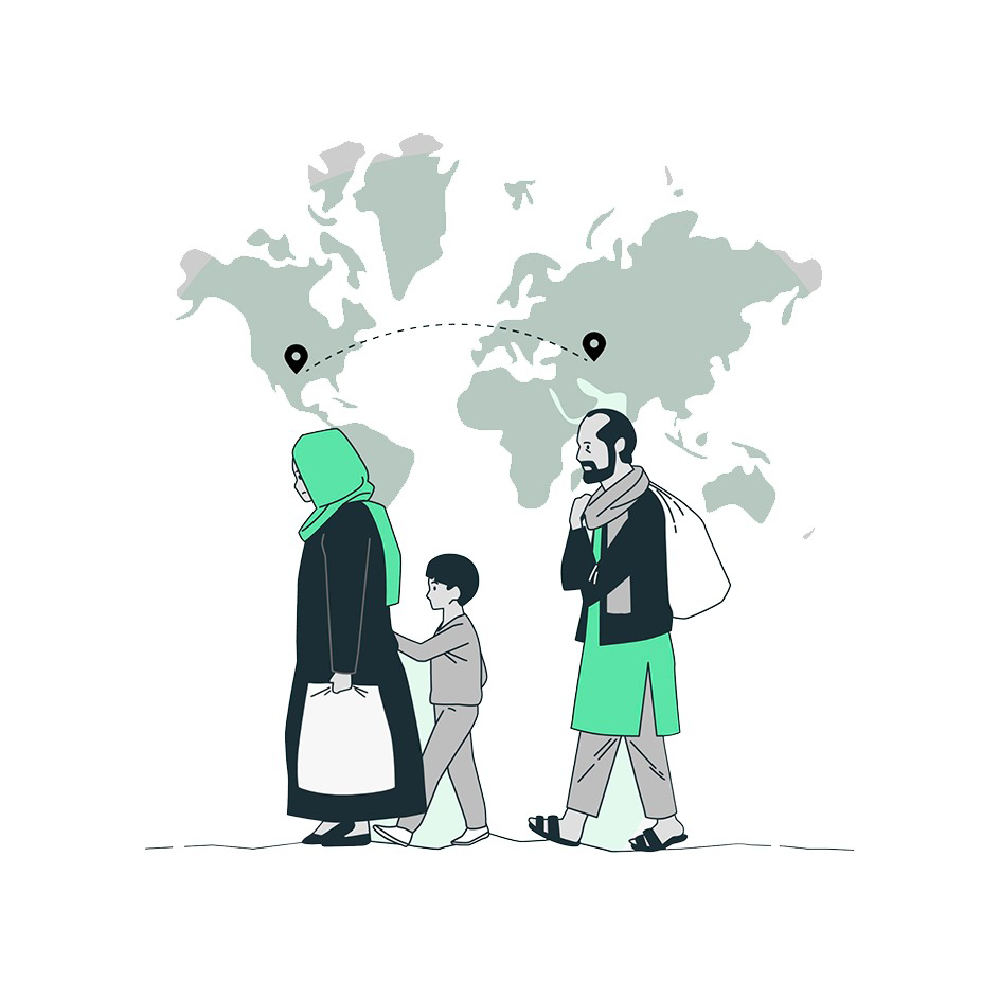
under pressure, repression, and occupation, migrated from their homelands to
non-Muslim lands in order to preserve their faith—especially to Europe,
America, Canada, and Australia—arriving with their culture, civilization,
customs, and traditions, only to find themselves in societies with different
religions, languages, cultures, and lifestyles.
2.
When Muslim lands were occupied by
non-Muslim states, their peoples became minorities under the control of the
occupiers.
Thus, Muslim
minorities were formed in various ways as mentioned.
Today, these Muslim
minorities scattered across the world are subjected to continuous
campaigns of restriction, persecution, killing, and mass expulsion. Many have
been forced to disperse across different countries, living in a state of
diaspora in search of safe refuge and stable life. Those who remain—a small
few—have stayed rooted in their lands but remain weakened, suffering poverty,
disease, and deprivation of rights amidst non-Muslim majorities. Yet they
continue to hold fast to their faith, cling to their land and homes—even to this
day—offering sacrifices that would turn the hair of children gray. Still, the flame
of hope has not been extinguished within them for establishing an independent
state in a free homeland.
By virtue of my
journalistic work since 1985, and through my continuous reporting journeys
spanning more than thirty years across the world, I have been able to visit the
regions and entities of most of these minorities, meet their peoples, examine
their conditions, learn about their ideas and intellectual projects, live their
suffering, and listen to their aspirations and pains. This has obliged me to
convey all of this to the Muslim reader everywhere, through Egyptian and Arab
newspapers whose pages I am honored to write on—fulfilling a trust and
informing people of the condition of their brothers who live holding fast to
the embers of their creed without compromising or relinquishing it.
Before embarking
on these articles, the series “Muslims Behind Memory” had already begun,
covering nine Muslim minorities under the sponsorship of the Insan Center for Human
Studies,
which I was honored to establish in Istanbul in 2015.
Faced with the
scarcity of documented information, I encountered great difficulties in
producing this series—due to weak reliable sources on one hand, and
manipulation or even falsification of statistics on the other by Western and
other entities seeking to bury this issue and consign it to oblivion, so that
its rights are lost and its memory erased, in line with the designs of colonial
powers and enemies
of Islam.
With God’s help
and will, I will continue writing and publishing more works and books about
Muslim minorities spread across the seven continents of the world (considering
the Arctic region as a separate continent with its own Muslim minority). I
extend thanks and gratitude to my teacher, Professor Dr. Muhammad Harb,
Professor of Ottoman Studies at Sabahattin Zaim University in Turkey, who drew
my attention to this issue—as he did for others—through his writings in the
late 1970s, while I was still a university student diligently following his
work on this matter. Today, I am honored to remain in contact with him in
Istanbul regarding this important issue.
And so… This is
our story of Muslim minorities, which we shall narrate, documented, one after
another, until we reach the last Muslim minority on earth—as long as life
endures, God willing.
{O mankind, indeed We have created you from male and female and
made you peoples and tribes that you may know one another. Indeed, the most
noble of you in the sight of Allah is the most righteous of you. Indeed, Allah
is Knowing and Acquainted.} [Al-Hujurat 49:13]
--------
Disclaimer:
This article marks the opening chapter in a series exploring Muslim minorities around the world. It is written exclusively for Al-Mujtamaʿ magazine by Shaban Abdelrahman, former Managing Editor of the publication.
Writer's Mail: shaban2012 @gmail.com