






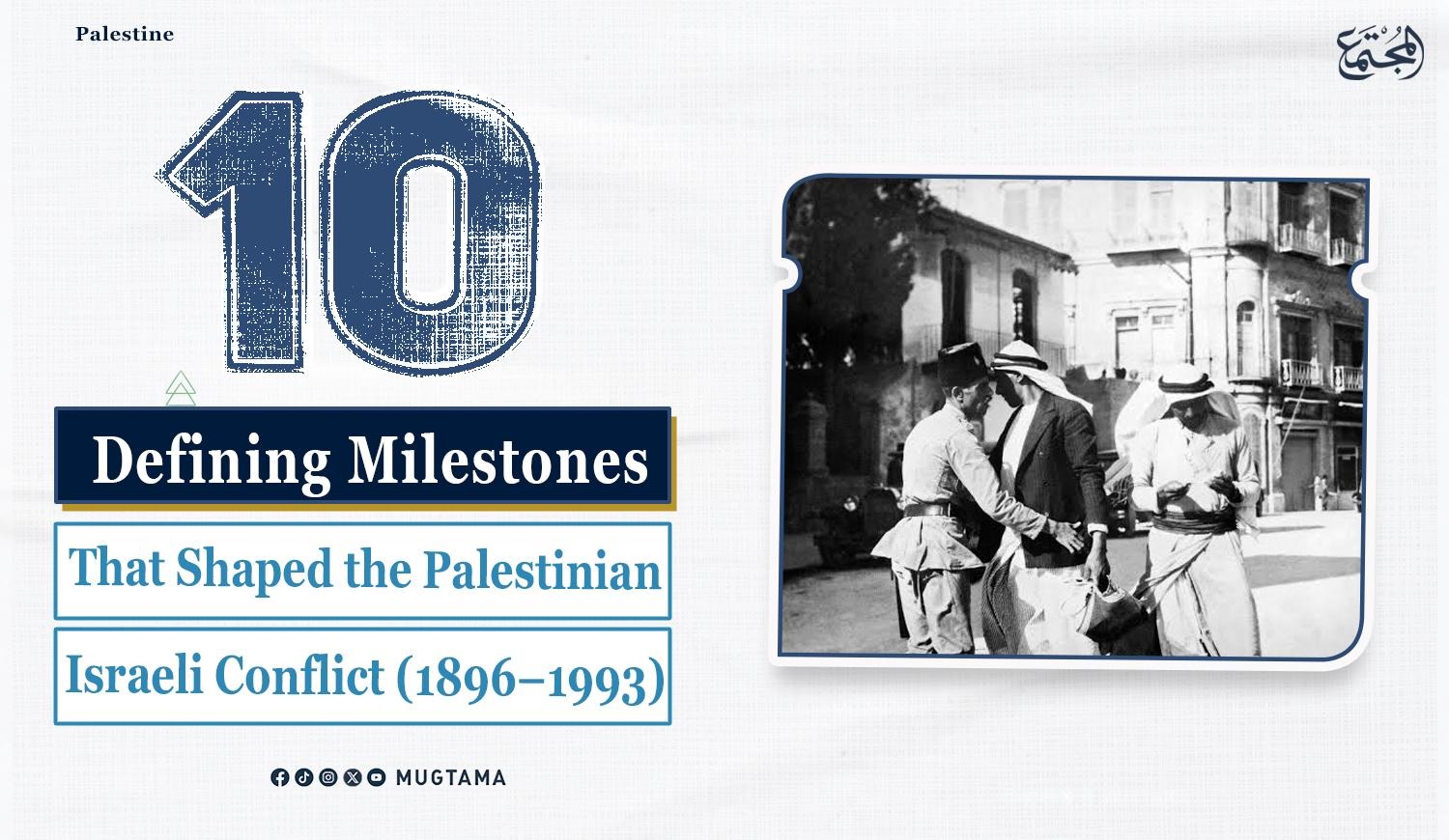
10 Defining Milestones That Shaped the Palestinian Israeli Conflict (1896–1993)
The
roots of the modern Palestinian Israeli conflict trace back to the late 19th
century, when the rise of political Zionism intersected with the decline of the
Ottoman Empire and shifting Western colonial interests. Across nearly a
century, key political turning points, popular uprisings, wars, and diplomatic
maneuvers reshaped the region's reality.
Here
is a chronological breakdown of the 10 pivotal eras and events that defined the
trajectory of the Palestinian cause from 1896 to the Oslo Accords in 1993.
1. Sultan Abdul Hamid II’s Rejection
of Zionist Offers (1890s)
During
the final decade of the 19th century, European Jewish leaders formulated modern
political Zionism with the aim of establishing a national homeland in
Palestine, which had been part of the Ottoman Empire's Syrian province since
the early 16th century. Zionist representatives approached Ottoman Sultan Abdul Hamid II with financial incentives to purchase the land. The Sultan famously
refused, stating that Palestine was not his personal property to sell, but
belonged to the Islamic nation, adding that they could only take it without a
price if the Caliphate were ever dismantled.
2. The Balfour Declaration and the
British Mandate (1917)
Following
the collapse of the Ottoman Empire during World War I, the Zionist movement
shifted its diplomatic focus toward Western powers, particularly Great Britain.
After occupying Palestine in 1917 and dividing Ottoman territories with France
under secret agreements, Britain issued the Balfour Declaration. In a famous
letter to Lord Rothschild, British Foreign Secretary Arthur Balfour pledged
British support for establishing a "national home for the Jewish people"
in Palestine. Under the subsequent British Mandate, authorities actively
facilitated rapidly increasing Jewish immigration into the territory.
3. Early Palestinian Revolts and Armed
Resistance (1929–1936)
As
Jewish immigration accelerated and tensions mounted under British rule,
Palestinian Arabs launched widespread protests and strikes in 1929, known as
the Buraq Uprising. By November 1935, Sheikh Izz ad-Din al-Qassam sparked the
first organized military resistance against British Mandate policies and Zionist
expansion. Although short-lived, his uprising catalyzed a broader national
awakening, culminating in the massive 1936 general strike and widespread armed
operations across Palestinian towns and villages.
4. Partition Plans and the UN
Resolution 181 (1937–1947)
In
response to the 1936 uprising, Britain attempted to broker negotiations, first
proposing a Jewish state and later convening the London Round Table Conference
with Arab states (Syria, Iraq, and Saudi Arabia) and Zionist
representatives—both of which failed due to irreconcilable demands. In 1947,
Britain declared itself unable to resolve the dispute and referred the issue to
the United Nations. The UN General Assembly passed Resolution 181, proposing a
partition plan that allocated 56% of Palestine—including its most fertile
agricultural lands—to a Jewish state, 44% to an Arab state, and placed
Jerusalem (1%) under international administration. While Zionist leaders
accepted the plan, Palestinians and Arab nations rejected it as a violation of
their historical rights and the UN Charter’s principle of self-determination.
5. The Nakba and the Establishment of
Israel (1948)
As
the 30-year British Mandate expired, Zionist paramilitary groups intensified
operations across Palestine, including the April 9, 1948 attack on the village
of Deir Yassin, driving hundreds of thousands of Palestinians from their homes
in what became known as the Nakba (Catastrophe). On May 14, 1948, David
Ben-Gurion declared the establishment of the State of Israel. Major world powers,
led by the United States and the Soviet Union, quickly recognized the new
state, solidifying its presence in the region.
6. The Suez Crisis and the Birth of
the PLO (1956–1964)
In
1956, Egyptian President Gamal Abdel Nasser nationalized the Suez Canal,
prompting a joint military invasion by Britain, France, and Israel—known as the
Tripartite Aggression—which resulted in the temporary occupation of the Sinai
Peninsula and the Gaza Strip. Later, in late 1963, Israel began diverting
waters from the Jordan River, prompting the first Arab League Summit in Cairo
in January 1964. Among the summit's most consequential decisions was the
creation of the Palestine Liberation Organization (PLO), initially led by Ahmad
Shukeiri.
7. The 1967 War (Naksa) and the Battle
of Karameh (1967–1968)
In
June 1967, Israel launched a surprise six-day military offensive against
neighboring Arab states, seizing the Sinai Peninsula, the Golan Heights, the
West Bank, East Jerusalem, and the Gaza Strip—a devastating defeat remembered
by Arabs as the Naksa (Setback). However, Palestinian resistance
escalated soon after. In 1968, Palestinian fighters, alongside the Jordanian
army, repelled an Israeli military assault on the border village of Karameh,
delivering a major psychological boost to the Arab world.
8. The Al-Aqsa Fire and the October
War (1969–1973)
On
August 21, 1969, an arson attack damaged the Al-Aqsa Mosque in Jerusalem,
leading Islamic nations to convene their first summit in Rabat, Morocco, and
establish the Al-Quds Committee. Peace efforts such as the 1970 U.S. Rogers
Plan stalled following Nasser's death. On October 6, 1973, Egyptian forces
crossed the Suez Canal and breached the fortified Bar-Lev Line, while Arab
oil-producing nations deployed an oil embargo against Western allies—shattering
the myth of Israeli military invincibility before a ceasefire halted the
advance.
9. Camp David, the Lebanon Invasion,
and the First Intifada (1974–1987)
In
November 1974, PLO Chairman Yasser Arafat addressed the UN, signaling openness
to a political settlement as the PLO gained recognition as the sole legitimate
representative of the Palestinian people. Meanwhile, Egyptian President Anwar
Sadat broke ranks with the Arab world by visiting Jerusalem in 1977 and signing
the 1978 Camp David Accords, resulting in Egypt's temporary isolation from the
Arab League and Sadat's assassination in 1981.
Following
Israel's formal annexation of Jerusalem in 1980, Israeli forces invaded Lebanon
in 1982, besieging Beirut for over 80 days, forcing the PLO to relocate to
Tunisia, and enabling the Sabra and Shatila massacres. In December 1987, after
an Israeli truck killed four Palestinian workers in Gaza, the First Intifada
erupted—a mass grassroots uprising that restored the Palestinian struggle to
the forefront of global politics.
10. The Rise of Hamas and the Oslo
Accords (1988–1993)
As
the Intifada evolved from stone-throwing protests to organized armed
operations, Israel arrested Hamas founder Sheikh Ahmed Yassin in May 1988.
Months later, in Algiers, Arafat declared Palestinian statehood before
recognizing Israel's right to exist in Stockholm in December 1988. Following
the 1991 Gulf War, the U.S. and Soviet Union co-sponsored the Madrid Peace
Conference, leading to deadlocked bilateral talks in Washington and Israel's
1992 deportation of over 400 Hamas and Islamic Jihad members to Marj al-Zuhur
in southern Lebanon.
Behind
the scenes, secret Norwegian-mediated negotiations produced a breakthrough in
August 1993. On September 9 and 10, Arafat and Israeli Prime Minister Yitzhak
Rabin signed letters of mutual recognition, culminating in the historic
September 13 White House ceremony establishing Palestinian self-rule in Gaza
and Jericho. While hailed by Western leaders and official Arab governments, the
Oslo Accords sparked fierce debate—viewed by critics on both sides as a
betrayal of core principles, and raising the enduring question of whether
diplomacy would end the Intifada or fuel a new chapter of struggle.