









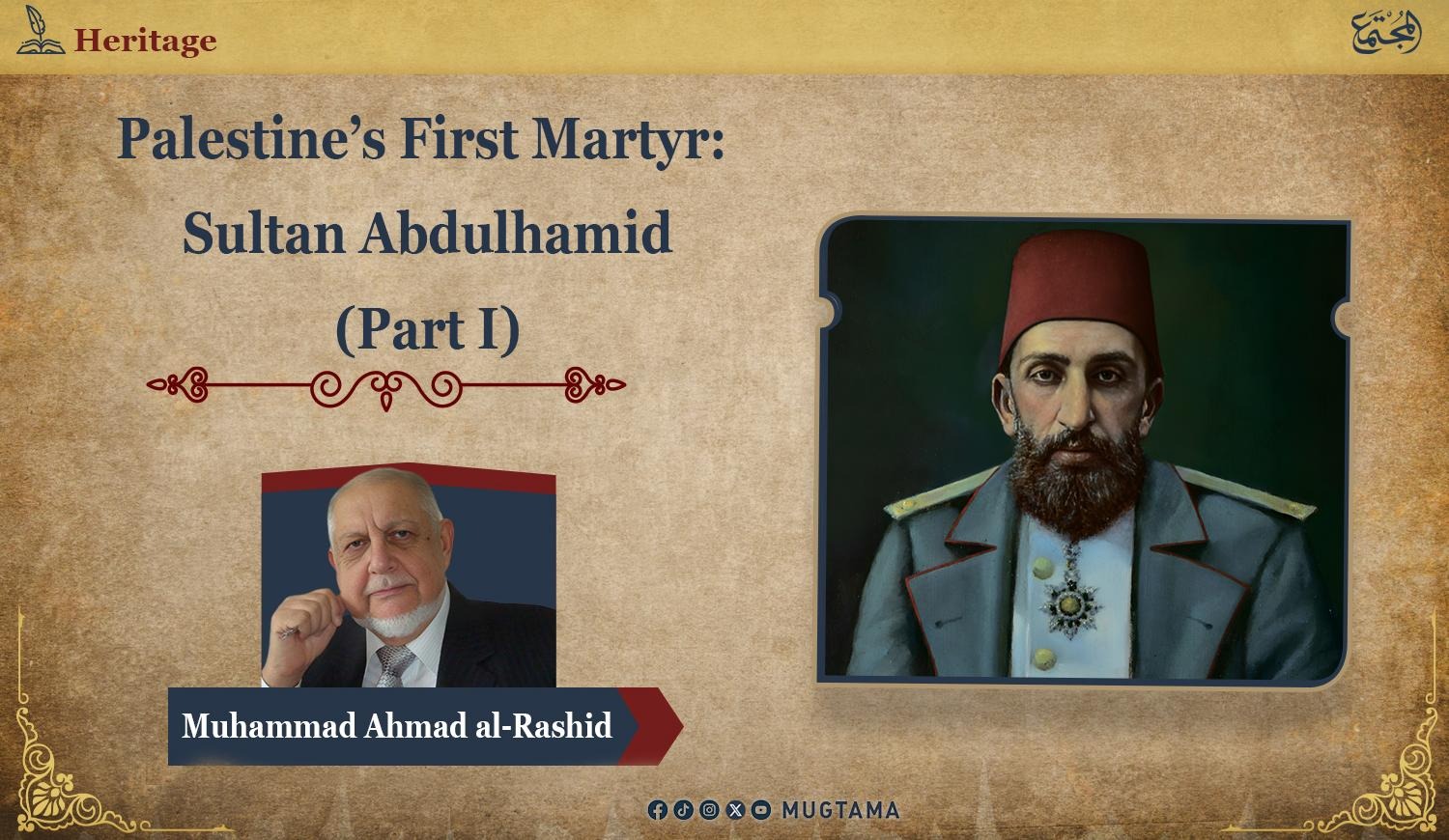
Palestine’s First Martyr: Sultan Abdulhamid (Part I)

It thus becomes evident to us
that the deposition of Abdulhamid did not reflect the will of the Muslim
community’s upright and trusted figures. Rather, his dethronement was a
conspiracy orchestrated by resentful minorities—among them Jews, Armenian
Christians, Freemasons, and esoteric, heterodox sects—catching those trusted
leaders off their guard, paralyzed as they were by the propaganda of this
spiteful faction. This was further achieved by exploiting certain Muslim
reformers who had been seduced by Western philosophy and upbringing; yet, the
endeavors of these minorities would never have prevailed had it not been for
the foreign backing that sustained them.
The British Aid the Traitors
For the British had
guaranteed aid to the plotters whenever needed. Prince Sabahaddin entered into
negotiations with them through a traitor among his entourage named Ismail Kemal
Bey, seized by an opportunity that had presented itself years prior to 1908,
yet which they failed to turn to their advantage.
Ramsaur describes their plot,
observing:
'The plan devised was
straightforward. Contact was made with Field Marshal Recep Pasha, an Albanian
who commanded the Turkish forces in the Vilayet of Tripolitania. He agreed to
undertake the operation, which called for transferring part of his army to
Salonica, from whence he would rally his Albanian compatriots to his aid—or
dispatching them to strategic vantage points such as Bolayır on the Gulf of
Saros, thereby seizing them and securing command of the Dardanelles. They
believed, as Ismail Kemal relates, that this maneuver would capture Europe's
attention and bring pressure to bear upon the Sultan, whom they thought easily
intimidated, compelling him to accede to whatever terms were dictated to him.'
Ismail Kemal continues his
narrative, stating that once he had secured Recep Pasha’s pledge of cooperation,
he laid the entire plot before Sir Edmund Monson, the British Ambassador in
Paris. After pondering the matter, Monson furnished him with letters of
introduction to the British Foreign Office, which he promptly bore to London.
Ramsaur further recounts
Ismail Kemal’s success in eliciting a British promise of backing, on the
strength of which they directed him to Cairo. There, he conferred over the
specifics of this aid with Lord Cromer, an imperialist harboring deep-seated
hostility toward Islam.
Commenting on this account to
affirm its authenticity, Ramsaur notes:
'The main lines of the story
summarized by Ismail Kemal Bey appear to be fundamentally correct,'
and that it: 'seems
well-grounded, even though uncorroborated by other sources.'
Such was the extent
acknowledged by Ramsaur in his bid to mitigate the cloud of suspicion hanging
over the coup plotters—much as he attempted regarding the scale of Masonic
complicity. Even so, he directs us to sources alleging far deeper entanglement
in this treason, which he himself discounted, attributing to them comparable
intrigues with Austria, Italy, and Greece. This he does while freely conceding
their receipt of funds—funds subsequently misappropriated by that deceitful
conspirator, Ismail Kemal.
In spite of all this, Ramsaur
strains in the concluding pages of his book to persuade us that no foreign
power stood behind the movement that ultimately toppled Abdulhamid. Yet there
was no need for him to go to such pains; imperialist powers intervene solely
when occasion demands. Once the ranks of Jews, Freemasons, Armenians,
Bektashis, and westernized intellectuals spared the colonial empires the burden
of blatant intervention, there remained no pretext for those powers to expose
their hand so brazenly.
And what do we truly know of
all that transpired? We merely seize upon the inadvertent admissions of Ramsaur
and his ilk as testimony, for no documentary study has yet emerged to shed full
light upon the complete, unvarnished truth.
Is it conceivable that the
colonial powers would, in the final hour, forsake the patronage they had
habitually rendered from the very outset?
Colonial backing is an
established fact from their very first steps. Indeed, Ramsaur himself verifies
that the foreign post offices attached to the embassies—enjoying
extraterritorial capitulations that exempted them from inspection—had, from its
earliest issues, circulated Ahmed Rıza’s journal Meşveret across the
length and breadth of the Ottoman realms.
The Armenian Question Was the Trigger
Ramsaur laid bare the fervor
that swept through the crusader colonial powers to depose Abdulhamid in the
wake of the Armenian massacres, goaded as they were by deep-seated ancestral
prejudice.
Ramsaur remarks:
'Abdulhamid initially made a
favorable impression both at home and abroad. For several years, he encountered
virtually no opposition to his rule from his subjects, and foreign observers
were nearly unanimous in their praise of the new Sultan.'
'Yet these accolades ceased
abruptly on account of the Armenian massacres that unfolded during the final
decade of the nineteenth century.'
He proceeds to recount how
the colonial powers very nearly dethroned him in 1896 following these
massacres.
Thus, it was Christian
propaganda championing the Armenian cause that served as the trigger for the
counter-propaganda campaign. Abdulhamid was not marked for deposition from the
outset of his reign; rather, it was what befell the Armenians that made him a
prime target for removal. This was so despite Abdulhamid being entirely
blameless regarding responsibility for the massacres, which were provoked by
unruly mobs. It was the Armenians who struck first by seizing the Ottoman Bank
headquarters and killing several of its employees—purportedly in retaliation
for the suppression of their revolt, an insurrection that, as historical
evidence confirms, they were goaded into by the Russians and the British,
rather than arising from ill-treatment as some might imagine.
Indeed, the very reverse
holds true: the Christian subjects of the Ottoman Empire revolted solely
because they perceived an atmosphere of tolerance, which spurred them to
exploit circumstances in order to embarrass the Sublime Porte and extort ever
more privileges.
This is not our own
contention; rather, it is asserted by eminent Christian statesmen and
historians from abroad, such as 'Djuvara'—one of Romania's foremost statesmen
and chroniclers who lived through the reign of Abdulhamid.
This authority observes:
'Among the foremost factors
in the dissolution of the Ottoman Empire was its custom of granting absolute
sectarian and educational liberty to the Christian subject peoples under its
sway. For through these twin freedoms, these nations propagated their
nationalist propaganda, consolidated their ranks, arose, acted in collusion,
and marched resolutely along the path of secession from the Ottoman Sultanate.'
This passage is drawn from
the conclusion of a work by this very statesman, translated by Shakib Arslan,
who incorporated its synopsis into a chapter of The Present World of Islam
(Hadir al-Alam al-Islami). Therein, this Romanian chronicler
enumerates—complete with names, figures, and dates—precisely one hundred
Christian imperialist schemes designed to partition the Ottoman Empire, none of
which came to fruition until the hundredth design was enacted during the First
World War.
Commenting upon the
aforementioned statement, Shakib observes:
'Whether this author
proclaimed this truth or kept his peace, it remains an incontrovertible reality
beyond shadow of doubt.
Hence, we find the atheists
of Ankara citing among their arguments for divesting themselves of Islamic
Sharia the claim that, had it not been for adherence to this Sacred Law, the
Turkish Sultanate would have maintained its pristine grandeur and been spared
the afflictions that beset it across six centuries on account of a Christian
populace comprising one-third—or perhaps more—of its inhabitants, and that
Sharia was what forbade the sultans from compelling them either to embrace
Islam or face expulsion.'
Would it not have been far
more fitting for the writer in Al-Arabi to turn his pen in defense of
the Muslims of the Philippines, who are being slaughtered like sheep these days
by a vengeful crusader spirit, rather than assailing an Islamic sovereign
deposed by crusader powers on charges of massacres whereof he was entirely
blameless?
Or does that writer fail to
perceive that even the most conservative estimates of the victims of Aba Island
in Sudan—those pious souls slain while bowing and prostrating before God by the
aerial bombardments of secular Arab nationalism—surpass more than twice the
highest estimate of Armenian casualties who merely executed the Russian
stratagem of provocation?
And where was the conscience
of Al-Arabi's writer when the heralds of Arab nationalism gave their
blessing to the butcher Abeid Karume's slaughter of twelve thousand Arab
Muslims in Zanzibar just a few short years ago, that he should stand today
zealous to impugn a Muslim Caliph whose sole pretext for deposition was his inability
to rein in mobs that slew fewer than half the casualties of Zanzibar?
Or is it that the eye of
favor is blind to every flaw?
We grieve indeed to conclude
that the writer in Al-Arabi fell victim to Armenian and Zionist
propaganda, and that he was manifestly unjust in the pronouncements he
rendered.
To be continued in Part II
Footnotes
- 1 Original Source: Al-Rashed, Muhammad Ahmad. "Palestine’s First Martyr: Sultan Abdulhamid." Al-Mujtama Magazine, Issue No. 171, Kuwait, 1973.
- 2 On Ramsaur and his Work: The citations referenced in the text are drawn from the seminal historical study by the American diplomat and historian Ernest Edmondson Ramsaur, Jr. (1914–2003), entitled The Young Turks: Prelude to the Revolution of 1908 (Princeton University Press, 1957). Ramsaur was a scholar of late Ottoman history and foreign affairs; his work extensively documented the internal machinations, European diplomatic ties, and covert societies that culminated in the 1908 Young Turk Revolution against Sultan Abdulhamid II.
- 3 On Djuvara and Shakib Arslan: The quotes attributed to Trandafir G. Djuvara (a prominent Romanian diplomat and historian) are sourced from his 1914 work Cent projets de partage de la Turquie (One Hundred Projects for the Partition of Turkey). It was translated, annotated, and incorporated by the renowned Lebanese-Arab thinker and historian Emir Shakib Arslan (1869–1946) into his Arabic commentary on Lothrop Stoddard’s The New World of Islam (Hadir al-Alam al-Islami).
- 4 Al-Arabi Magazine: A prestigious, widely circulated pan-Arab cultural magazine founded in Kuwait in 1958. The author directs his polemic against an article published in Al-Arabi that was critical of Sultan Abdulhamid's reign.
