









Truth About the Houthi Militia: Islamic Rulings Versus Misleading Slogans
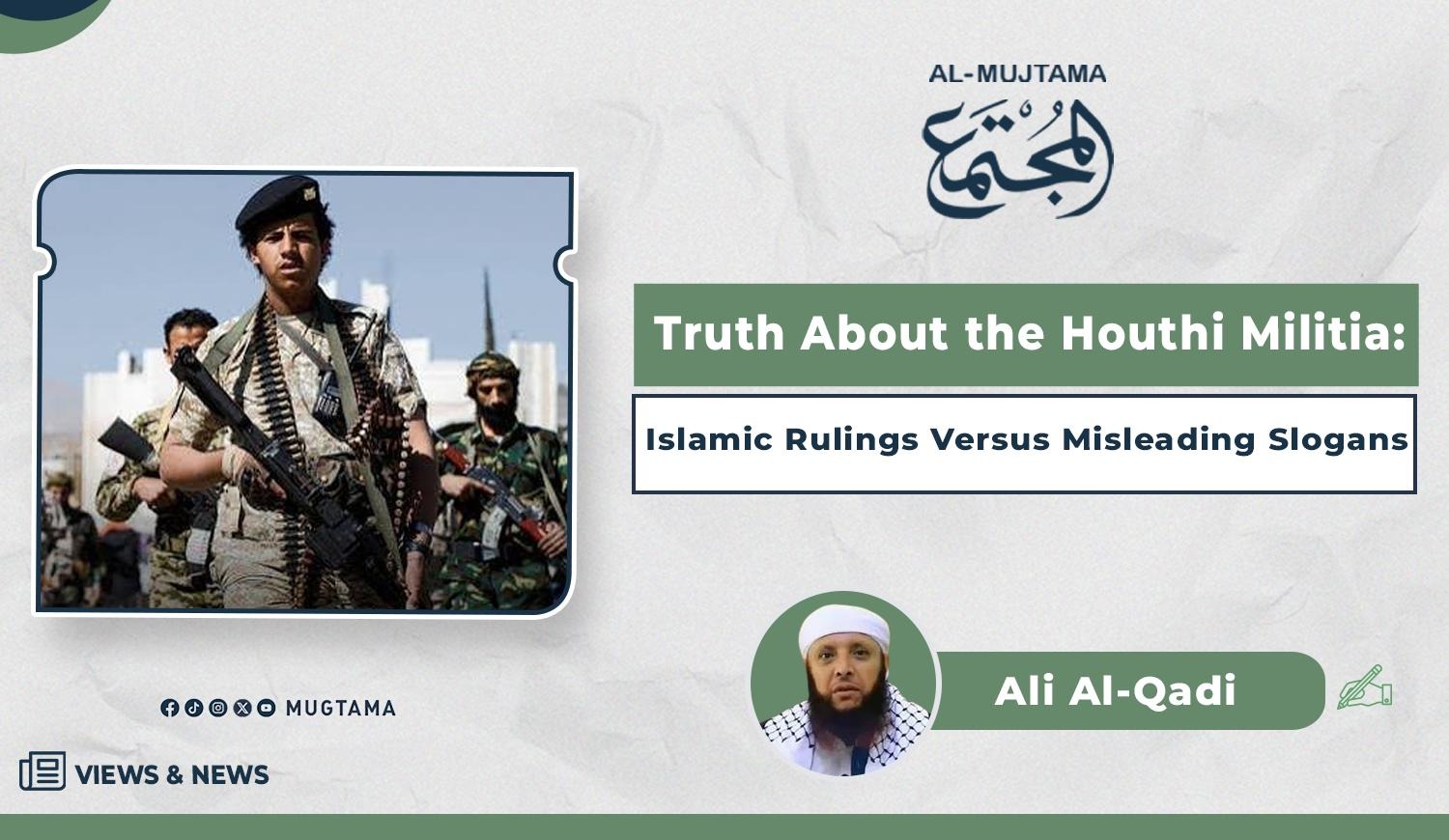
During times of
turmoil, the Muslim Ummah passes through critical and complex stages in which
lofty slogans often stand in stark contrast to painful realities. Even some
scholars, preachers, and intellectuals can lose sight of the true nature of
events and the issues at stake as a result of the systematic media
disinformation employed by deviant groups.
One of the most
pressing duties of scholars and those with knowledge and insight during such
exceptional times is to clarify the facts, establish sound definitions, and
assess unfolding events in light of the principles of Islamic law and its
authentic objectives. This is essential to ensure that the five fundamental
necessities protected by Islamic law are not violated, that aggression is not
legitimized, and that Muslims are not misled by political slogans or
media-driven attempts to outbid one another in displays of religious
commitment.
Against this
backdrop, this article seeks to establish the precise Islamic legal
classification of the ongoing conflict with Yemen's Houthi rebel militia and
expose what its author regards as the false claims and slogans through which
the group seeks to mislead regional and Islamic public opinion.
Jurists across
all Islamic schools of thought have unanimously held that armed rebels who take
up weapons against the legitimate government must be fought if they refuse
reconciliation. They cite the following verse: {And
if two groups of believers fight each other, then make peace between them. But
if one of them transgresses against the other, then fight against the
transgressing group until they ˹are willing to˺ submit to the rule of Allah.} [Al-Hujurat
49:9]
(See: Ahkam Al-Quran
(4/149) by Ibn Al-Arabi; Tafsir Al-Qurtubi (16/317); Al-Sayl Al-Jarrar
(p. 965) by Al-Shawkani; and Al-Fiqh Al-Islami wa Adillatuhu by Wahbah
Al-Zuhayli, among other works.)
This consensus was also cited by the eminent scholars Qadi Iyad and Imam An-Nawawi
in An-Nawawi's Commentary on Sahih Muslim (7/169).
According to
this legal framework, the war that has been raging in Yemen for twelve years
between the internationally recognized government and the Houthi rebel militia
falls within the category of armed rebellion.
The majority of
Sunni scholars maintain that abandoning the fight against armed rebels is
impermissible, as confronting them is a religious obligation that cannot simply
be waived, even if they are within the boundaries of the Sacred Mosque in
Makkah. This is stated by Imam An-Nawawi in his commentary on Sahih Muslim
(9/124–125).
The majority of
the Companions and their Successors also held that armed rebels, highway
robbers, and criminals must be fought to prevent evildoers from gaining power
over the righteous and society from descending into disorder, as discussed in Fath
Al-Bari by the hadith scholar Ibn Hajar.
Scholars have
likewise agreed that fighting armed rebels, highway robbers, and thieves falls
under jihad in the cause of Allah. (See: Al-Nawawi's Commentary on Sahih
Muslim (26/13); Umdat Al-Qari Sharh Sahih al-Bukhari (1/231) by
Al-Ayni; and Irshad Al-Sari Sharh Sahih Al-Bukhari by Al-Qastallani
(Hadith 2803).)
The Houthis,
the author argues, are guilty of far more than rebellion. Their conduct is more
dangerous than that of highway robbers and thieves.
The
Houthi Militia: Between Armed Rebellion and Doctrinal Deviation
The legal
ruling concerning armed rebels generally applies when they are not followers of
deviant doctrines or religious innovations. The Houthis, however, are not
merely rebels. According to the article, they are an extremist group that
considers the Yemeni people misguided, and even disbelievers, because they
recognize the legitimacy of the Companions of the Prophet (may Allah be pleased
with them). This position is attributed to their leader, Hussein al-Houthi, in
his published lectures and writings.
The group, the
author contends, seeks to impose its doctrine by force and intimidation,
violating the five fundamental necessities protected by Islamic law in the
process.
It is therefore
impermissible, according to this argument, to classify doctrinally deviant
groups alongside other armed rebels whose rebellion does not extend to
distorting and corrupting religion, and who do not regard the violation of the
lives, property, and honor of those who oppose them as an act of religious
devotion, as the author alleges is the case with the Houthis and similar
groups.
Ibn Taymiyyah
criticized jurists for including rebels motivated by religious innovation and
other forms of doctrinal deviation under the general legal category of armed
rebels. He argued that such groups pose a greater danger and that fighting them
is an even more pressing obligation. While ordinary rebels seek political
power, these groups corrupt religion itself. He elaborated on this distinction
in Majmu' al-Fatawa (4/450–452), noting that hadith scholars were more
precise than jurists in distinguishing between rebels driven by religious
innovation and other types of rebels.
Imam Ibn Hazm Az-Zahiri
had made a similar point before him, writing:
“Any group
whose rebellion is based on an interpretation that entails erasing some aspect
of the Sunnah, such as those who adopt the views of the Kharijites,
disassociate themselves from some of the Companions, reject established
practices of the Messenger of Allah (peace and blessings be upon him), or call
for referring matters to someone other than the Messenger of Allah, cannot be
excused on the grounds of a false interpretation, for this is sheer ignorance.”
(Al-Muhalla,
11/334).
The author
argues that the Houthis have committed all the violations described by Ibn
Hazm.
Houthi
Slogans of Support for Gaza: Between Propaganda and Reality
It is
regrettable that some scholars and preachers from outside Yemen have sided with
the Houthis after being taken in by the group's media campaign portraying
itself as a supporter of Gaza.
We do not deny
that the Houthis launched a handful of missiles toward Israel. However, these
attacks did nothing to alleviate the Israeli aggression against Gaza. What
these respected scholars may not know is that the same Houthi group that
publicly proclaims its support for Palestine seized the offices of the Al-Aqsa
Association in areas under its control, detained its employees and directors,
and subsequently shut it down, despite the billions of riyals the association
had collected from the Yemeni people to support Palestine.
I make this
statement based on firsthand knowledge, not out of a desire to malign anyone. I
am the chairman of the Al-Aqsa Association in liberated Taiz. Allah forbid that
we should fabricate accusations, even against a disbeliever. Besides, the
group's actual record speaks for itself; there is no need to distort it through
lies.
Even if we were
to assume that the Houthis' support for Gaza constituted a great and
commendable achievement, how could it compare with the grave crimes they have
committed and continue to commit in Yemen? These include the killing of
civilians, the looting of property, and violations of people's honor. The group
has imprisoned hundreds of women and thousands of elderly people and men, among
other abuses.
And how could a
handful of missiles outweigh its doctrinal corruption and its documented public
insults against the Companions, whom it has even declared disbelievers?
The Prophet
(peace and blessings be upon him) became angry with Khalid ibn Al-Walid, as
reported in Sahih Al-Bukhari, despite his many military victories. He also
disavowed the killing of members of the Banu Jadhimah tribe by some of Khalid's
men, who had mistakenly believed them to be disbelievers, even though the
killing was not intentional.
How, then, can
some scholars approve of and support the Houthis despite their killing of tens
of thousands of Yemenis, a practice that continues to this day, their
displacement of millions, and their imprisonment of thousands?
Can all these
atrocities be erased by a handful of missiles launched toward Israel, which did
not ease Gaza's suffering in the slightest? The Houthis have launched many more
missiles at Yemeni cities, where they have fallen on civilians. They have also
blown up dozens of mosques and Quran memorization centers.
At the very
least, scholars and preachers from outside Yemen who sympathize with the
Houthis are urged to consult Yemeni scholars, who know the group's conduct and
ideological deviations far better than outsiders do.
-------------------------------------------------------------
