




Houthi Crimes: From Destroying Mosques in Yemen to Threatening Makkah
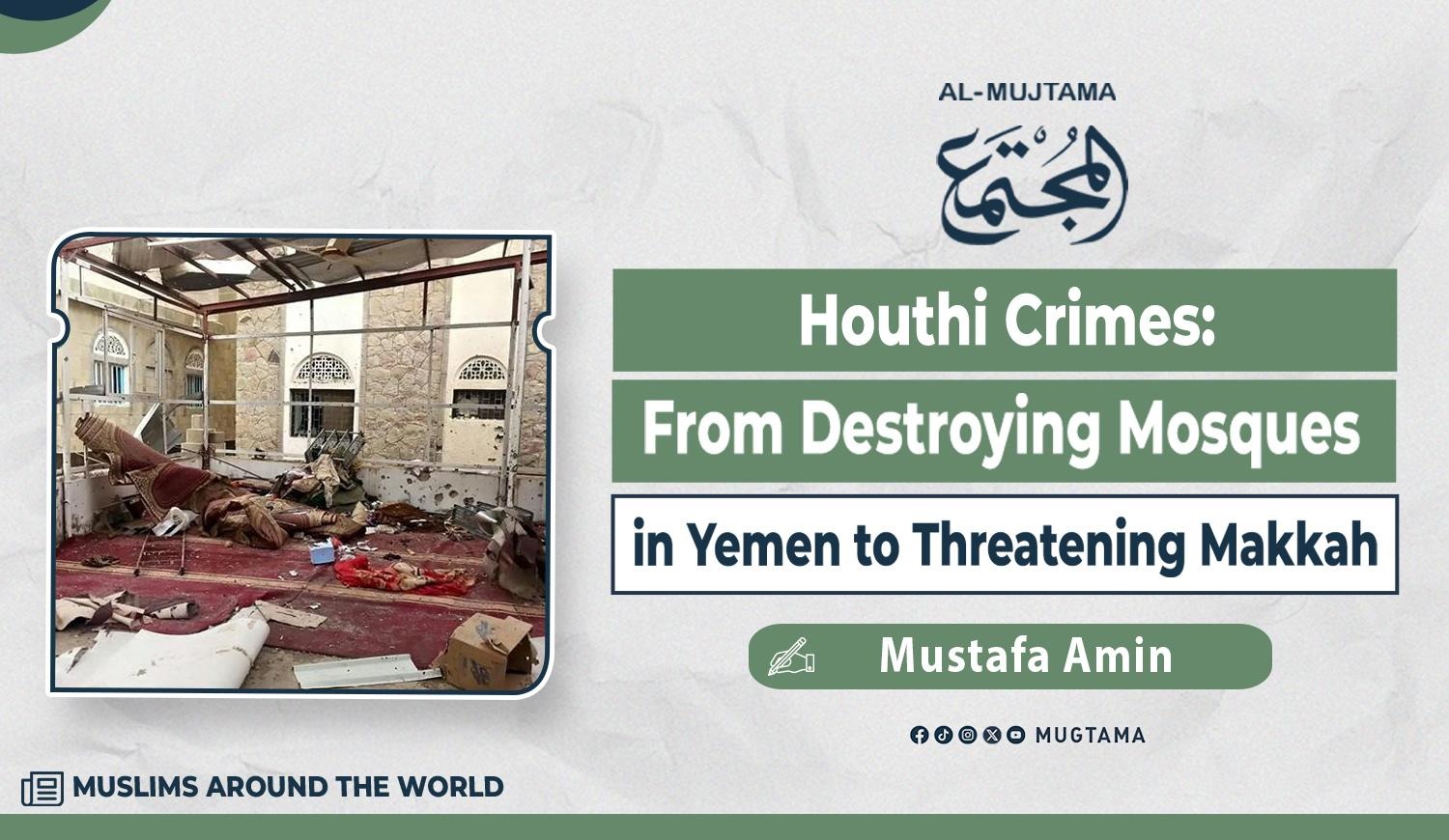
The Arab and Islamic region is witnessing the repercussions of extremist behavior that violates all international laws and religious norms. Rights documentation and field reports reveal a systematic pattern by the Houthi group targeting the fabric of Islamic society and its holy sites, beginning with the bombing of mosques and the assassination of scholars within Yemen, and culminating in criminal attempts targeting the Holy Land in the Kingdom of Saudi Arabia.
Systematic Violations Against Mosques and Religious Personnel in Yemen
Field documentation issued by human rights organizations, led
by the Yemeni Network for Rights and Freedoms, shows a marked escalation in the
volume of attacks targeting religious sites and their personnel, including
imams and preachers.
According to documented data covering January 2015 to June 2025, 4,896 violations were recorded across various
Yemeni governorates. These included converting places of worship from their
religious and educational purposes into barracks and centers for ideological
mobilization.
According to human rights documentation, the prominent
violations are distributed as follows:
1. Targeting Preachers, Imams, and Worshipers:
Documenting 277 fatal cases, comprising 72 direct shooting
incidents, 19 shelling incidents, 28 severe beatings, and 19 attacks with
bladed weapons, alongside recording 178 physical injuries.
2. Direct Attacks on Mosques:
Recording 791 direct attacks, including 103 bombings, 201
shelling incidents, 52 arson cases, and 341 raids and acts of looting.
3. Exploitation and Confiscation of Religious Properties:
Converting 423 mosques into military barracks, 219 mosques
into ideological mobilization centers, and 61 mosques into operations rooms, in
addition to closing 394 mosques, forcibly imposing preachers in 1,291 cases,
and closing 467 Quran memorization schools.
In Dhamar Governorate alone, the network documented 15,413
violations between January 2018 and May 2025, which included the killing of 474
civilians, the abduction of 1,183 individuals, the bombing of mosques and Quran
teaching centers, and the closure of 7 religious schools.
Documented Cases of Confiscating Religious Facilities and Targeting Educational Staff
Field events illustrate multiple patterns of direct targeting
of religious infrastructure and educational personnel:
1. Al-Firdous Mosque (Sanaa):
The second-largest mosque in the capital (accommodating
approximately 25,000 worshipers) was subjected to the seizure of its facilities
and annexes, alongside the closure of its scientific centers, Quran
memorization house, and affiliated hospital, with parts of them demolished to
convert them into commercial facilities.
2. Targeting Quran Teachers (Raima Governorate):
A military security campaign in the As-Salfiyah District (July
2025) led to the killing of 70-year-old Quran teacher Sheikh Saleh Hantous
following a siege and bombardment of his home, years after the closure of the
Al-Radwan School he managed.
Aggressive Attempts Against the Holy Land and International Stances
The aggressive conduct of the Houthi group extended to
violating the sanctity of the Holy Land in the Kingdom of Saudi Arabia. The
Coalition Forces Command announced the interception and destruction of a
hostile drone on September 15, 2026, before it entered the restricted airspace
of the Holy City of Makkah (south of the city). This marks the second attempt
following a previous attack with a ballistic missile in July 2017.
These attacks met with widespread statements of condemnation
and outrage at the Arab, Islamic, and international levels:
1. Official and Governmental Stances:
Arab and Islamic governments (including the Gulf Cooperation
Council countries, Yemen, Egypt, Jordan, Lebanon, and Libya) reaffirmed their
full solidarity with the Kingdom of Saudi Arabia and their absolute rejection
of any threat to the Kingdom's sovereignty or targeting of civilian objects and
Islamic holy sites.
2. Religious Bodies and Institutions:
Official statements were issued by the Muslim World League,
Al-Azhar Al-Sharif, the Organization of Islamic Cooperation, the International
Islamic Fiqh Academy, and the Lebanese Fatwa House, emphasizing that protecting
the Two Holy Mosques and sacred sites is a binding religious and humanitarian
constant that admits no compromise, calling on the international community to
take a firm stance to stop these violations and hold those responsible
accountable.