









The Prophetic Guide to a Lasting Marriage
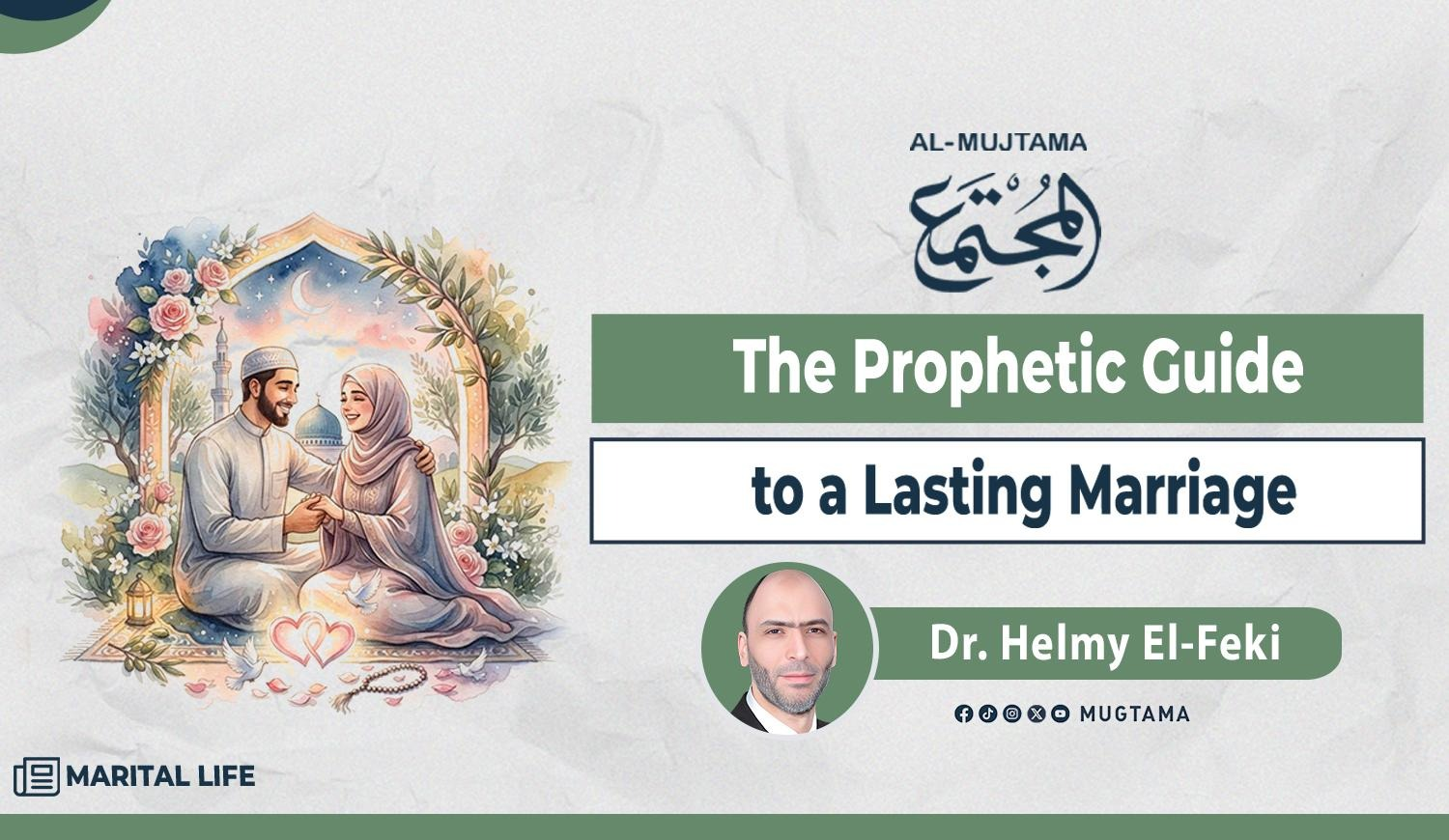
The family is the fundamental building
block of society. It is not merely a civil contract; rather, as the Quran
describes it, it is a “solemn covenant” founded
upon tranquility, affection, and mercy. Since human nature is inherently marked
by imperfection and mistakes, conflict between spouses over the details of
daily life is inevitable. Islamic law, therefore, did not stop at an idealistic
theoretical vision of married life. Instead, it offered practical solutions for
managing everyday problems and resolving emotional and psychological crises
within the home.
A profound Prophetic principle appears
in an authentic hadith narrated by Imam Muslim from Abu Hurairah, in which the
Prophet (peace and blessings be upon him) said: “A
believer must not hate a believing woman; if he dislikes one of her
characteristics he will be pleased with another.” This stands as one of the greatest legal
principles and educational values for protecting families from breakdown and
establishing justice, fairness, and kind treatment between spouses.
The Meaning of “Hatred” in Marriage
To understand the profound meanings
highlighted by this Prophetic teaching, it is necessary to examine the words
used in the hadith.
Linguists explain that the term refers
to a woman hating her husband, a husband hating his wife, and each developing
deep aversion toward the other. It does not refer merely to passing anger or
temporary resentment. Rather, it describes deep-seated hatred and complete
aversion that takes control of the heart, blinding a person to the other’s good
qualities and naturally pushing them toward separation and estrangement.
Why the Prophet Warned Against Letting
Hatred Control Marriage
The prohibition here comes in a
decisive form, referring to behaviors and attitudes that result from aversion
and hatred. Islam recognizes that a person may not have complete control over
their innermost feelings, but they do have control over how they direct their
behavior and reason.
The meaning, therefore, is: Do not
surrender to the excesses of hatred. Do not allow dislike of a particular trait
to become a justification for wronging your spouse, treating them harshly, or
rushing into divorce.
Faith as a Foundation for Patience
Between Spouses
The choice to describe both spouses
through their faith carries a profound educational message. The Prophet (peace
and blessings be upon him) reminds spouses of the highest bond that unites
them.
The woman whose husband may dislike
some of her qualities is still a believer in Allah and His Messenger,
fulfilling the responsibilities of servitude to Him. The husband who is called
upon to be patient is also a believer who hopes for Allah’s reward and fears His
punishment.
This reminder of their essential
qualities lowers the intensity of anger and elevates the relationship from its
narrow material dimension to its broader spiritual horizon.
A wife who has stayed awake through
the night out of love, pain, longing, and concern for her sick husband should
not have her virtues forgotten simply because some of her shortcomings become
apparent.
Balancing Love and Dislike in Marriage
The hadith presents a comprehensive
approach to dealing with love, dislike, emotional attachment, and human
feelings. When a person becomes angry, they can fall under the influence of
temporary emotions and passing feelings. They focus their attention and heart
on the current mistake and generalize it to the entire personality of the other
person, making that person appear completely dark and flawed.
Here, Prophetic guidance intervenes to
break this bias through two principles:
1. Recognizing Human
Imperfection
The Prophet (peace and blessings be
upon him) did not ask a husband to live in an illusion or deny the existence of
shortcomings. Rather, he addressed a fundamental human reality: a woman is not
an infallible angel, and a man is not free from mistakes.
Disliking certain behaviors or
traits—such as impatience, occasional harshness in speech, or shortcomings in
certain aspects of household management—is part of human nature.
Al-Zaydani said in Al-Mafatih Sharh
Al-Masabih: “A husband should not hate his wife because he sees poor
manners from her. If she does something he dislikes, she also does things he
likes. Therefore, he should overlook what he dislikes because of what he
appreciates in her.”
2. Practicing Gratitude and
Focusing on the Good
This is the central principle in
emotional relationships. The Prophet (peace and blessings be upon him) teaches
the mind to move beyond narrow focus on a disliked trait and broaden its
perspective to the other good qualities, which may be deeper and more abundant.
If a husband dislikes his wife’s quick
temper, let him remember her chastity and the way she protects their home and
children. If he dislikes a shortcoming in her appearance or self-care, let him
remember her good companionship, kindness, and support during his difficulties.
This balance restores justice and
objectivity to the marital relationship. Hundreds of good qualities should not
be erased because of a single fault.
How to Cultivate Love and Affection at
Home
Cultivating love within the home is
not an unrealistic ideal or merely a wish. It is a constructive process that
requires practical tools derived from understanding this hadith. These tools
are built upon three foundations: managing expectations, developing a culture
of overlooking minor faults, and offering encouragement and positive
reinforcement.
1- Manage Expectations and
Let Go of Unrealistic Ideals
Many homes become fractured and may
even collapse because of the shock of reality. A man
or woman may enter marriage carrying a stereotypical image of an ideal partner
drawn from novels or screens—a partner who fulfills every desire without any conflict.
But the Prophetic teaching establishes
a realistic mindset: you are dealing with a human being, and human beings are
made up of both virtues and shortcomings.
Accepting this reality is the first
step toward creating stable homes and cultivating genuine affection.
2- Develop the Wisdom to
Overlook Minor Faults
Overlooking minor faults is not
weakness. Rather, it is a sign of intellectual maturity and emotional depth.
Imam Ash-Shafi`i said: “The
intelligent and wise person is perceptive yet knows how to overlook.”
Dwelling on every mistake, holding a
spouse accountable for every word, and constantly tracking their shortcomings
creates distress and brings about aversion, hatred, resentment, and hostility.
By contrast, overlooking minor
mistakes and turning a blind eye to slips that do not violate fundamental
religious principles or honor can help extinguish hatred and resentment and
cultivate affection and love within the Muslim home.
It is the oil that keeps the wheel of
married life turning smoothly.
3- Encouragement Can Work
Wonders
One of the secrets behind applying the
Prophet’s teaching, “he will be pleased with another,” is that a husband
should not merely feel appreciation internally. He should express it through
words and praise.
When a husband praises his wife and
acknowledges her good qualities—such as her good cooking, her care in raising
the children, or her support for him—this works as behavioral and psychological
encouragement.
It motivates her to preserve those
virtues and may even encourage her, naturally and out of love, to improve
negative traits and behaviors.
The Educational Impact of This Prophetic
Teaching
Spreading this Prophetic approach to
family relationships goes beyond the husband and wife and can positively
influence society as a whole in several ways:
1- Creating Psychological
Security for Children
Homes built on harsh criticism,
constant conflict, and an obsessive focus on shortcomings become emotionally
hostile environments. They can produce generations that are psychologically
distressed and emotionally unsettled.
By contrast, homes in which spouses
practice balance and appreciate one another’s good qualities provide children
with a safe and stable environment. They nurture psychological peace, inner
tranquility, and emotional balance while teaching children, through practical
example, how to resolve conflicts and respond to life with flexibility.
2- Reducing Divorce
Statistics indicate that the largest
proportion of divorces occurs during the early years of marriage, often because of trivial reasons and passing incidents
that become magnified in the absence of balance and fairness.
If spouses in conflict followed the
Prophetic guidance, “If he dislikes one of her qualities, he will be pleased
with another,” they would pause and reconsider. They would understand that
divorce and replacing one home with another are not simple matters, and that
the qualities found in a current spouse may not necessarily be found in someone
else.
3- Love Is a Conscious
Creation, Not a Passing Emotion
In the Islamic and Prophetic
understanding, love is not merely a temporary emotional surge that suddenly
appears and disappears with the first storm of disagreement.
Rather, love is something consciously
built and cultivated, with both spouses participating in its construction day
after day.
The hadith, “A believing man should
not hate a believing woman,” represents a lifeline for families. It does
not ask us to suppress our emotions or live in illusions and dreams. Instead,
it gives us a clear roadmap based on justice, fairness, and looking at one’s
spouse with appreciation and gratitude.
Stable homes are not homes free from
problems or negative traits. Rather, they are homes in which people learn how
to move beyond accumulated shortcomings and conflicts while holding firmly to
the strong bond of Allah, appreciating beautiful qualities, and cherishing
moments of affection—moments for which the loyal are grateful and the heedless
fail to appreciate.
-------------------------------------------------------------