






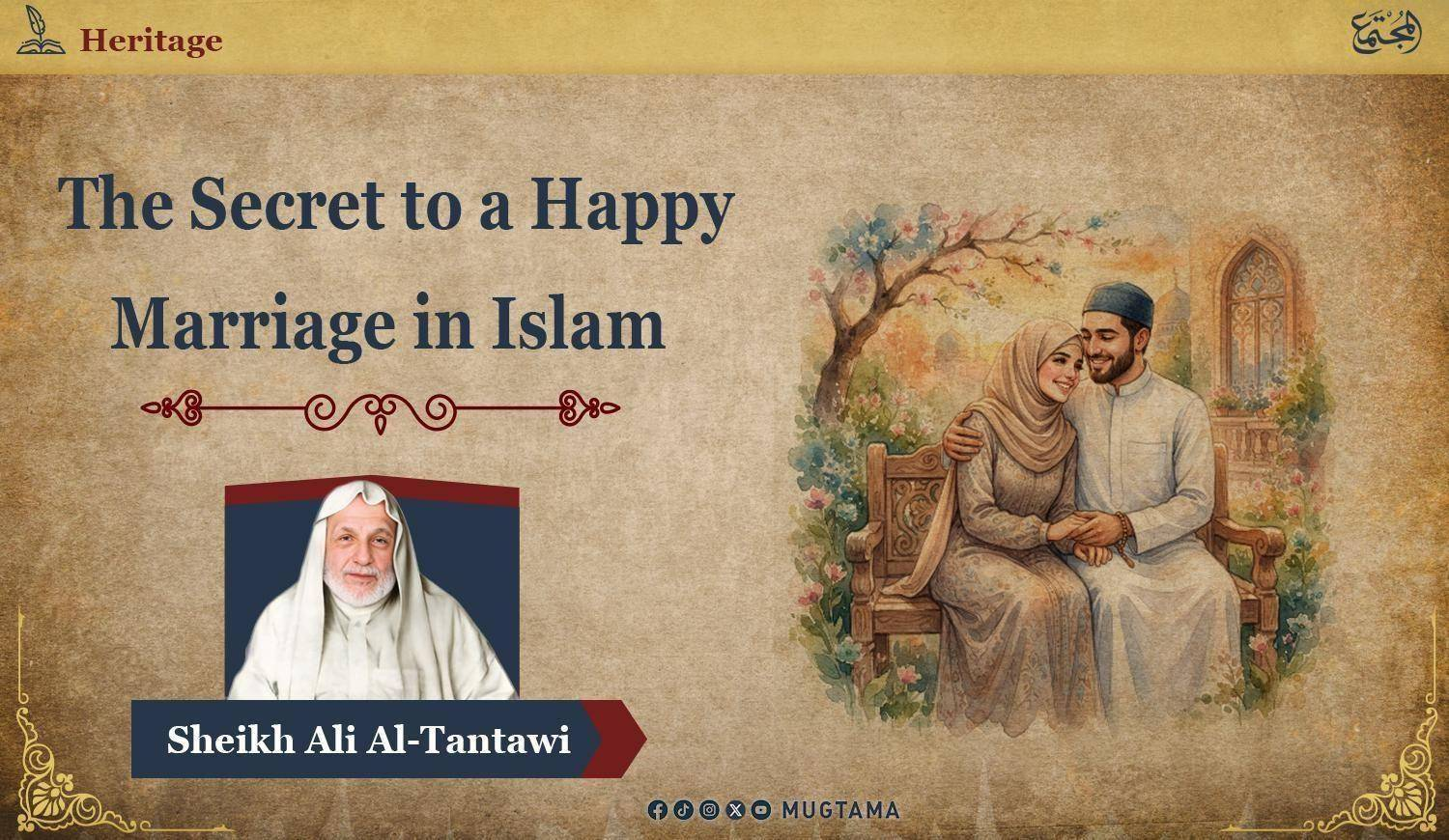
The Secret to a Happy Marriage in Islam
A friend once told me—a man known for
rigid thinking, the worship of habit, and fear of every departure from
tradition or renewal: “Do you really write about your wife in your magazine
Ar-Risalah, saying
that she is one of the wisest and finest of women? Have you ever heard of
anyone writing about his wife? The Arabs used to avoid mentioning their wives
openly. Out of modesty and reserve, they referred to them indirectly as 'the
sheep' or 'the ewe.' Their sense of modesty was so strong that it prevented the
poet Jarir from openly elegizing his wife or publicly visiting her grave.
When Malik Ibn Ar-Rayb listed the
women who would weep for him after his death, he said: 'My mother, her two
daughters, my maternal aunt, and another woman whose crying would stir the
others to tears.' He did not say, 'my wife.'
The same was true of our fathers and
the elders of our families. None of them would say 'my wife.' Instead, they
would say 'the people of the house,' 'the mother of my children,' 'the
household,' or similar expressions.
Would you abandon all this, leave what
people know, and do something they find strange?”
I replied: “Yes.”
He was almost stunned by my answer and
exclaimed: “You still say yes after all that?”
I answered again: “Yes.”
Why Shouldn’t a Husband Praise His Wife!
Why should I not write about my wife?
Where is the fault in doing so?
Why is it acceptable for a lover to
write about his beloved when their relationship is unlawful, yet unacceptable
for a husband to write about the woman who is lawfully his beloved?
Why should I not mention her genuine
virtues to encourage people toward marriage, while lovers exaggerate imaginary
beauties and make disobedience attractive to others?
People read articles every day about
the tragedies and hardships of marriage. Why should they not read one article
about its blessings and goodness?
Nor am I writing only about my own
wife, but as Victor Hugo once said: “When I describe my feelings as a father, I
describe the feelings of all fathers.” *
I have never heard a husband say that
he is content and at peace, even when he truly is. Human beings are naturally ungrateful.
We rarely appreciate blessings until they disappear. We are also created with
endless desire; every blessing we receive only makes us long for another. As a
result, we neither feel satisfied nor fully recognize the joy already in our
hands.
That is why husbands constantly
complain about their wives. Most men praise their wives only after death has
separated them forever, when hope of benefiting from them is gone. Then they
suddenly remember their virtues and acknowledge their goodness.
As for me, I choose to say it now—as
gratitude to Allah and acknowledgment of His favor: I am happy and content in
my marriage.
The things that helped me achieve this
happiness are within the reach of every person who sincerely seeks a successful marriage.
Let those who have not yet walked this path benefit from the experience of one
who has.
Achieving Happiness in Marriage
1. Marry People You Truly
Know
First, I did not seek marriage from a
family I did not know, nor did I marry strangers whose true character would
only become clear after living among them. Many people appear admirable in
public while hiding flaws that only intimate life reveals.
Instead, I married relatives who knew
me, and whom I knew well. I had seen their family life, just as they had seen
mine.
Many men are
celebrated as the most cheerful companions, the delight of every gathering, yet
inside their homes they are unbearable. Some appear generous in public but are
miserly with their families. Others are pleasant with strangers but harsh with
those closest to them. People are often deceived by pleasant appearances, only
to discover painful realities.
I married the daughter of my mother’s
cousin. Her father was Judge Salah Ad-Din Al-Khatib, one of Syria’s leading
judges, formerly a counselor in the judiciary and later a notary public.
Her mother was the daughter of the
renowned scholar of Damascus, Sheikh Badr Ad-Din Al-Hasani, may Allah have
mercy on him. She came from a noble family on both sides.
2. Choose Compatibility
Before Romance
Second, I married someone whose social
background resembled my own.
Her father served alongside my father
in the Court of Cassation. He is a judge and I am a judge. Their way of life
closely resembled ours.
This is one of the strongest pillars
of marital happiness. Therefore, the Hanafi jurists—who may rightly be
described as the philosophers of Islamic law—considered compatibility between spouses an essential condition for a successful marriage.
3. Beauty Alone Cannot
Sustain a Marriage
Third, I did not make beauty the sole
condition of marriage, as mathematicians speak of a necessary and sufficient
condition.
I knew that physical beauty is a
passing shadow. It is not that the beautiful woman loses her beauty. Rather,
you gradually lose your awareness of it. That is why we often see men
abandoning beautiful wives for women who possess little outward beauty.
It is in this sense that the notorious
poet Al-Farazdaq—one of the great masters of vice—uttered his famous words to
his wife, An-Nawar: “How delightful you were when forbidden, and how unbearable
you became once lawful.”
4. Keep Extended Family in
Their Proper Place
Fourth, my relationship with my wife’s
family has remained, even after nearly an eighth of a century, within healthy
and respectful boundaries.
There are mutual affection, mutual
respect, and occasional visits. I have never experienced the interference that
so many husbands suffer from in-laws who impose opinions and intrude into
private marital affairs.
Like every married couple, we
experienced moments of satisfaction and moments of disagreement. Yet not once
did anyone from her family interfere in either.
To this day, I have examined more than
twenty thousand marital disputes in court, which allows me to state with
confidence: If quarreling spouses were simply left alone, without interference
from relatives or well-meaning acquaintances, three-quarters of marital disputes
would end in reconciliation.
5. Begin Marriage With
Honesty, Not Illusion
Fifth, we did not begin our marriage
by pretending life was endless honey, as many couples do, only for the rest of
life to become bitterness and poison.
Instead, from the very first day I
showed her the worst aspects of my character. When she accepted them patiently
and endured them for God’s sake, I gradually showed her the better parts of
myself. As the days of our marriage increased, so did our happiness.
6. Respect Each Other’s
Responsibilities
Sixth, I left to her what properly
belonged to her. I did not interfere in arranging the home or managing the
upbringing of the children. She likewise left to me what properly belonged to
me in leadership and guidance.
Many marital conflicts
begin when the wife attempts to wear the husband’s turban and assume his role,
or when the husband insists on wearing the woman’s apron, involving himself in
matters such as how the house should be swept, how eggplants should be sliced,
or how garments should be sewn.
7. Build Marriage on
Complete Honesty
Seventh, neither of us hides anything
from the other. I do not conceal matters from her, and she does not conceal
matters from me. I never lie to her, and she never lies to me. I tell her the
full truth about my financial circumstances.
Whenever I travel somewhere, I either
take her with me or tell her exactly where I am going, and she likewise informs
me wherever she goes.
We have raised our children to value
honesty and openness, to reject lies, and to feel genuine disgust toward
deception.
The Virtues of a Devoted Wife
By Allah, I ask for no greater
loyalty, wisdom, or good judgment than what I find in her. She is one of those
Eastern women who live not for themselves, but for their homes, their husbands,
and their children.
She goes hungry so that we may eat, stays
awake so that we may sleep, tires herself so that we may rest, and spends
herself so that we may endure.
She is the first in the house to rise
every morning and the last to sleep at night. She never ceases cleaning,
sewing, organizing, planning, and managing.
Her greatest concern is my comfort and
happiness. If I am writing—or even sleeping—she quiets the children, calms the
house, and removes every disturbance from around me.
She loves those whom I love, and dislikes
those whom I dislike. If most women seek the approval of society, her greatest
concern is winning my approval. If many women dream of jewelry or fine
clothing, her greatest wish is simply that we own a home of our own and no
longer depend upon rented houses.
She loves my family and constantly
tells me good things about them. If I neglect one of them, she encourages me to
fulfill my duty. If I forget, she reminds me.
At times I almost wish there would be
some disagreement between her and my sister—like those found in many
households—simply to experience what others experience. Yet I find nothing but
affection, love, sincerity and faithfulness between them.
She represents, in my eyes, the
complete model of the traditional Eastern Muslim woman—a woman whose world
revolves around her husband and her home. Yet some young men turn away from
women like her.
They travel to Europe or America
seeking knowledge, but often return with nothing more than a diploma in one
hand and a wife under the other arm.
A woman whom they carry across half
the globe, only to discover that she possesses neither the beauty of character,
nor the honor, nor the loyalty that would qualify her even to serve the
traditional Eastern woman they abandoned. This is the corruption of taste, the
loss of sound judgment, a sense of inferiority, and the weak imitating the
strong.
One imagines that by marrying an
American woman—any American woman, perhaps a cinema ticket clerk or a hotel
receptionist—he has somehow become related to President Truman, acquired the
skyscrapers of New York, gained possession of the atomic bomb, and engraved his
name upon the Statue of Liberty!
But our women are the finest women on
earth. They are the most faithful to their husbands, the most compassionate
toward their children, the noblest in character and purest in conduct, and the
most willing to obey what is right, to accept sincere advice, and to follow
sound guidance.
I have mentioned only a small part of
my wife’s virtues for one purpose alone: To offer myself as an example of the
happiness that awaits the husband of a Muslim Arab woman—indeed, I nearly said,
a Muslim woman from the Levant.
Perhaps, by Allah’s grace, one
unmarried reader may be inspired to get married, then Allah will have guided
someone through me, after He first guided me.
-------------------------------------------------------------
* Meaning: Likewise, when I describe my own marital happiness, I speak of a happiness that countless husbands experience but rarely acknowledge.