









Media Report: Al-Islah Society Ranked Most Influential in Addressing Current Challenges
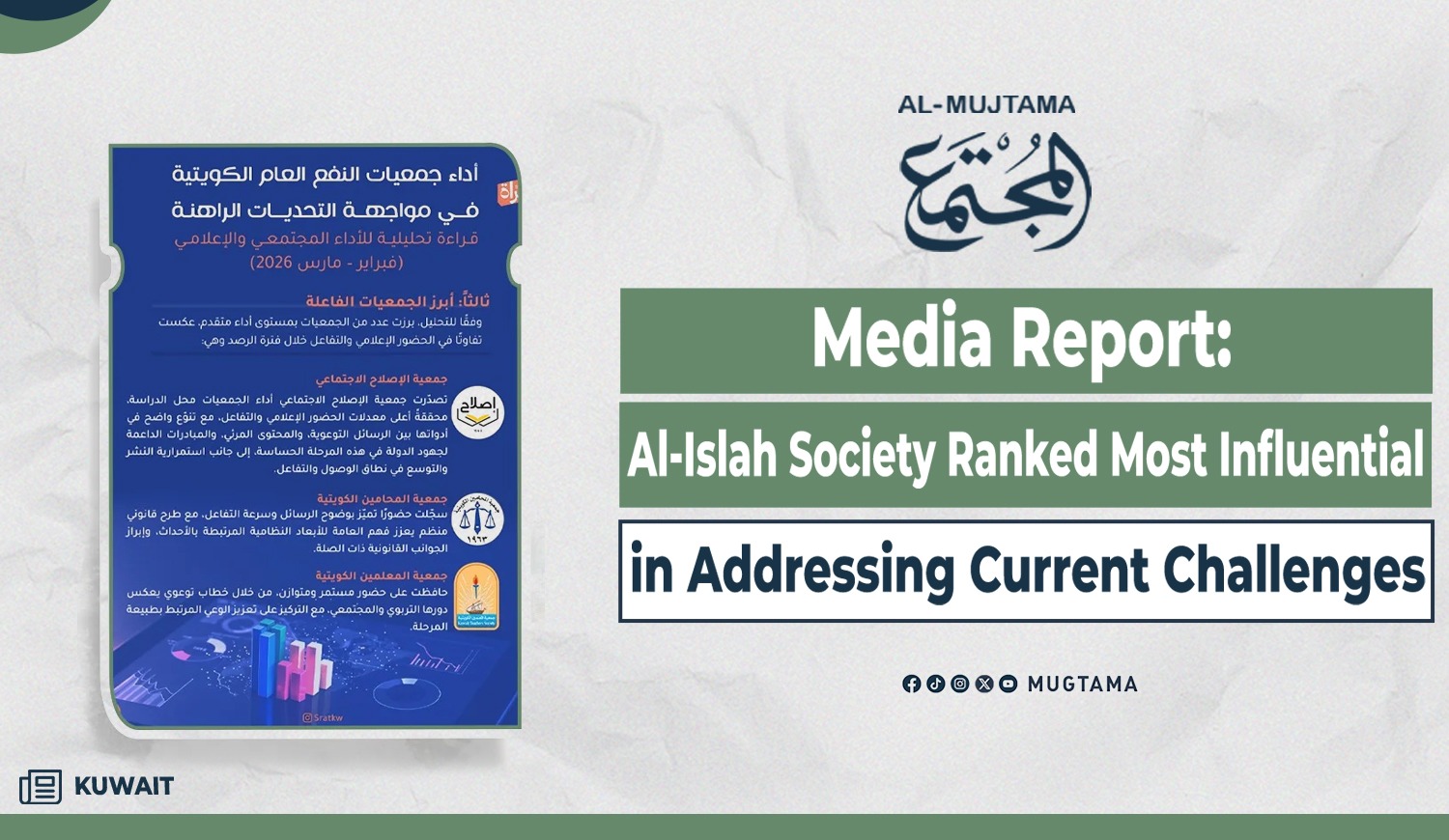
A recent analytical media report revealed that the Social Reform Society has taken the
lead in the Kuwaiti scene as the top institutional entity among public benefit
associations in terms of the strength and effectiveness of its media and
societal performance. This comes amid the exceptional circumstances the country
is experiencing following the unjust Iranian attack.
The
report, issued by the “Srat” platform under the title “Performance of
Kuwaiti Public Benefit Associations in Facing Current Challenges
(February–March 2026)”, showed that civil society institutions have emerged
as a key supporter of state efforts in protecting the internal front,
maintaining public stability, and strengthening societal resilience—drawing
inspiration from the historical role these associations played during the Iraqi
invasion crisis.
Reasons Behind Leadership and Excellence
According
to the analysis results, Al-Islah Society achieved the highest levels of media
presence and digital engagement, excelling due to the clear and well-planned
diversity in its tools. It professionally combined awareness messages with
visual content, alongside launching field initiatives that supported the
efforts of state institutions during this sensitive phase.
The Society
also stood out through its consistent and uninterrupted publishing, which
significantly expanded its reach and generated positive public engagement.
In
addition to Al-Islah’s leadership, the report praised the performance of other
active associations, including the Kuwaiti Lawyers Association, which
demonstrated a strong presence through clear messaging and rapid response with
structured legal discourse, and the Kuwaiti Teachers Society, which maintained
a balanced and continuous presence through messaging that reflects its
educational and societal role.
Key Metrics and Speed of Response
The
report’s methodology was based on monitoring and analyzing the media content
and activities of a sample of 10 associations during the period from February
28 to March 28, 2026. It relied on five precise criteria: official statements,
awareness messages, visual content, community initiatives, and the level of
support for state institutions.
Regarding
estimated quantitative indicators, the report noted that the average response
time to events and developments ranged between only 8 to 18 hours.
Visual
content (video) proved to be the most influential tool, accounting for 30% to
40% of total published content, with an average of 2 to 4 posts per day among
active entities.
The
report also indicated that only 30% of the sample maintained continuous
(near-daily) presence, while 40% had limited or interrupted activity.
Additionally, between 15 to 20 publicly announced initiatives and community
activities were recorded.
Strategic Recommendations for
Institutional Media Performance
The
analytical assessment concluded that the most influential associations were
those that maintained consistency, delivered clear and context-driven messages,
effectively utilized visual content, and proactively launched initiatives
aligned with current events.
The
report concluded by presenting a set of recommendations to enhance
institutional performance, most prominently: establishing specialized media units within public
benefit associations, developing crisis communication management skills,
aligning messaging with official entities, investing heavily in visual content,
and preparing proactive media emergency plans.
It
emphasized a fundamental principle: that influence during times of crisis is
not measured solely by the volume of presence, but by the quality of messaging,
continuity of engagement, and the ability to keep pace with events in support
of the state’s overall efforts.
For Further Reading:
- 10 Values Guiding the Work of the Social Reform Society
- Aggression Against Concepts!
- A Message to the World from Kuwait
-------------------------------------------------------------