









January 5 Marks Zionist Assassination of Yahya Ayyash
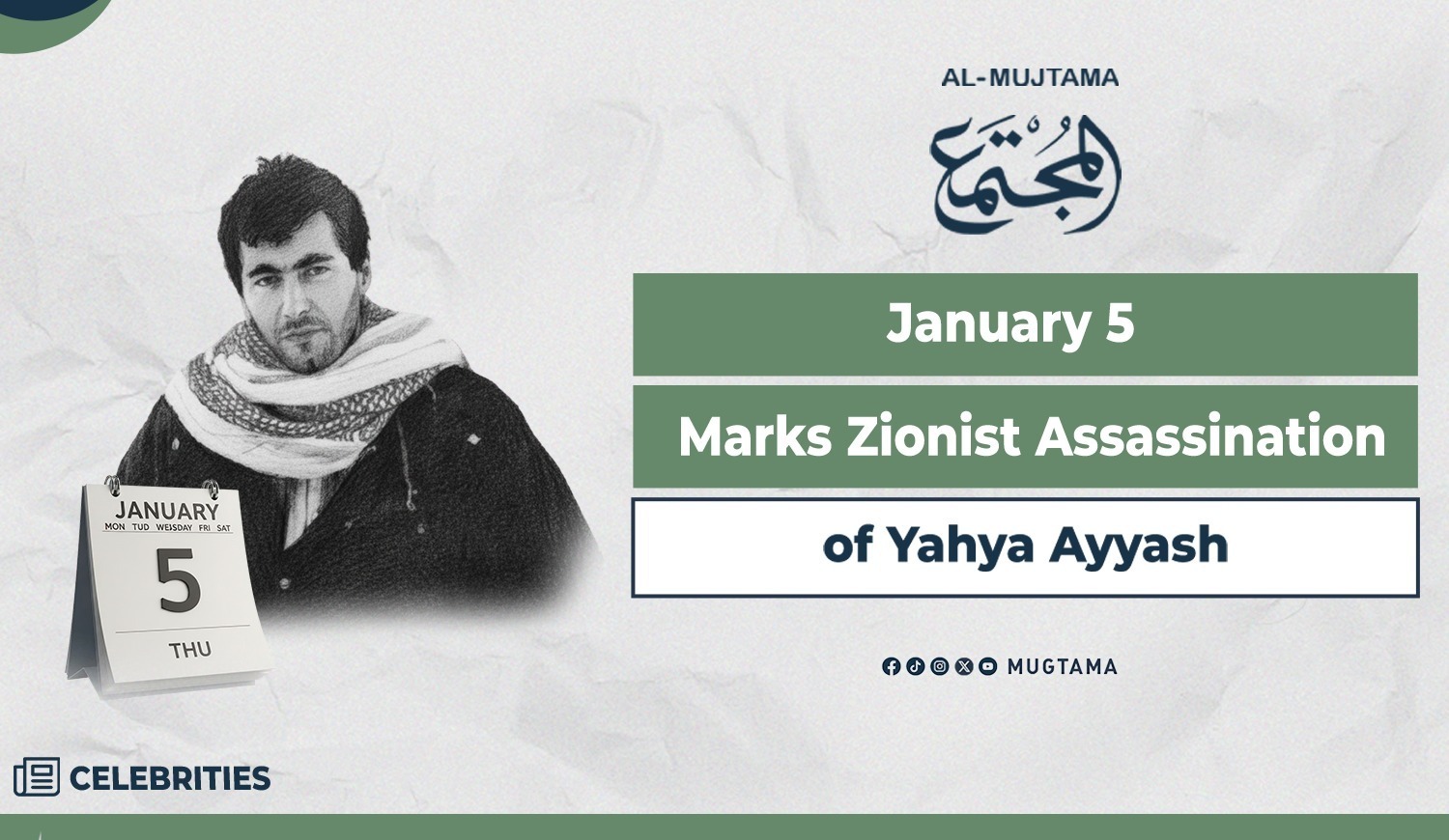
"I fear that Ayyash is sitting among us
right now in the Knesset." With this admission, steeped in a sense of
defeat, former Israeli Prime Minister Yitzhak Rabin captured the state of
paranoia that rattled the foundations of the Israeli security establishment in
the 1990s. Yahya Ayyash was never just another name on a "most
wanted" list; he was a living technical and military nightmare.
Thirty
years on, the resonance of Yahya Ayyash—the man known as 'The Engineer'—is still
felt in every corner of Palestine, his influence outliving his final moments.
Early Life and Education: Glimpses of
Genius
Yahya
Abd al-Latif Ayyash was born in March 1966 in the serene West Bank village of Rafat. From a young age,
he stood apart from his peers, characterized by a profound calmness and an
obsession with reading and dismantling electronics. His academic brilliance led
him to Birzeit
University, where he graduated with honors in electrical engineering in 1991.
Ayyash dreamed of pursuing postgraduate studies in Jordan, but the Israeli
occupation barred his travel for "security reasons." This travel ban
served as the catalyst—the fuel that ignited his genius—as he pivoted from
academia to authoring his own thesis in the "Engineering of
Resistance."
Against All Odds: The Journey from the
West Bank to Gaza
Once
he became the West Bank’s most wanted man, and as his options for concealment
dwindled, Ayyash decided to move to the Gaza Strip to transfer his expertise
and expand operations. The transit itself was a profound intelligence coup; in
late 1994, he was smuggled inside a wooden crate hidden within a produce truck.
He bypassed heavily fortified Israeli checkpoints undetected, arriving in Gaza
to begin what would be his most perilous chapter.
Yahya
Ayyash’s transit to Gaza was a turning point that transcended individual
survival; it was a paradigm shift in weaponry. Under his guidance, Gaza's
clandestine workshops evolved from makeshift operations into professional
manufacturing hubs. The knowledge he shared regarding chemical explosives
became the cornerstone of a legacy, eventually evolving into the expansive
missile arsenal witnessed in the territory today.
Death Out of Nothing: The Operations
that Rattled the Security Establishment to its Core
Yahya
Ayyash’s operations were never mere fleeting explosions; they were
"political and military messages" encoded in gunpowder. Ayyash’s
genius lay in his pioneering of "grassroots explosives technology."
He possessed the uncanny ability to transform mundane chemicals—found in local
pharmacies and agricultural stores—into explosive charges that surpassed
conventional military-grade munitions in their sheer potency.
The Debut: The Enigma of "Ramat
Ef’al" (1992) This operation served
as Ayyash’s military "birth certificate." He rigged a car bomb and
positioned it in the Ramat Ef’al neighborhood of Tel Aviv. While the device
malfunctioned and failed to detonate, the subsequent investigation by Shin Bet
(Shabak) explosives experts left them in a state of shock. Upon examination,
they discovered intricate electrical circuitry and a novel explosive mixture unlike
anything they had encountered before. It was the moment the Israeli security
establishment realized a new "engineering mastermind" had officially
entered the fray.
The
Seismic Retaliation: Avenging the Ibrahimi Mosque Massacre (1994) Following the
massacre at the Ibrahimi Mosque in Hebron, Ayyash vowed a "seismic,"
five-fold response. During this phase, "The Engineer" shifted the
theater of operations deep into the heart of Israeli cities (inside the Green
Line):
- The Afula Operation
(April 6, 1994): Marking the 40th day since the massacre, one of Ayyash’s
protégés, Raed Zakarneh, detonated a car bomb next to an Israeli bus,
killing eight and wounding thirty. The shock for the security
establishment lay in Ayyash’s ability to breach high-level security cordons.
- The Hadera Operation
(April 13, 1994): Just one week later, and at the height of a nationwide
security alert, Ammar Amarna blew himself up on a bus in Hadera. The
attack, which killed seven, solidified Ayyash's reputation for being able
to strike at will, regardless of the state of mobilization.
The
Dizengoff Operation: The Blow that Shook Rabin to his Core :
On
October 19, 1994, Yahya Ayyash orchestrated his most lethal and intricate
operation to date. He engineered a suitcase bomb packed with high-potency
chemical explosives and nails—designed to maximize casualties—which was carried
by Saleh Nazzal onto Bus No. 5 in the heart of Tel Aviv’s Dizengoff Street. The
blast killed 22 Israelis and wounded over 40 others, transforming the iconic
thoroughfare into a grim war zone. The magnitude of the attack forced Prime
Minister Yitzhak Rabin to abruptly cut short an overseas trip, later prompting
his haunting admission regarding his fear of Ayyash’s invisible presence even
within the halls of the Knesset. This operation cemented "The
Engineer's" status as "Public Enemy No. 1" for the Israeli
security establishment and its global allies.
The Assassination: The Call That Ended
in an Explosion
On
January 5, 1996, one of the most sophisticated technical operations in the
history of the conflict was executed to assassinate Yahya Ayyash. It’s shocking
details were laid bare 24 years later by Israel’s Channel 13, through leaked
recordings from the Shin Bet’s "Black Room." Within the labs of
Israeli intelligence, a Motorola mobile phone was meticulously dismantled; 50
grams of high-explosive RDX were planted directly behind the earpiece in a
professional manner that left no trace. Reassembled and handed to collaborator
Kamal Hammad, the device was delivered to the home of his nephew, Osama
Hammad—where "The Engineer" was hiding—under the guise that it was a
secure and "clean" line of communication.
The
leaked recordings capture the nerve-wracking moments inside the Israeli command
center. As an AWACS aircraft circled Gaza’s skies to ensure a flawless wireless
link, the trap was sprung. The moment Ayyash answered his father’s call, his
voiceprint was electronically verified within seconds. At that precise instant,
Shin Bet Director Carmi Gillon gave the final order to press the remote
trigger. The earpiece detonated in Ayyash’s ear, ending his life instantly
The
departure of "The Engineer" in 1996 did not mark the end of his
story; rather, it signaled the birth of a new generation that evolved "IED
engineering" into "long-range missile engineering." This legacy
was most vividly realized when the Al-Qassam Brigades introduced the
"Ayyash 250" into service—the most powerful and longest-range rocket
in their arsenal, named in his honor. On May 13, 2021, during the "Sword
of Jerusalem" battle, this missile made its operational debut by striking
Ramon Airport in the far south, once again upending Israeli security doctrine
with a range exceeding 250 kilometers.
You may also like:
Voice of Battalions: The Masked Man, A Symbol of
Resistance
Meet the five Al-Qassam leaders mourned by the group
On the 9th Anniversary of Al-Zawari's Martyrdom: The
Other Side of the 'Ababil' Engineer