



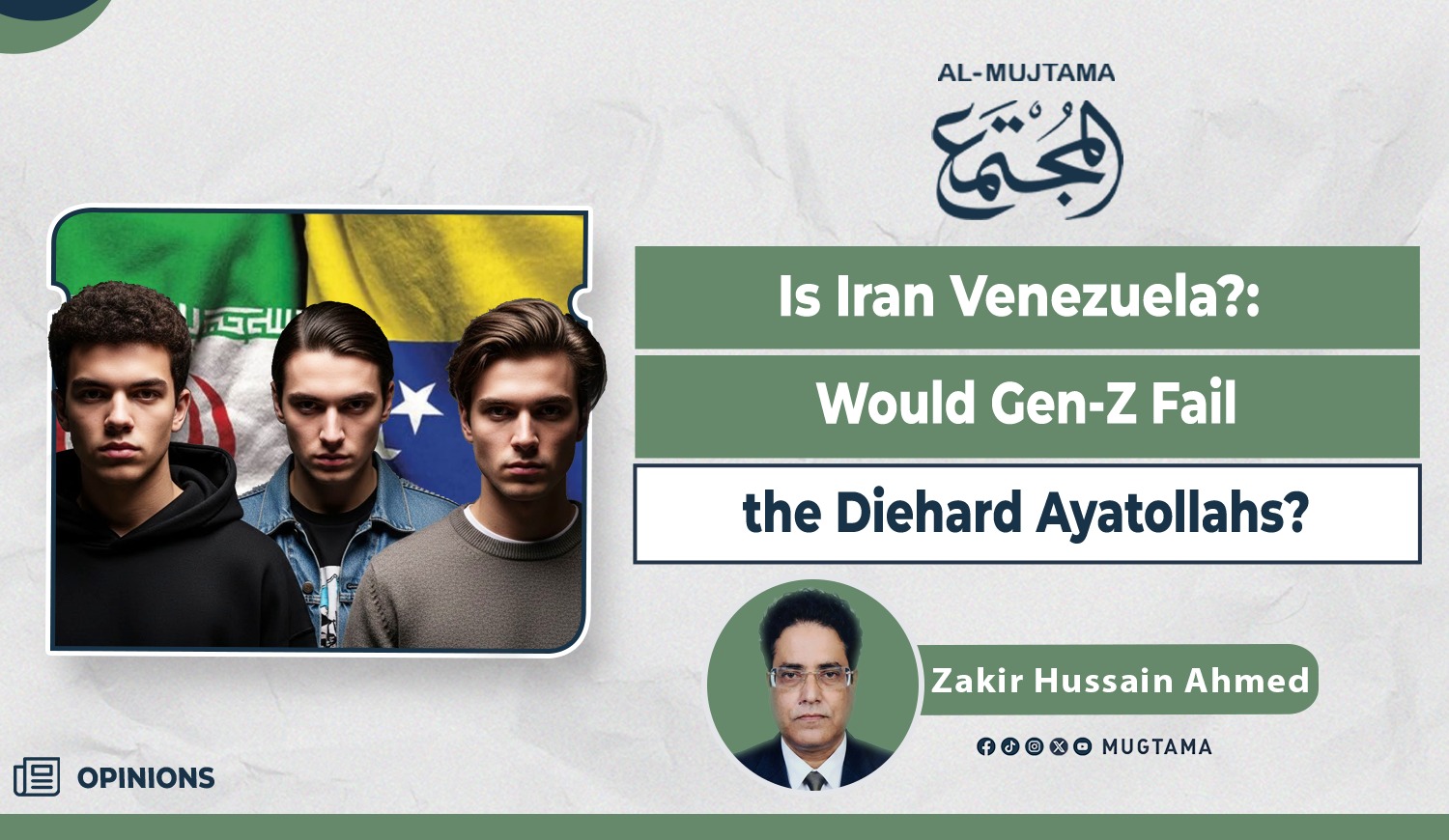
Is Iran Venezuela: Would Gen-Z Fail the Diehard Ayatollahs?
President Donald
Trump has once again assured the US “intervention” to rescue protesters
in Iran. The world is watching the so-called Gen-Z protests with caution, while
a large segment of global opinion, largely shaped by Western media, portrays
the Islamic Republic as fragile and perhaps collapsing, much like Venezuela. US
fighter jets stationed at Al-Udeid Air Base in Qatar are often cited as ready
to act on Washington’s command.
Why Iran Is Not Venezuela
Given Iran’s
severe economic distress and mounting social pressures, such
assessments may appear persuasive. Yet, in practical terms, Iran is not
Venezuela. Unlike Caracas, Tehran retains robust state institutions, a coherent
military doctrine, ideological legitimacy among large sections of society, and
a deeply entrenched regional deterrence architecture. Venezuela collapsed under
sanctions because it lacked strategic depth, reliable allies, and an autonomous
defence capability. Iran, by contrast, remains capable of mounting a credible
counter-response even against combined Israel–US pressure.
Netanyahu, Trump, and the Shifting Logic of US Policy
It is true that whenever Prime
Minister Benjamin Netanyahu visits President Trump in the Oval Office,
he often returns with ambitious and aggressive plans. However, past US
administrations, particularly those of George W. Bush and Barack Obama,
demonstrated a clearer understanding of regional realities, including Iran’s
ability to absorb shocks and retaliate against US allies. During their tenures,
Washington was not perceived as being driven from Tel Aviv. Neither AIPAC nor
any single foreign leader exercised decisive control over US policy, nor was
foreign policy shaped by the transactional instincts (MAGA) of a
business-oriented president like Trump.
Nature of the Current Unrest in Iran
The current unrest in Iran
does not appear aimed at outright regime collapse or a Mossadegh-style
overthrow. Rather, it seems calibrated to distract Tehran and entangle
resistance forces in limited internal strife, thereby giving Israeli room to
capture the entire Palestine. Iran, it appears to be targeted more seriously at
a later stage.
The Gen‑Z Movement: Overstated and Unsustainable
For now, the Gen-Z
narrative in Iran appears overstated. Excessive enthusiasm is misplaced.
The movement is likely to lose momentum, potentially ending in disillusionment
among anti-government elements rather than systemic change.
Unintended Consequences: Iran Exposes Sleeper Cells
Ironically, US-Israeli pressure has
once again provided Tehran
an opportunity to identify and neutralize sleeper cells, particularly within
university campuses. This is the second instance in which external intervention
has inadvertently helped the Iranian state expose pro-Shah networks embedded in
society. During recent Israel-US attacks, including B-bombers targeting Fordow,
Iran reportedly dismantled several anti-government cells.
Israel’s Declining Intelligence Reach in Iran
Israel is gradually losing the
intelligence networks that once deeply penetrated Iranian society and
administration. Though delayed, Iran is now moving toward a self-sustaining
posture of defence and strategic confidence. Its post-war relations with China
and Russia have also transformed; neither power remains hesitant or ambivalent.
Global Tensions and the Expanding Geopolitical Chessboard
As tensions rise globally,
particularly in the Indo-Pacific, the declaration of Somaliland’s independence
near China’s only overseas military base in Djibouti has heightened Beijing’s
strategic anxieties. China has invested in 100 ports in 63 countries. Trump’s
threat to seize the Panama Canal, a critical artery for China’s access to Latin
American markets, has further escalated tensions. Meanwhile, US-Israeli inroads
into Central Asia, such as Azerbaijan and Kazakhstan aligning with the Abraham
Accords, have further unsettled Moscow, while Ukraine continues to bleed
Moscow.
China and Russia Build Counter‑Pressure Points
In response, China
and Russia are developing counter-pressure points within US-Israeli
spheres of influence. Under these conditions, strengthening Iran economically
and militarily has become a strategic necessity for Beijing and Moscow, not
merely a favour to Tehran.
Iran’s Evolving Military Doctrine
Iran’s evolving military doctrine now
reflects near superpower-level competence and a sophisticated grasp of modern
warfare. Tehran has focused heavily on hypersonic missiles, advanced drone
warfare, space capabilities, and indigenous small-arms production. Compared to
earlier strikes, recent missile and drone attacks demonstrated greater
precision and lethality.
Hypersonic Missiles and the Erosion of Israeli Deterrence
Hypersonic missiles reportedly
penetrated multiple layers of missile defence across the Persian Gulf, Jordan,
the Mediterranean, and Israel, including Arrow, David’s Sling, and Iron Dome.
The use of inexpensive drones followed by hypersonic missiles has severely
undermined Israel’s aura of invincibility. The strike on Al-Udeid Air Base in
Qatar further signalled Tehran’s willingness to punish Gulf states cooperating
with Washington and Tel Aviv.
Fordow: A Failed Strike and Lingering Doubts
The B-bomber attacks on the Fordow
nuclear facility also failed to achieve their stated objectives. Even the
Pentagon contradicted President Trump’s claim that the site had been destroyed.
Israel’s subsequent bombardment of the Fordow gate itself suggested lingering
uncertainty about mission success.
Iran’s Expanding Military Partnerships
Russia and China are now reportedly
supplying Iran with advanced stealth fighter aircraft, missile-defence systems,
and satellite support for precision targeting.
The Three Pillars of the Israel‑US Strategy
The Israel-US
strategy appears to have pursued three objectives: first, the
destruction of Iran’s nuclear facilities, despite Tehran’s claim that its
programme falls within its rights under the Nuclear Non-Proliferation Treaty,
of which Iran was an early signatory. Second, the targeting of civilian
infrastructure, particularly oil and gas installations, to induce economic
collapse and social unrest. Third, regime change and the dismantling of the
Islamic system established in 1979.
Netanyahu’s Calls and Iran’s Economic Crisis
Prime Minister Netanyahu has
repeatedly urged the Iranian public to rise against their government, promising
full external support. Undeniably, Iran is passing through one of its most
difficult phases. The economy is near stagnation, the rial has collapsed—one US
dollar now approaching 100,000 rials, exports have slowed, essential goods are
scarce, inflation exceeds 50%, and fiscal pressure has crossed sustainable
limits.
Internal Weaknesses and Structural Failures
Yet the Islamic government must also
introspect and clean the system of corruption, mismanagement, and declining
external networks. The protests initially began among merchants and
shopkeepers. The crisis intensified after comprehensive EU sanctions, while
Tehran failed to diversify exports beyond oil. China remains the primary buyer,
but its economic slowdown and engagement with Gulf oil producers limit its
capacity to absorb more Iranian crude. Russia’s discounted oil exports have
further eroded Iran’s market share.
Public Opinion and the Logic of National Crisis
Public opinion in Iran remains
divided. Many view the protests as foreign-engineered. If Israel attacks Iran
at this stage, the unrest is likely to dissipate, giving the state
justification for a harsh crackdown. History shows that Iranians rarely revolt
against the state during national crises, regardless of corruption or
misgovernance.
A Pretext for Escalation
Paradoxically, the unrest also offers
Tehran a pretext to escalate confrontation with Israel.
Global Consequences of a Hypothetical Collapse
If the Gen-Z movement were ever to
succeed, it would not be isolated or episodic. Unlike Nepal, Sri Lanka, or
Bangladesh, the collapse of the Islamic Republic would carry global
consequences. Shockwaves would reverberate through Riyadh, Islamabad, Beijing,
Moscow, Brussels, Brasília, and beyond.
Why Iran Cannot Be Treated Like Venezuela
Circumstances demonstrate that the
United States cannot treat Iran as it treated Venezuela,
nor Khamenei as it treated Maduro. Israel remains Washington’s nearest and most
prized pressure point, and Tehran has already demonstrated both the will and
the capability to respond to Israeli attacks. Post-1979 Iran is not merely a
political entity; it is an ideology. Tehran taps 19% of global crude, passing
through Hormuz. This distinction requires careful understanding in Washington.
Nevertheless, President Trump is unpredictable, while Prime Minister Netanyahu
is a charmer who may yet entice him with visions of a Riviera, a Trump Tower,
and gas-drilling hubs along the IMEC corridor.
-------------
Disclaimer:
The views and opinions expressed on this site are those of the writers and do not necessarily reflect the opinions or positions of Al-Mujtama Magazine.