







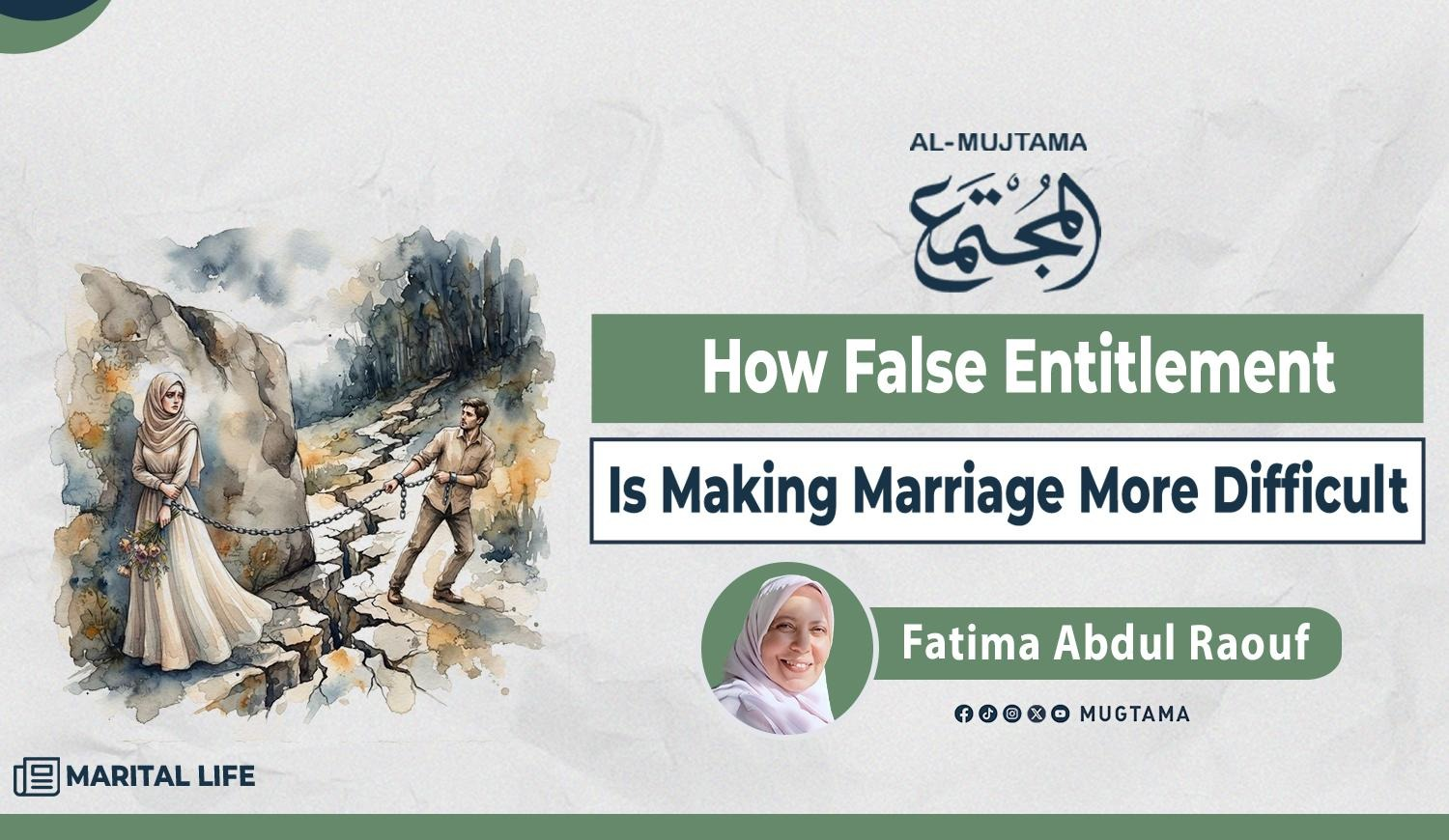
How False Entitlement Is Making Marriage More Difficult
Anyone following the affairs of the
Muslim family in general will notice the growing phenomenon that we might call
the “difficulty of marriage”: the increasing difficulty of forming a family in
the first place, coupled with the ease with which it later falls apart.
Data from the World Population Review
website showed that the average age of marriage for women in Lebanon and
Algeria has exceeded 30, while the average age for men has exceeded 32.
Meanwhile, the average age of marriage for women in Saudi Arabia was 26,
compared with 27.5 for men. In Tunisia and Egypt, the average age of marriage
for men has exceeded 30, while the average age of marriage for Tunisian women
was 28, and the average age of marriage for Egyptian women was 25.
These figures cannot be explained
solely by the difficult economic circumstances facing young people, although we certainly do not
underestimate their importance. Rather, they point to deep cultural and
psychological transformations that have reshaped young people’s views of
marriage and their expectations of it.
Among these transformations, one that
has not received sufficient attention from family researchers despite its
seriousness is the growing sense of entitlement among members of society,
particularly among millennials.
As successive waves of globalization
culminated in digital globalization, a culture of individualism became
widespread as one of the outcomes of global capitalism, and individualism
became closely associated with the idea of a heightened sense of entitlement.
Types of Entitlement
Here, we can distinguish between two
types of entitlement:
1. Legitimate Entitlement
This includes what we might call merit
or qualification; that is, a person is deserving of something because of the
effort they have made and the work they have done to develop themselves. A
woman who has received a high-quality education deserves to marry a suitable
man who has received a similarly high-quality education.
Likewise, a man who fulfills his
financial responsibility to the extent of his ability deserves his wife’s
obedience, and so on.
There are also fundamental human
rights that every person is entitled to simply by virtue of existence. The fact
that you exist means that you deserve dignity because Allah Almighty has
decreed that you be granted this right. Therefore, it is an inherent right: {Indeed, We have dignified the children of Adam.}
[Al-Isra’ 17:70]
2. False Entitlement
This occurs when a person believes
that they deserve the best job opportunity, the highest income, the best
possible spouse, special treatment, and the service of others, without ever
considering what they can offer in return or what abilities they possess that
would make them deserving of such privileges. Psychologists sometimes refer to
this as psychological entitlement.
Some self-help discourse, which
reflects cultural trends emerging in the West, has played a major role in
increasing this false sense of entitlement. In fact, it has linked a high sense
of entitlement to self-confidence and to obtaining what a person believes they
have a right to.
At the same time, it has associated a
realistic view of circumstances with low self-confidence and a low sense of
entitlement, and therefore with losing opportunities for happiness and success.
The Growing Difficulty of Marriage
If we look at the reality of marriage
today, we find that young men and women spend many years waiting for the ideal
spouse they believe they deserve. Theoretically, these young people believe
that no human being is perfect and that no ideal person exists. Yet, in
practice, many suitable and qualified people are rejected because of a
secondary flaw or a limited shortcoming.
The search has shifted from
compatibility and merit to perfection, and this has become an important factor
behind the growing difficulty of marriage.
Because they believe they deserve the
best, young men and women enter marriage with extremely high expectations that
soon collapse. At that point, what is known as “marriage shock” occurs. They
experience a state of disappointment that may reach the point of depression,
and they may seriously consider divorce because the marriage has not given them
the emotions they believe they deserve.
As a result, they do not feel
comfortable in the marriage without making the effort and investment required
to build it.
The absence of the values of patience,
sacrifice, and overlooking minor faults is an inevitable consequence of a
philosophy based on high entitlement. This set of values is sometimes labeled
as negative because it supposedly prevents a person from achieving the
happiness they believe they deserve.
The philosophy of false, excessive
entitlement has become associated with a state of deep psychological fragility
affecting some young people who are unable to deal with ordinary, temporary,
and relatively simple marital problems arising from the fact that two people
with different upbringings, backgrounds, and personalities are sharing all the
small details of life together.
This is the fragile person living in a
world of emotional instability, who knows only fragile forms of love. It is a
concept used by Zygmunt Bauman, who titled his book Liquid Love, in
which he discusses the fragility of some human relationships.
Social Media and the Rise of False
Entitlement
We cannot discuss false entitlement
without addressing the role of social media in creating and amplifying it, to
the point where it has become an almost widespread social affliction. Social
media spreads excessive entitlement through two main mechanisms:
1. Popular Psychology and the
Culture of Entitlement
The first is through the spread of
short videos and brief posts written in simple language, falling under what we
might call “popular psychology,” which overlaps in some of its ideas with the
common discourse of self-help and personal development.
These posts and attractively produced
videos have played a role in spreading and promoting a culture of excessive
entitlement. Their message often focuses on the idea that the more you feel you
deserve something, and the more deeply you believe that you deserve it, the
more likely it is to become yours.
You are the sole person responsible
for your happiness, according to how much you trust yourself and how much you
believe you deserve.
2. Social Media Algorithms and
the Comparison Trap
The second is the way these platforms’
algorithms operate. They have helped spread the culture of the selfie, and it
is only natural that most people have rushed to share their happiest, most
remarkable, and most successful moments, following the example of influencers.
The matter has reached the point of
exaggeration and boasting in pursuit of likes and engagement, creating a state
of competition.
This has made the question of
entitlement strongly present in people’s consciousness: Why did my friend
deserve to have a lavish wedding, receive an expensive bridal jewelry set, and
spend the first days of her marriage at a luxurious resort? She is no better
than I am. So I deserve the same.
If someone proposes to me who cannot
provide what I deserve, why should I accept him?
If a woman who has fallen victim to
what is published on social media platforms—and to the unfair comparison
between an entire life and carefully selected moments designed for public
display—is already married, she may begin to resent her married life because it
does not provide her with what she believes she deserves.
She may enter a cycle of complaints,
pain, and dissatisfaction, which could eventually lead her to end her marriage
in pursuit of what she believes is a better opportunity for her life.
Capitalism, Individualism, and the
Illusion of Entitlement
There appears to be an urgent need for
a critical examination of many of the concepts and terms produced by the
capitalist system and its reinforcement of consumerism and individualism, which
have transformed human beings into materialistic and insatiable creatures who
are never satisfied.
Capitalism has formulated a philosophy
filled with misguided ideas and turned psychological entitlement into a virtue.
It has spread these ideas through simple and attractive methods that appeal to
the lower instincts of human beings who have lost sight of the greater meanings
of life.
There is no alternative to exposing
and dismantling these ideas for young people and connecting this discussion to
a different understanding of existence: one in which seeking the pleasure of
Allah is the ultimate goal.
It is essential to understand that
human dignity is a gift from the Almighty Creator, that a person’s confidence
in themselves is an outcome of their confidence in their Lord and their good
expectations of Him, and that contentment does not contradict striving. Rather,
contentment accompanies and follows striving regardless of the outcome, because
this is part of the belief in divine destiny, with both its good and difficult
dimensions.
Young people must understand that,
according to our Islamic philosophy, one must strive, place one’s trust in
Allah, remain content, and think well of Allah.
In light of this, a young man or woman should assess the limits of their abilities and capabilities and set their expectations accordingly. Then, they should never stop striving and doing what is best afterward.
-------------------------------------------------------------