





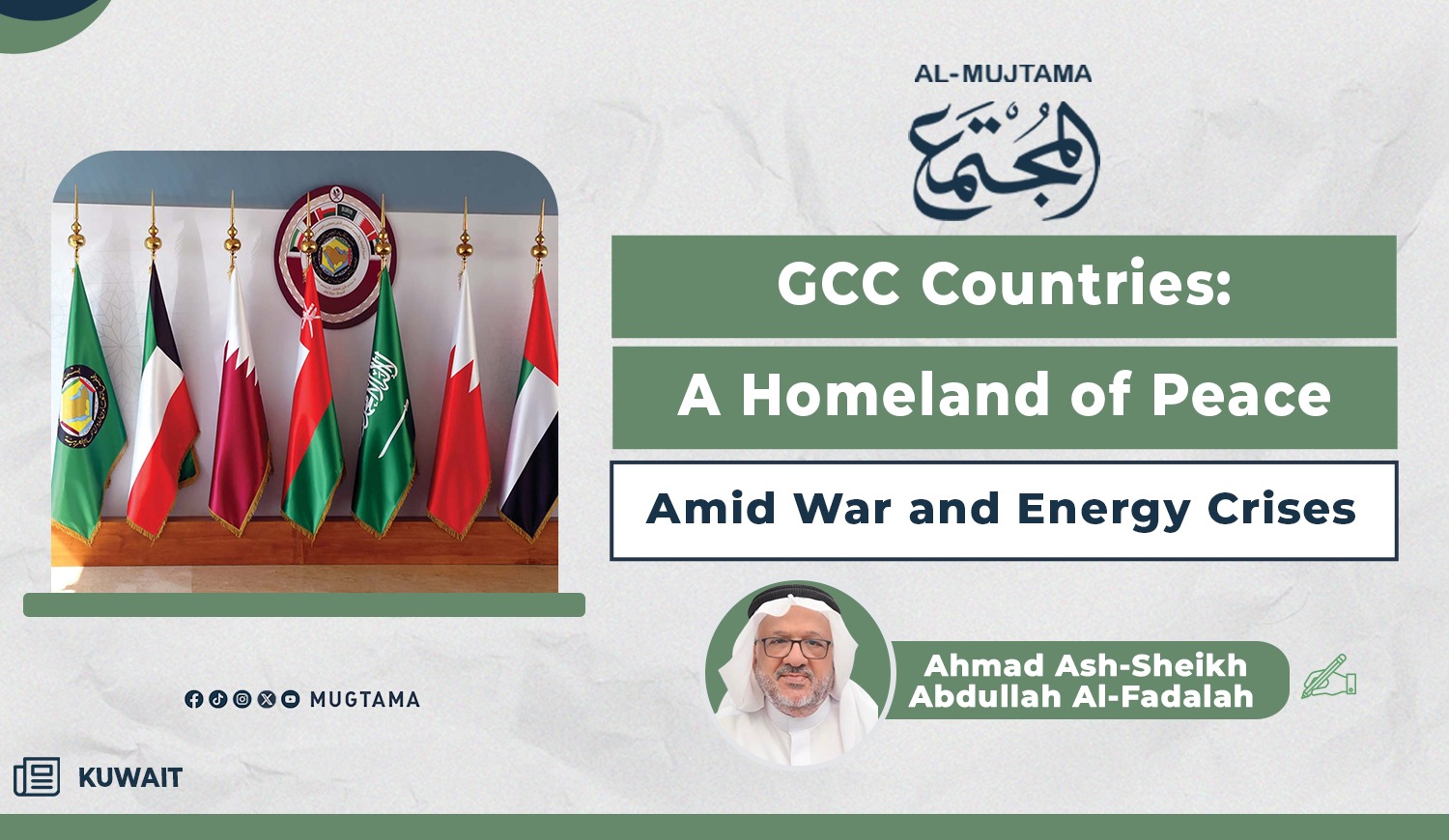
GCC Countries: A Homeland of Peace Amid War and Energy Crises

Not just
lines on a map or flags raised on occasions, nations are history, memory, and a
shared destiny—one whose reality is tested whenever dangers draw near to their
skies and borders. Therefore, love of the homeland is not tested in times of
calm and prosperity, but in moments of anxiety when threats approach. It is
then that the difference becomes clear between those who merely repeat love of homeland in words and those who translate it into stance and
responsibility.
When Crisis Reveals the True Meaning of
Patriotism
The
Arabian Gulf region entered a new phase of tension on Saturday, February 28,
2026, following the outbreak of war between Iran
on one side and the United States, along with the Zionist entity, on the other.
This was followed by regional and international escalation involving additional
global actors. As the circle of confrontation expanded, its effects extended
across the region, directly impacting the security and stability of the Gulf
Cooperation Council (GCC) countries.
Amid
these developments, vital facilities across all GCC countries were subjected to
attacks by missiles and drones, resulting in civilian casualties. These
assaults targeted civilian and economic infrastructure that represent essential
pillars of life and development. The attacks included critical infrastructure
such as oil fields, desalination plants, electricity generation and supply
stations, oil refineries, as well as other industrial and service facilities.
Energy Security in the Gulf: A Pillar of
Global Stability
It is
clear that targeting such facilities does not only affect the countries of the
region; its impact extends to the entire global economy. GCC countries are
among the world’s most important centers for energy production and export. Any
disruption to oil facilities or supply chains directly affects international
markets, energy prices, and global supply systems.
Indeed,
signs of concern have already begun to appear in energy markets, raising the
possibility that this escalation could develop into an economic crisis
affecting many countries worldwide. Disruptions to maritime shipping routes,
along with attacks on ships and oil tankers, have significantly impacted the
transportation of energy and goods through international maritime corridors. In
addition, such incidents may result in serious marine pollution due to oil
spills in seas and oceans.
However,
what distinguishes GCC countries throughout their modern history is that they
have never been advocates of war. Rather, they have consistently chosen the
path of peace, development, and cooperation. Since the establishment of the
GCC, these states have represented a regional model of economic integration and
political coordination, continuously striving to promote stability and enhance
prosperity for their peoples.
Nations Are Strengthened by Unity
In times
like these, the true nature of nations becomes clear. Strong nations are not
those that never face crises, but those whose people unite around them when
crises occur. In such moments, the true meaning of love of homeland emerges—not as mere emotion, but as awareness,
responsibility, and behavior. Protecting the security of these countries is not
solely the responsibility of governments; it is a shared duty between leaders
and citizens, built upon awareness, unity, and a strengthened sense of belonging.
Love of homeland is not a slogan raised during occasions; it is a
system of values and behaviors reflected in respecting the law, preserving
public property, strengthening social solidarity, and standing united behind
the nation’s higher interests.
At such
moments, the essence of nations becomes evident. They are not built by stones
alone, but by the hearts of their people. When awareness meets belonging, and
unity joins responsibility, nations become stronger than any storm.
Amid
these challenges, hope remains strong in the awareness and cohesion of the
peoples of the GCC countries, and in their ability to overcome crises through
solidarity and unity.
We ask
Allah to protect the GCC countries, to preserve for them the blessings of
security and stability, to safeguard their leaders, peoples, and all residents
from harm, and to keep these nations an oasis of peace, development, and
prosperity despite all storms.
For
nations endure as long as their people remain loyal to
them—standing united in hardship before ease.
For Further Reading:
- How Kuwait Became a Beacon of Peace in a Region of Conflict
- Kuwaitis: A Legacy of Kindness & Goodness
- 10 Values Guiding the Work of the Social Reform Society
-------------------------------------------------------------