








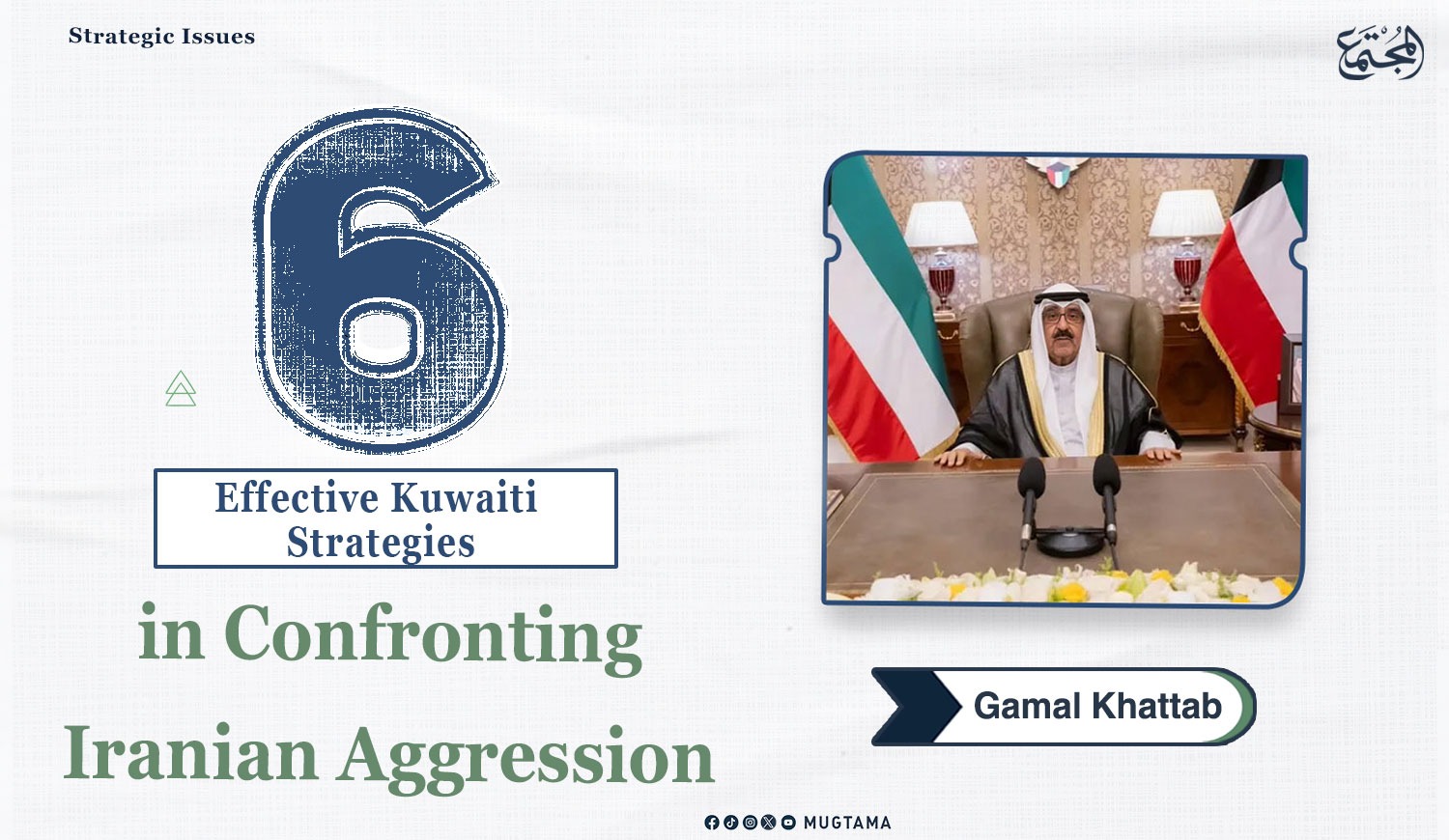
6 Effective Kuwaiti Strategies in Confronting Iranian Aggression

Strategic Issues
Geographically, Kuwait is among the
most sensitive states in the Arabian Gulf, lying in direct contact with several
regional powers. With the escalation of the “current major crisis,” marked by
waves of aggressive ballistic missile and suicide drone attacks launched from
Iranian territory, Kuwait faces a decisive test of sovereignty with remarkable
efficiency. The country demonstrates resilience rooted in rare historical
experience in confronting major crises. This resilience is deliberate and
calculated, the product of studies and strategic expertise blending “soft
diplomatic power” with “hard military strength.”
Kuwait has not relied on passive
defense. Instead, it has acted proactively, guided by a flexible security
doctrine built on six pivotal strategies. The nation has succeeded in crafting
an exceptional formula that combines the heritage of Kuwaiti diplomacy with
advanced military deterrence, transforming an existential challenge into a saga
of resilience that proves Kuwait’s ability to manage major crises and safeguard
its national entity amid the fiercest regional storms.
1. Legal Deterrence Strategy
Kuwait adopted a strategy of turning
military assaults into “legal battles” in international forums. From the moment
the first Iranian missile struck civilian facilities in Kuwait, the Foreign
Ministry documented the attack and submitted it to the UN Security Council
under the category of “explicit aggression.”
In his address to the UN General
Assembly (March 2026), Kuwait’s Foreign Minister stated: “Kuwait’s security
is not a local matter; it is a cornerstone of global economic stability. Any
violation of our sovereignty is a stab at the heart of international
covenants.” Dr. Abdullah Al-Shayji, Professor of Political Science, noted
that Kuwait succeeded in “delegitimizing” Iranian claims by proving the
civilian nature of the targeted facilities, embarrassing Tehran before the
international community.
2. Networked Air Defense System
During the intense attacks of
mid-March, Kuwait’s air defense system demonstrated unparalleled efficiency.
The strategy relied on “multi-layered defense,” integrating American Patriot
PAC-3 missiles with advanced radar systems linked to the unified GCC command
center.
Reports from Kuwait’s Ministry of
Defense (March 2026) indicate that Kuwaiti defenses intercepted 92% of hostile
targets entering Kuwaiti airspace, destroying 187 ballistic missiles and 384
drones. Kuwaiti Eurofighter Typhoon jets carried out long-range interceptions,
preventing explosive debris from reaching populated areas in the capital.
3. Securing the Home Front and Dismantling Sleeper Cells
Iran attempted to “destabilize Kuwait
from within,” but the country countered with a strict preemptive security
strategy. The Interior Ministry announced the dismantling of a spy and sabotage
network planning to strike water desalination and power plants. Security data
revealed the arrest of 24 operatives linked to the so-called “Quds Force” and
the seizure of 500 kg of C4 explosives. These preemptive strikes protected
vital infrastructure from “fifth column attacks,” preserving high morale among
the Kuwaiti people.
4. Diplomacy of Hedging and Mediation Under Fire
Despite aggression, Kuwait maintained
diplomatic channels with Tehran to prevent “sliding into full-scale war.” This
strategy kept Kuwait from impulsive reactions, instead leading a Gulf
initiative to highlight to Iran the “cost of escalation.”
The Gulf Studies Institute in
Washington notes that Kuwait leveraged balanced relations with major powers
(China, Russia, and the United States) to pressure Tehran into halting attacks
on Kuwaiti oil facilities, warning of a “global environmental and economic
catastrophe.”
5. Independent Water and Food Security Strategy
One of the gravest aspects of Iranian aggression was the attempt to impose a naval blockade and threaten desalination
plants. Kuwait responded by activating a “dual strategic reserve” strategy. The
Public Investment Authority injected immediate funds to secure alternative
supply chains via Omani ports and land transport, ensuring 100% availability of
essential goods during the crisis. Kuwait’s strategic water reserves remained
safe and sufficient thanks to expansions in the “Mutlaa” and “West Funaitees”
reservoirs.
6. Balanced Popular and Media Mobilization
Kuwait manages the battle of awareness
with rare efficiency, through vigilant national media capable of countering
attempts to spread rumors and sectarian strife via social media. In his address
to citizens, the Prime Minister affirmed: “Our national unity is the true
wall that their missiles will never breach. We are one body against any
invader.”
Volunteerism emerged as a cornerstone
of national community defense. Official volunteer platforms, led by the
“Volunteer Work Center” and the “Kuwaiti Red Crescent Society,” saw wide
participation from young national cadres. Volunteers engaged in intensive
training programs under the supervision of the General Directorate of Civil
Defense.
Kuwait confronts current challenges
and unjustified assaults through an integrated system combining military,
security, diplomatic, and economic tools, proving to the world that—despite
geographic inevitabilities—it can play major strategic roles in safeguarding
regional and global stability. The Kuwaiti experience demonstrates that true
deterrence is not limited to missiles and aircraft but lies in managing
national awareness, securing the home front, wisely leveraging international
relations, and activating strategic reserves to ensure normal life amid
threats.
Kuwait’s success in turning military
assaults into legal and diplomatic battles, thwarting internal sabotage
attempts, and preserving social unity reflects a unique model in crisis
management. The state has shown with rare efficiency that national security is
a comprehensive system where hard power and soft power intersect, official
efforts complement popular awareness, and a sober political and media discourse
strengthens trust and foils attempts to sow discord.
Once again, the Kuwaiti experience
offers a rich lesson in transforming existential challenges into opportunities
to rebuild national confidence and reinforce the state’s position in the global
order. Kuwait has never been merely a victim of aggression but has always been
an active player capable of influence and change. While the cost of escalation
remains high, the cohesion of the Kuwaiti people stands as the impregnable wall
that cannot be breached, writing a new chapter in Kuwait’s history: resilience
and awareness are the keys to survival and leadership in a turbulent world.