


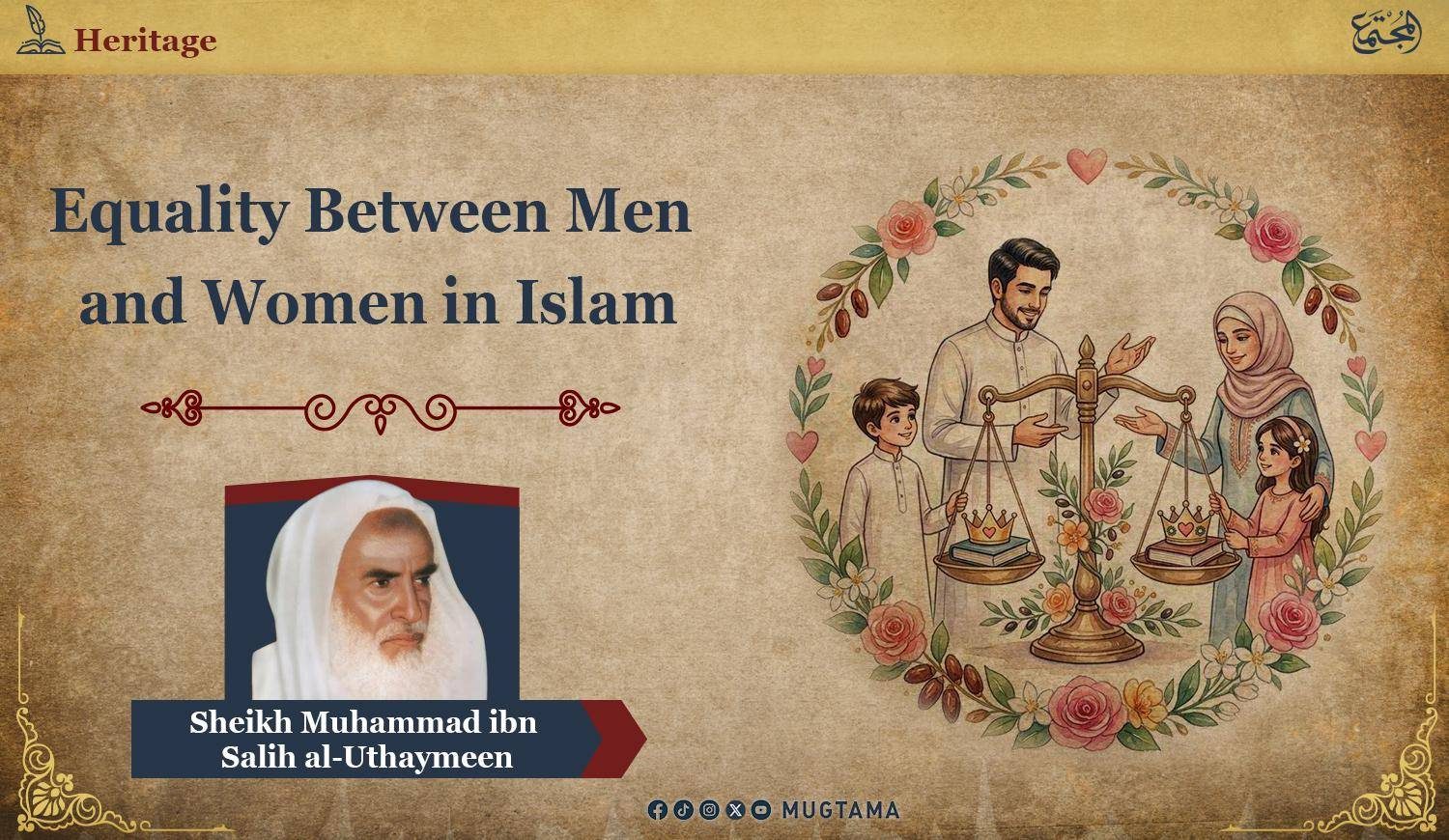
Equality Between Men and Women in Islam
Equality was never commanded in the
Quran or the Sunnah. Rather, what is commanded in the Quran and Sunnah is
justice. Allah, the Most High, says: {Indeed, Allah
commands justice, grace, as well as generosity to close relatives.} [An-Nahl
16:90]
The Prophet, peace and blessings be
upon him, said: “Be afraid of Allah, and be just
to your children.” He also said: “When
a man has two wives and he is inclined to one of them, he will come on the Day
of resurrection with a side hanging down.”
No one who understands the
implications of words can doubt that there is a significant difference between
saying justice and saying equality. Equality, in its apparent meaning, implies
treating different things as though they were the same, and this contradicts
both reason and revealed teachings.
Justice, on the
other hand, means giving everyone who has a right what they are entitled to and
placing each person in the position appropriate to them. This is what agrees
with both reason and revealed teachings.
Justice, Not Absolute Equality, in Islam
Accordingly, neither the Quran nor the
Sunnah ever commands that women be made equal to men in every respect. Rather,
both command justice, as you have heard. What I would like our writers and
intellectuals to do is to use the word justice instead of equality, because the
word equality carries ambiguity, shared meanings, and potential confusion.
Justice, by contrast, is a clear,
evident, and explicit word indicating that the intended meaning is for everyone
who has a right to be given their due.
The Quran on the Difference Between
People
If you contemplate the Quran, you will
find that much of what it contains is a negation of equality: {Those of you who donated and fought before the victory ˹over Mecca˺ are unparalleled.} [Al-Hadid 57:10]
{Those believers who
stay at home—except those with valid excuses—are not equal to those who strive
in the cause of Allah with their wealth and their lives.} [An-Nisa’ 4:95]
{Say, “Can the blind and
the sighted be equal? Or can darkness and light be equal?”} [Ar-Ra`d 13:16]
And there are many similar verses that
negate equality rather than affirm it. I know of no evidence in the Quran or
the Sunnah that commands absolute equality.
If this is the case,
then justice means that a woman should be given what is appropriate to her in
terms of roles and particular characteristics, while a man should be given what
is appropriate to him in terms of roles and particular characteristics.
Men and Women Working Together in Islam
As for men and women sharing work that
requires mixing,
conversation, looking at one another, and similar interactions, there is no
doubt that such work conflicts with what Islamic law requires according to the
Book of Allah and the Sunnah of the Messenger of Allah, peace and blessings be
upon him.
In the Book of Allah, He, the Most
High, says, {Settle in your homes, and do not
display yourselves as women did in the days of ˹pre-Islamic˺ ignorance.} [Al-Ahzab 33:33]
And He, the Most High, says, {And when you ˹believers˺ ask
his wives for something, ask them from behind a barrier. This is purer for your
hearts and theirs.} [Al-Ahzab 33:53]
If a man, even when there is a need to
address and speak with a woman, is instructed to speak to her from behind a
barrier, then what about when there is no need to do so?!
Allah’s statement, {This is purer for your hearts and theirs,} indicates
that when something contrary to this occurs, it can lead to the heart becoming
polluted and losing its purity.
It is well known that if this practice
is purer for the hearts of the Mothers of the Believers, then other women are
even more deserving of maintaining purity and distancing themselves from
anything that may pollute the heart.
-------------------------------------------------------------
