






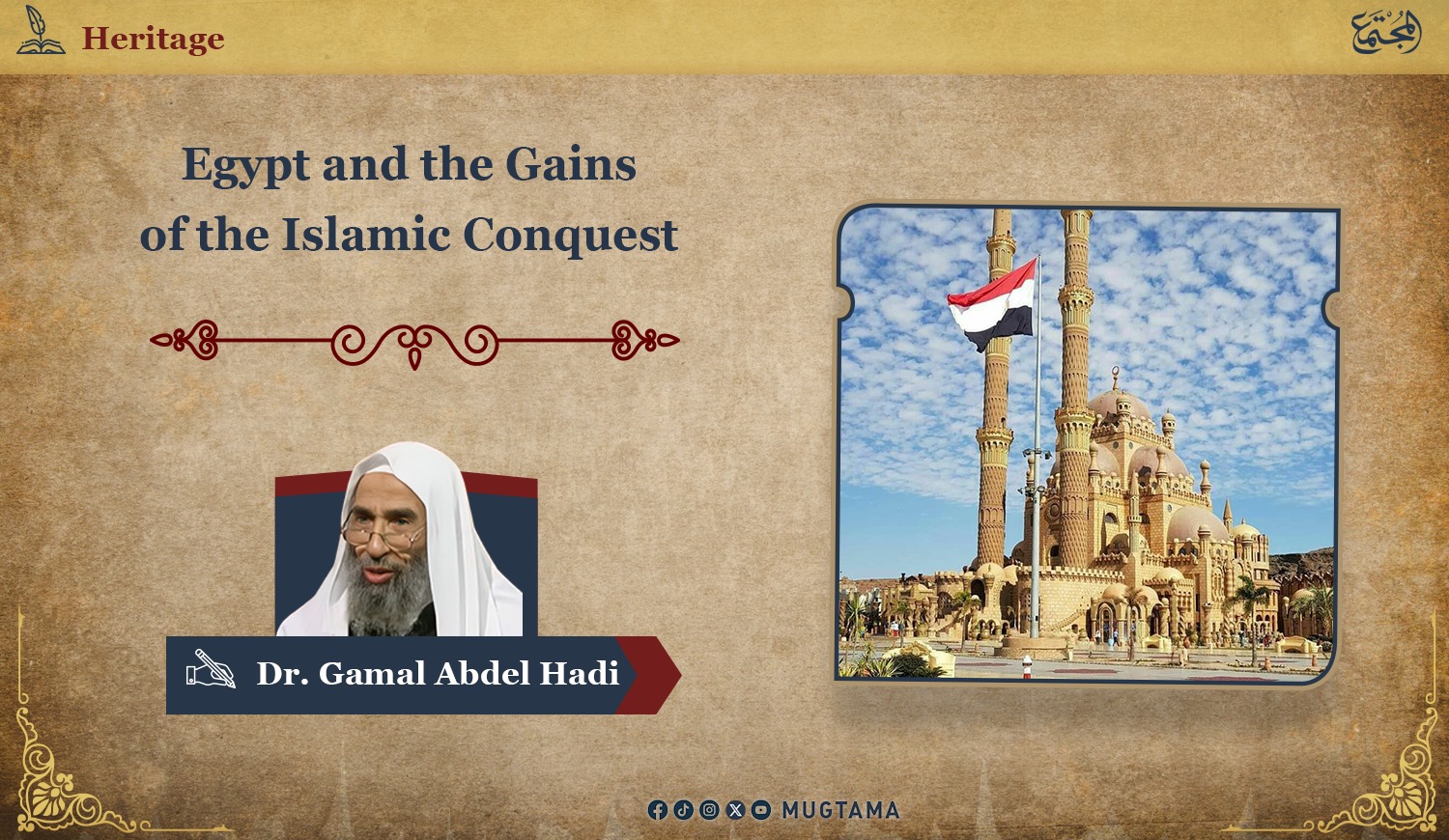
Egypt and the Gains of the Islamic Conquest
Economic Prosperity and Fiscal Reform
Under Islamic Rule
Under Islamic governance, industry
flourished, while agriculture and trade experienced significant growth.
Alexandria emerged as the world’s premier marketplace and the most bustling thaghr
(1), driving a massive trade in wheat, linen, paper, glass, and ivory from
Nubia and Ethiopia. Furthermore, the city became a convergence point for an
influx of goods and merchandise from India and China.
Simultaneously, the burdensome array
of taxes that the Copts(2) had endured throughout six centuries of Roman
occupation was dismantled. These were replaced solely by the Kharaj(3)—a
unified tax levied on agricultural, industrial, and commercial wealth.
Jizya Guarantees and Egyptian Market
Freedom
The Jizya (4)was fixed at two
dinars, levied exclusively on able-bodied men capable of earning a livelihood.
In exchange for this tribute, they were granted exemption from military service
and guaranteed state protection. It functioned, in essence, as a form of social
security for those who later became unable to work due to age or disability.
Crucially, the tax was strictly waived for the elderly, children who had not
reached puberty, and women.
Recognizing Egypt’s pivotal position
in global commerce, the Muslim administration understood that robust internal
trade was the backbone of this international connectivity. They prioritized
this sector immensely, empowering Coptic merchants to reclaim their standing in
Egypt’s economy. These merchants were granted a level of commercial freedom and
market access that had been systematically denied to them under the Roman
occupation.
Prosperity and Justice: Egypt’s Path to Embracing
Islam
The new administration opted for
continuity rather than upheaval, preserving the varied institutional systems
Egypt had known since antiquity. They instituted a policy of religious freedom,
granting the population full security over their lives and property. Daily
economic life—including civil service positions, industry, agriculture, and
general commerce—remained largely in the hands of the locals. The Muslim
leadership restricted their own direct involvement to high-level governance:
state oversight, the judiciary, law enforcement, military command, and
executive rule.
This environment of stability and
non-interference served as a potent catalyst, encouraging many Egyptians to
embrace Islam. Conversion, however, brought with it a linguistic imperative:
the necessity to master the Arabic language. This was essential not only for
reciting the Quran and comprehending Islamic jurisprudence but also for social
mobility specifically, the ability to join the administrative bureaus (Diwans)(5),
the Arabization of which had already commenced during the caliphate of Omar ibn
al-Khattab.
By the close of the third century
Hijri (the ninth century AD), a demographic turning point had been reached: the
vast majority of Egypt’s population had embraced Islam, while a Christian
minority remained. Simultaneously, Arabic cemented its status as the definitive
language of the land. It became the medium for all aspects of life dominating
government administration (Diwans), daily conversation, worship,
culture, thought, and science. In this new era, Arabic was no longer just the
language of the conquerors; it was the shared tongue of all Egyptians Muslims,
Christians, and Jews alike.
Consequently, the Copts discovered in
their new Muslim rulers a stark contrast to their former Byzantine Roman
overlords. Driven by a surge of enthusiasm, they actively collaborated with the
Muslims in the administration of Egypt's affairs. They were emboldened by their
status as the demographic majority within the workforce, staffing various
sectors across the nation.
Crucially, they retained ownership of
their land, cultivating it free from interference by the ruling Islamic
authority. Beyond agriculture, they effectively managed the national economy;
historical records indicate they served as the chiefs of finance throughout the
entirety of the Umayyad era, while
virtually all civil service positions remained under their purview.
This inclusive approach fostered deep
respect among the Christian population for the Muslims. They reciprocated this
benevolence with gratitude and recognition, demonstrating profound dedication
to the responsibilities entrusted to them. Egypt thus basked in a period of
stability; its people enjoyed a tranquil existence, untainted by the bitterness
of sectarian strife or the disruptions of political and economic upheaval.
Ultimately, the Islamic conquest
empowered Egypt to assume its long-awaited historical role. The nation became a
strategic hub for mobilizing land armies and outfitting naval fleets,
dispatching expeditions to Ifriqiya, the Maghreb, and eventually Andalusia.
This pivotal contribution secured Muslim sovereignty over the Mediterranean,
establishing a widespread reign of safety and security. It is a realization of
the truth spoken by God Almighty: (It is those
who have faith, and do not mix their faith with idolatry, who will be secure,
and it is they who are rightly guided) (Al-An'am:82)
Why did the Muslims prevail, and why
were the lands opened before them?
Heraclius, the Byzantine Emperor, once
questioned one of his soldiers who had been held captive by the Muslims and
subsequently released as an act of grace. "Tell me about these
people," the Emperor commanded.
The soldier replied, "I shall
describe them so vividly it will be as if you see them with your own eyes: They
are knights by day and monks by night. They consume nothing under their
protection without paying its fair price, and they enter no place without a
greeting of peace. Yet, they remain unyielding against those who wage war upon
them until victory is secured."
Upon hearing this, Heraclius declared,
"If what you say is true, they are destined to inherit the very ground
beneath my feet.
Quoting The Preaching of Islam
(p. 128), the author highlights the prominent standing of the Copts: they
filled the ranks of ministers and scribes within the government Diwans,
determined tax assessments on land concessions, and in some instances,
accumulated vast fortunes.
Furthermore, their own ecclesiastical
history abounds with examples of clergy who enjoyed the favor of the ruling
princes, noting that the Coptic community lived under their reign in "the
utmost state of tranquility" (p. 74).
The Testimony of Armanousa: Fear and
Reassurance at the Siege of Bilbeis
During the Muslim siege of the Roman
garrison at Bilbeis, panic spread among the women inside the fortress. Fearing
for their safety, they projected the brutalities of their Roman occupiers onto
the besieging army, anticipating the same atrocities of rape and violation.
However, Armanousa, the daughter of
Al-Muqawqis (the ruler of Egypt), intervened to quell their terror. Addressing
one of her ladies-in-waiting, she delivered a profound rebuttal:
"You are mistaken, Maria; you are
truly mistaken! Have you forgotten that my father gifted their Prophet the lady
from Ansena—Maria al-Qibtiyya (peace be upon her)? She lived with him in a
kingdom that was half celestial and half of the heart.
My father confided in me that he sent
her to uncover the true nature of this religion and this Prophet. She sent back
confidential dispatches confirming that these Muslims represent a new intellect
destined to teach the world to distinguish between truth and falsehood.
She reported that their Prophet is
purer than a cloud in the sky, and that they all act within the boundaries of
their faith and virtues, not the boundaries of their own egos or desires. If
they draw the sword, they do so by law; and if they sheathe it, they do so by
law."
For a woman to fear for her chastity
from her own father is more plausible than to fear it from the companions of
this Prophet. They are collectively bound by the duties of the heart and the
dictates of the intellect. Indeed, the Islamic conscience within each of them
acts almost as a weapon, poised to strike its owner should he even contemplate
a transgression."
Armanousa further confided to her
companion:
"My father told me that this
religion, driven by its ethics, will surge through the world just as vital sap
surges through a green tree—a force of nature working within nature. It will
not be long before the world turns verdant and casts its benevolent
shade."
Armanousa’s intuition proved
prophetic. In a final gesture of chivalry that confirmed her words, the Muslim
commander Amr ibn al-Aas returned her to her father, Al-Muqawqis, safe and
fully honored. She was sent back with all her wealth, servants, and belongings
intact, under the protection of a Muslim detachment commanded by Qais ibn Abi
al-Aas al-Sahmi.
Notes by the editor
1. Thughur (Singular: Thaghr): Translated here as "ports" or "frontiers." Historically, this term referred to strategic border fortresses or coastal towns. In the context of Alexandria, it emphasizes the city's dual role as a bustling commercial port and a fortified frontier post facing the sea.
2.
Copts
(al-Aqbat): Derived from the Greek
word for "Egyptians," this term originally referred to the general
population of Egypt regardless of creed. Following the Islamic conquest, the
usage evolved to specifically denote the indigenous Christians of Egypt,
distinguishing them as a religious community within the new Islamic state.
3.
Kharaj: A specific form of tax implemented under early
Islamic administration. Unlike the arbitrary levies of the previous rulers,
Kharaj was a structured tax primarily levied on landed property and
agricultural yield. In this text, it is described as a broad tax covering
agricultural, industrial, and commercial wealth, signifying a streamlined
fiscal policy compared to the complex Roman tax system.
4.
Jizya: A specific tribute fixed at two dinars during this
period. As defined in the text, it was levied exclusively on able-bodied men
capable of work in exchange for state protection and exemption from military
service. The text characterizes it as a form of social security, ensuring
support should the individual later become unable to earn. It was strictly
inapplicable to women, children, and the elderly.
5.
Diwan
(Plural: Dawawin): Government administrative
bureaus or registries established to manage state affairs.
Historical Note: While the establishment of the Diwan system is credited to Caliph Omar ibn al-Khattab, the process of Arabization (shifting the official language from Greek/Coptic/Persian to Arabic) was comprehensively implemented later during the reign of Caliph Abd al-Malik ibn Marwan.
You may also like:
The economic, social, and religious conditions before Islam
What Is Islam? Meaning, Origin and Core Beliefs Explained
Al-Andalus :From the Islamic Conquest to Spanish Forced Christianization
_____________________________________
Source:
The book The Islamic Conquest of Egypt.