






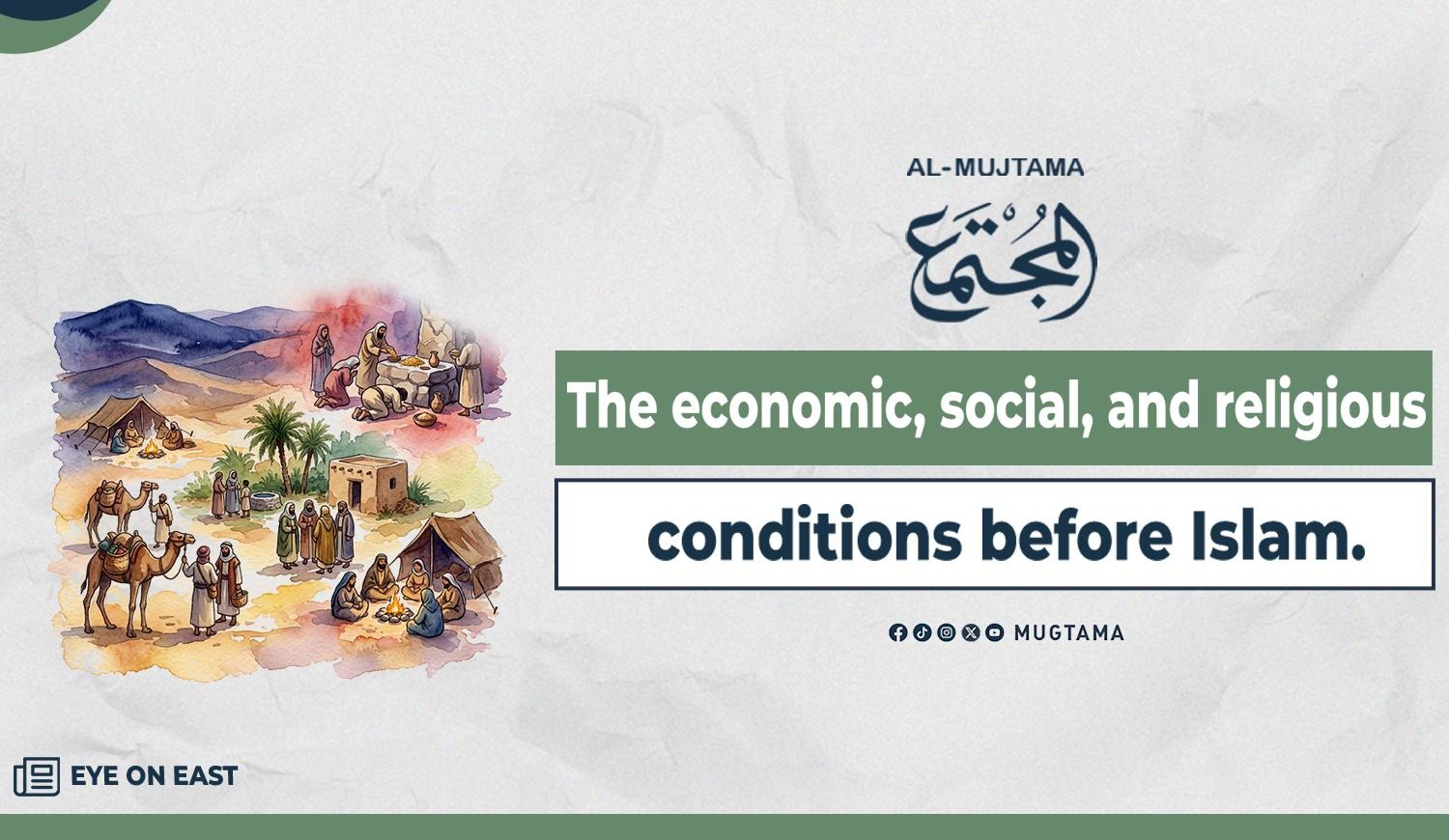
The economic, social, and religious conditions before Islam
Religions
had become prey for the corrupt and the manipulators, a plaything for
distorters and hypocrites, until they lost their spirit and form. In this
section, we will attempt to take a look at the state of some ancient creeds.
The Jewish faith before Islam
In Europe, Asia, and Africa there existed a
nation that was among the richest of all peoples in terms of religious
heritage, and the most knowledgeable of its terminology and meanings — the
Jews. Yet they were not a factor in shaping civilization, politics, or religion
that influenced others. Rather, for many centuries, they were destined to be
ruled by others and subjected to persecution and tyranny, exile, and expulsion,
suffering and affliction.
Their long history marked
by prolonged servitude, harsh oppression, humiliation, greed, love of wealth,
and engagement in usury — left them with a peculiar psychology not found in any
other nation. They came to possess distinct moral traits that characterized
them through successive ages and generations: submissiveness in times of
weakness, violence, and misconduct when in a position of power, deception, and
hypocrisy in most circumstances, along with harshness, selfishness, consuming
people’s wealth unjustly, and turning others away from the path of God.
The Qur’an offers a precise and
profound description of them, portraying their moral decline, psychological
decay, and social corruption during the sixth and seventh centuries conditions that led to their removal from the
leadership and guidance of nations.
Second: Christianity
Christianity was never, at any time, a matter
of detail and clarity, nor a system for addressing human issues upon which a
civilization could be built, or a state could be governed. It did, however,
contain traces of Christ’s teachings and bore the essence of a simple
monotheistic religion. Then came Paul, who dimmed its light and adulterated it
with the superstitions of the ignorance he had inherited and the paganism in
which he had been raised.
Constantine then
extinguished what little remained, until Christianity became a mixture of Greek
superstitions, Roman paganism, Egyptian Platonism, and monastic practices. The
simple teachings of Christ faded beside it, like a drop vanishing in the sea.
Christianity turned into a rigid fabric of beliefs and traditions that neither
nourished the soul, nor fed the mind, nor ignited the emotions, nor solved
life’s dilemmas, nor illuminated the path. Instead, with the additions of the
distorters and the interpretations of the ignorant, it became a barrier between
humans and knowledge and thought, turning into a pagan religion through
successive ages.
Sale, the English translator of
the Qur’an, commented on the Christians of the sixth century CE: “Christians
excessively venerated saints and Christian images, surpassing even the
Catholics of our time.”
During this period, an internal
conflict arose among the followers of Christianity, dividing them into two
groups: the Chalcedonians and the Monophysites — or the Christians of the
Levant and the Roman state, versus the Christians of Egypt. The Chalcedonians
upheld the doctrine of the dual nature of Christ, while the Monophysites
believed Christ had only one nature, the divine, in which His human nature was
dissolved — like a drop of vinegar falling into a boundless sea. The dispute
between the two sides intensified, becoming almost like a civil war between
competing religions, or like the conflict between Jews and Christians, with
each sect declaring that the other was in error.
Social and Economic Conditions.
As for the social and economic conditions,
social decay had reached its peak in the Eastern Roman (Byzantine) state.
Despite the numerous calamities facing the populace, taxes and levies increased
and multiplied, until the people of the land grew resentful of their
governments. They despised them intensely and preferred any foreign rule over
their own. The foundations of virtue dissolved, and the pillars of morality
collapsed, to the extent that people preferred celibacy over marriage to pursue
their desires freely. Justice, as Sale notes, was bought and bartered like
merchandise, while bribery and treachery weakened the nation.
Gibbon writes: “By the end of the
sixth century, the state had declined and fallen to its lowest point. It was
like a great palm tree, under whose shade the nations of the world once found
shelter; now nothing remained but a trunk that only withered further with each
passing day.”
The authors of A History of the
World for Historians note: “The great cities, which quickly fell to ruin and
never regained their former glory and splendor, testify to the enormous decline
of the Byzantine state during this period, resulting from excessive taxation
and levies, deterioration in commerce, neglect of agriculture, and the
dwindling of urban development in the provinces.
_____________________________________
Source :
From “Virtues of
Islam Encyclopedia “
__________________________________________________
You may also like:
The state of the world before Islam.(1)
What are the Main Pillars of Islam?