









Book review: Strategies for the Judaization of Jerusalem and Al-Aqsa
The
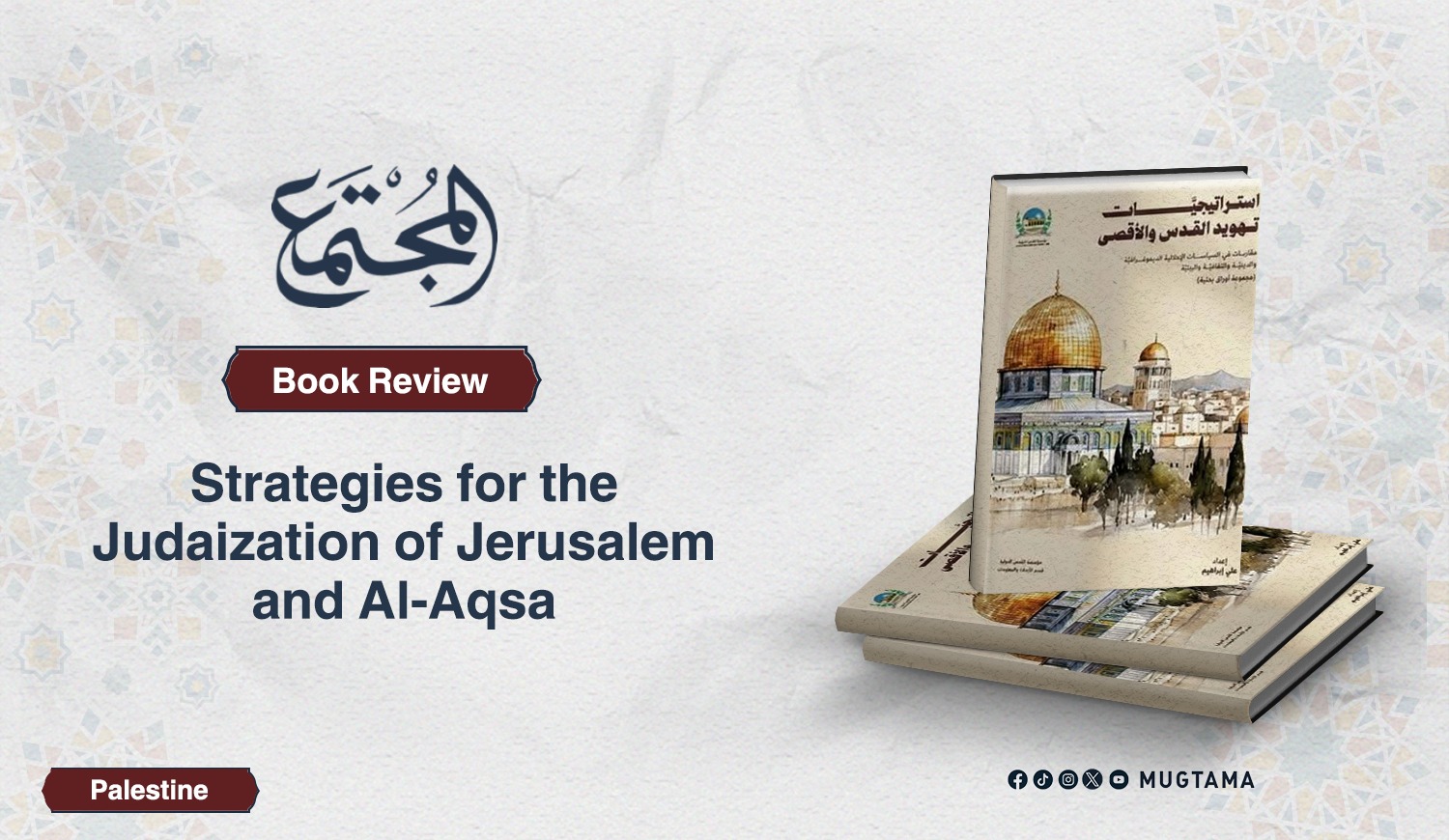
Al-Quds International Foundation (QIF) has recently released a new book titled
"Strategies for the Judaization of Jerusalem and Al-Aqsa: Approaches to
Demographic, Religious, Cultural, and Environmental Displacement
Policies." Prepared by Ali Ibrahim, Senior Researcher at the Foundation's
Research Department, the book is considered one of the most significant
research publications dedicated to deconstructing the Zionist project in Jerusalem.
This work
comes amid an unprecedented escalation in Judaization policies, offering a
profound scientific analysis of the non-military tools employed by the
occupation. It examines how these tools aim to reshape Jerusalem and Al-Aqsa across
demographic, religious, cultural, urban, and environmental levels.
A Cognitive Map of Judaization Plans
In his
introduction to the book, Hisham Yacoub, Head of the Research and Information
Department at the Al-Quds International Foundation, emphasizes that this
publication serves as a revealing map of critical aspects of Judaization
strategies. He asserts that understanding the mechanisms of Zionist liquidation
in Jerusalem is the first step toward safeguarding its identity, supporting the
steadfastness of its people, and confronting the Zionist project through an
informed, knowledge-based approach.
Yacoub
notes that the author, a specialist in Jerusalem affairs, has provided a
comprehensive, documented, and focused work that reflects extensive knowledge
and a multi-dimensional understanding of Judaization schemes. He considers the
book a qualitative addition for researchers and those interested in the affairs
of Jerusalem and Al-Aqsa, as well as an implicit message confirming that
confronting this aggressive momentum can only be achieved by renewing the will
for support and moving forward with insight across various fields of action.
An In-depth Analysis of the Tools of Control over Jerusalem and
Al-Aqsa
The book
comprises nine specialized research papers that monitor multiple trajectories
of the Judaization of Jerusalem and the Blessed Al-Aqsa Mosque, providing
detailed analysis supported by figures and statistics.
These
papers cover nine primary axes, beginning with the systematic aggression
against Al-Aqsa Mosque and its Muslim human components. It further examines the
transformation of tourism into a tool for control and incursions, and the
silencing of the mosque’s preachers and imams, particularly amidst the
genocidal war on Gaza.
The book
also addresses the erosion of Jordanian custodianship over Al-Aqsa Mosque,
analyzing the manifestations of this decline. Additionally, it explores the
targeting of the Christian presence in occupied Jerusalem, policies of
architectural, visual, and urban Judaization, the falsification of landmark and
street names, and the exploitation of the environment, parks, and forests to
serve the settlement project. Finally, it delves into one of the most dangerous
forms of "hidden Judaization" carried out through festivals,
concerts, and cultural events.
For his
part, the book's author emphasizes that this research collection seeks to
provide a profound analysis of the occupation's displacement tools. This
enables a more accurate understanding of central aspects of the conflict in
occupied Jerusalem, particularly in light of the events that have unfolded in
Jerusalem and Al-Aqsa during the genocidal war on the Gaza Strip. The work
further highlights the structural interconnectedness between the aggression
against Al-Aqsa and the comprehensive aggression against the Palestinian people
across all their locations.
Through
its data and analysis, the book highlights hidden facets of the Judaization
project, revealing how it is managed across multiple fields using non-military
tools. These tools are no less dangerous than walls, barbed wire, or weapons.
As the book concludes, the battle for Jerusalem is a comprehensive war on stone
and people, memory and identity, architecture and meaning—an attempt to
redefine the city, its status, and its history.
In doing
so, the book provides the reader with a tool for awareness and intellectual
resistance, contributing to a deeper understanding of the nature of the
conflict over Jerusalem. It exposes the depth and danger of the Zionist
project, affirming that the battle for Jerusalem begins with knowledge, but
certainly does not end there.
You may
also like:
Israel Escalates Al-Aqsa Restrictions to Assert Control Before Ramadan