









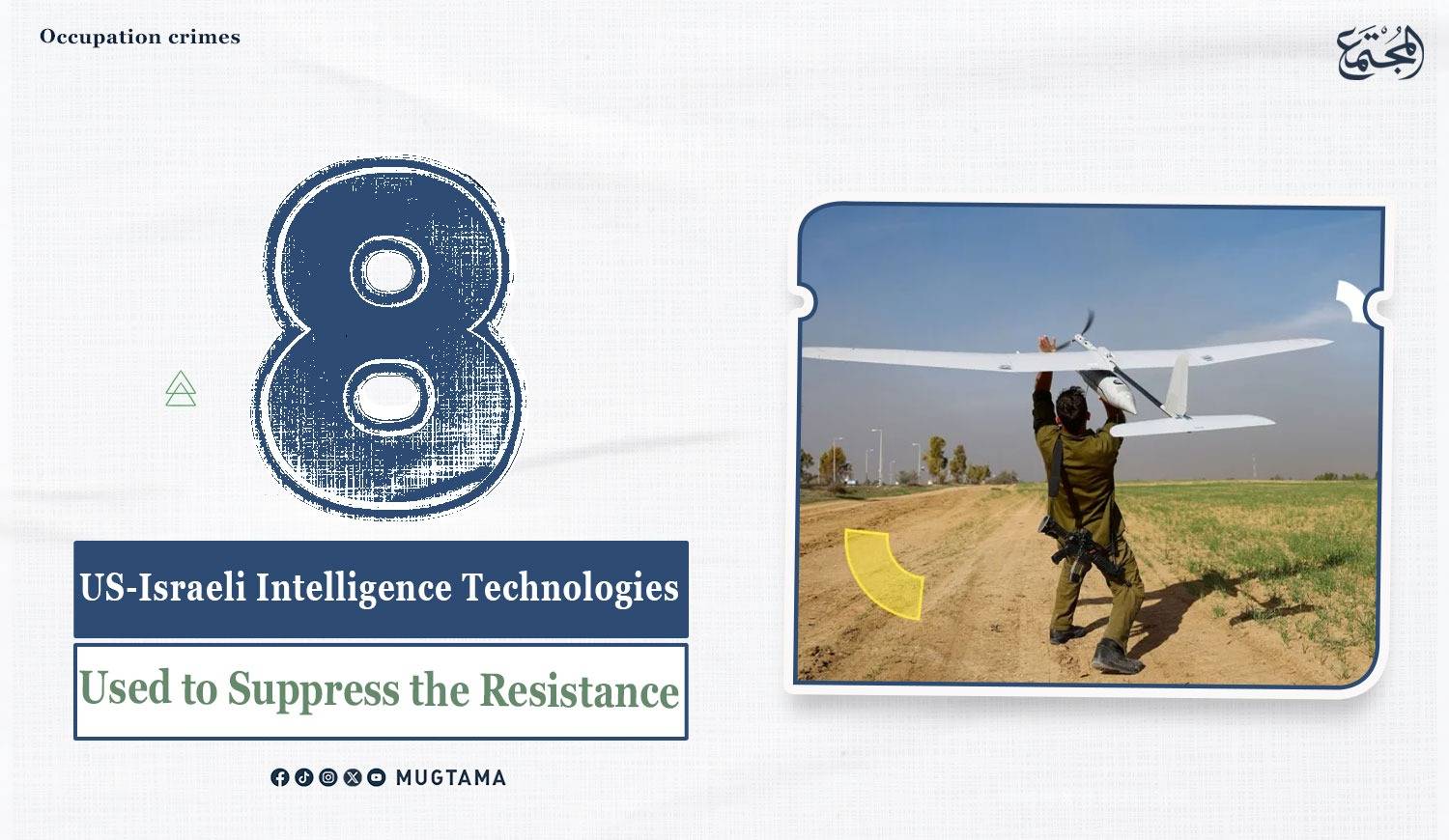
8 US-Israeli Intelligence Technologies Used to Suppress the Resistance
The military partnership
between Washington and Tel Aviv extends far beyond the supply of
munitions and political backing at the UN
Security Council; its infrastructure is fundamentally anchored in an
organic technical-intelligence alliance between the U.S. Intelligence Community
(notably the CIA, NSA, and the Pentagon) and Israeli security branches (Unit
8200, Shin Bet, Mossad, and Aman). This alliance operates through classified
protocols and complex data-sharing agreements designed to encircle and
dismantle resistance capabilities, assassinate key operatives, and disrupt
supply lines through an integrated technological surveillance matrix.
Here are 8 key intelligence technologies and systems jointly
shared and developed by Washington and Tel Aviv:
1.
Aerial Reconnaissance and Ultra-High-Resolution Satellite Imagery
(GEOINT)
This involves operating spy satellites managed by the U.S.
National Reconnaissance Office (NRO) in tandem with Synthetic Aperture Radar
(SAR) and unmanned surveillance aircraft (such as the MQ-9 Reaper). This
technology enables day-and-night topographic imaging through cloud cover.
Reports by The Washington Post (November 2023) and The New York Times
confirmed that U.S. Central Command (CENTCOM) operated unarmed MQ-9 drones over
the Gaza Strip for intelligence collection missions.
2. Signals and Electronic Eavesdropping (SIGINT)
Intercepting military radio frequencies, satellite
communications (such as Thuraya devices), wiretapping cellular networks, and tapping
undersea and terrestrial fiber-optic cable routes to harvest raw data, decrypt
ciphers, and monitor the field communications of resistance operatives.
The classified Memorandum of Understanding (MoU) between the
U.S. National Security Agency (NSA) and Israel's Unit 8200, leaked via the 2013
Edward Snowden revelations and published by The Guardian, officially
stipulated providing Unit 8200 with an unfiltered stream of raw signals
intelligence (Raw SIGINT) on a routine basis, which included both metadata and
full communications intercept content.
3. AI Algorithms and Target Banks
Investigations by the Israeli investigative outlet +972
Magazine and The Guardian (April 2024 and 2023) into the
"Lavender" and "The Gospel" (Habsora) systems revealed that
the Israeli military relied on artificial intelligence to mark tens of
thousands of Palestinians as potential assassination targets, leveraging cloud
servers and high-performance computing infrastructure supplied by major U.S.
tech giants (Project Nimbus, in partnership with Google and Amazon AWS).
4. Counter-Tunnel Detection and Monitoring Systems
Developing ultra-sensitive geophysical and seismic sensor
arrays that detect mechanical vibrations from underground digging or
subterranean movements, integrated with Ground-Penetrating Radar (GPR) to map
subterranean tunnels.
Reports by the Congressional Research Service (CRS) document
that Congress has authorized billions of dollars in joint funding since 2016
through annual defense appropriations under the "U.S.-Israel Anti-Tunnel
Cooperation Program," jointly overseen by the Defense Advanced Research
Projects Agency (DARPA) and the Israeli Ministry of Defense.
5. Cyber-Espionage and Commercial Spyware (Pegasus)
Leveraging sophisticated Zero-Click exploits to plant spyware
onto the mobile devices of resistance leaders, operatives, and their immediate
circles, effectively turning targeted smartphones into continuous, real-time
eavesdropping beacons.
Investigations by the University of Toronto’s Citizen Lab and
Amnesty International documented the deployment of Pegasus—developed by the
Israeli firm NSO Group—alongside similar commercial spyware tools against
Palestinian activists, officials, and political figures.
6. Facial Recognition and Biometric Surveillance
Deploying extensive urban camera networks across checkpoints,
border crossings, and forced evacuation corridors, linked to facial-scanning
algorithms that execute real-time cross-referencing against computerized
security watchlists of wanted individuals and suspected resistance members.
Amnesty International’s report (Automated Apartheid,
May 2023) documented in detail the deployment of AI-driven surveillance
systems, including "Red Wolf" in Hebron and the military's "Blue
Wolf" system for biometric facial scanning.
Furthermore, a New York Times investigation (March
2024) revealed that Israeli military intelligence deployed facial recognition
technology developed by the Israeli firm Corsight AI, utilizing U.S.-developed
algorithms alongside databases compiled via open-source Google Photos to
identify faction fighters and Gaza residents at checkpoints.
7. Open-Source Intelligence and Web Reconnaissance (OSINT &
WEBINT)
Scraping and data-mining social media metadata, alongside
leveraging commercial digital advertising networks (AdTech Tracking), to trace
the digital footprints of mobile devices across the Gaza Strip and the West
Bank.
Investigations by the U.S. investigative outlet The
Intercept revealed that American and Israeli intelligence agencies exploit
location-based AdTech data embedded in free mobile apps as a proxy for mass
surveillance, enabling high-precision geolocation tracking of device users in
conflict zones without requiring judicial warrants or direct device exploits.
8. Detainee Interrogations and Joint Human Intelligence (HUMINT)
Cross-referencing confessions and data extracted from
prisoners and detainees during interrogations in detention centers against U.S.
intelligence databases.
Reports by The
Washington Post (May 2024) revealed that the U.S. administration deployed
intelligence officers and specialized analysts from the CIA and Joint Special
Operations Command (JSOC) to Israel to work directly with Shin Bet and Aman
within intelligence fusion cells, assisting in debriefing analysis, screening,
and assessing detainee statements and seized records to track resistance
leadership.
