









10 Historical Turning Points: Why Washington Puts Israel Above International Law
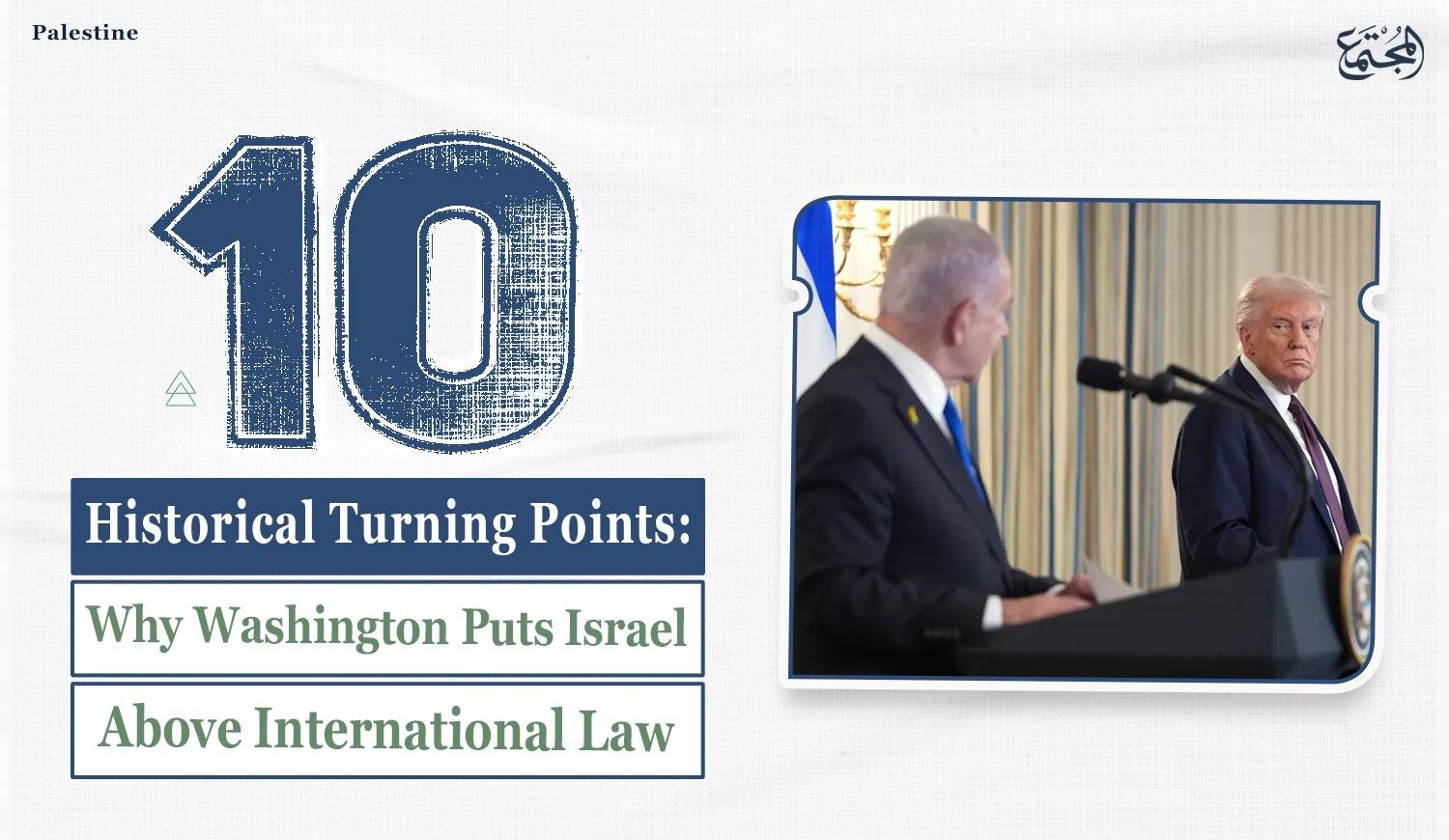
The relationship between the United States and Israel transcends conventional alliances rooted in
transactional interests. Instead, it reflects a structural commitment that
consistently renders Tel Aviv an exception to international law and global
consensus. Over eight decades, declassified records and presidential directives
reveal how Washington evolved from a political backer into a protective
umbrella and military pipeline, effectively granting Israel blanket immunity.
1. The Biltmore Conference (May 1942): Shifting the Zionist Center
of Gravity to Washington
In May 1942, roughly 600
delegates convened at New York’s Biltmore Hotel to adopt a landmark platform
demanding the repudiation of the British White Paper of 1939, unrestricted
Jewish immigration to Palestine, and the establishment of a 'Jewish
Commonwealth.' This strategic drive quickly gained bipartisan momentum,
culminating in pro-Zionist planks being incorporated into both the Democratic
and Republican national platforms in 1944. The move signaled a decisive shift
of the Zionist movement’s political and diplomatic center of gravity from
Britain to the United States, effectively transforming the Zionist enterprise
into a domestic wedge issue where American politicians competed for
endorsements, campaign funds, and electoral clout.
2. Swift Recognition of Israel (May 1948): Cementing Alignment and
Bypassing Institutional Diplomacy
On May 14, 1948, the United States granted de facto
recognition to Israel just 11 minutes after its declaration of statehood. The
move came despite fierce opposition from Secretary of State George Marshall,
who had warned in a closed-door White House meeting on May 12 of grave risks to
American interests. The recognition marked a decisive pivot in U.S. policy
toward Palestine, bolstering Israel’s international standing and laying bare
how domestic political and electoral calculations could override diplomatic
reservations inside the administration.
3. The Eisenhower Doctrine (January 1957): Filling the Colonial
Vacuum and Anchoring Israeli Security Regionally
In January 1957, President
Dwight D. Eisenhower unveiled his doctrine authorizing economic and military
aid to Middle Eastern nations and the use of U.S. forces to counter what he
termed 'Communist aggression.' Declassified 1958 National Security Council
records showed a strategic reappraisal of Israel’s value amid surging Arab
nationalism led by Egypt and Syria. Despite Washington having forced Israel to
withdraw from Sinai after the 1956 Suez Crisis, this shift helped pave the way
for anchoring Israeli security to U.S. regional strategy.
4. The
June 1967 War: From Arms Embargo to Cementing Qualitative Military Edge (QME)
The year 1968 marked a
watershed moment in U.S. arms policy toward Israel, with the landmark approval
to supply F-4 Phantom fighters—moving past earlier transfers limited to
defensive systems like the Hawk missile. In the wake of the June 1967 War, U.S.
intelligence assessments confirming Israeli military dominance, coupled with
the diplomatic framing of UN Security Council Resolution 242, elevated Israel’s
weight in Washington’s strategic calculus. This shift consolidated Israel’s
role as a vital regional military partner and laid the groundwork for an
enduring U.S. doctrine aimed at preserving Israel’s Qualitative Military Edge
(QME) over its neighbors.
5. The 1973 October War Airlift: Rescuing the Frontline and Flouting
Neutrality Rules
In October 1973, President Richard Nixon launched Operation
Nickel Grass, a massive strategic airlift to resupply Israel during the October
War. The operation delivered over 22,000 tons of weapons and materiel,
complemented by maritime shipments and $2.2 billion in emergency military aid.
These rapid transfers shored up Israeli battlefield capabilities, underscoring
the depth of Washington’s structural commitment to Israel's security and
demonstrating U.S. resolve to intervene militarily to avert a strategic defeat.
6. The
Camp David Accords (1978): Neutralizing the Southern Front and Conditioning Aid
on the Treaty
In September 1978, President Jimmy Carter brokered the Camp
David Accords between Egypt and Israel, paving the way for the historic 1979
peace treaty. The breakthrough was underpinned by massive U.S. aid packages to
both sides, which included Washington funding the relocation and construction
of advanced Israeli airbases in the Negev following the Sinai withdrawal.
Strategically, neutralizing Egypt removed the Arab world’s
primary military power from direct confrontation, dramatically tilting the
regional balance of power. This gave Israel a free hand to project military
force across other fronts—most visibly demonstrated four years later during the
1982 invasion of Lebanon.
7. The 1981 Strategic Cooperation Accord: Institutionalizing the
Security Alliance
On November 30, 1981, the United States and Israel signed a
Memorandum of Understanding on Strategic Cooperation, laying the groundwork for
deepened military and intelligence integration. This bilateral alignment expanded
significantly in 1987 when Israel was designated a Major Non-NATO Ally (MNNA),
alongside the establishment of U.S. war reserve stockpiles on Israeli soil.
These milestones effectively institutionalized the military alliance, broadened
joint defense development, and transformed the relationship from transactional
foreign aid into an enduring, operational strategic partnership.
8.
Wielding the Veto (Since 1972): The Diplomatic Shield in the UN Security
Council
Since 1972, the United States has routinely wielded its veto
against UN Security Council resolutions concerning Israel, emerging as the
primary bulwark against measures criticizing Israeli policies or demanding
international intervention. Washington's vetoes have shielded Tel Aviv on
issues spanning illegal settlements, the status of Jerusalem, the occupied
territories, and multiple military campaigns in Lebanon.
This systematic obstruction has repeatedly blunted measures
backed by broad international consensus, gutting the Security Council's ability
to enforce binding resolutions under the UN Charter. Consequently, Washington's
persistent diplomatic cover has fueled fierce scrutiny over Western double
standards and effectively insulated Israel from international legal
accountability.
9. Moving the Embassy to Jerusalem (2017): Defying UN Resolutions,
Legitimizing Annexation
In December 2017, President Donald Trump officially recognized
Jerusalem as Israel’s capital, followed by the relocation of the U.S. Embassy
in May 2018—a move that sharply broke with the international consensus
rejecting the annexation of East Jerusalem. Washington followed suit in 2019 by
recognizing Israeli sovereignty over the occupied Syrian Golan Heights. This
signaled a fundamental pivot in U.S. policy from traditional diplomatic backing
to outright legitimization of facts on the ground established through
occupation, drawing fierce global condemnation for undermining United Nations
resolutions and dismantling the foundational 'land-for-peace' doctrine.
10. Unconditional Support in the Gaza War (2023–2024): Operational
Partnership and the Erasure of Red Lines
In the wake of the October 7, 2023 attacks, the Biden
administration escalated its military and diplomatic backing for Israel to
unprecedented levels, deploying carrier strike groups and augmenting regional
troop posture while pushing through over $14 billion in emergency supplemental
military aid. Washington stood up an extensive air and maritime bridge to
expedite the transfer of heavy munitions and precision guidance kits, while
repeatedly wielding its UN Security Council veto to sink cease-fire
resolutions.
These interlocking
measures marked a decisive pivot from external patron to active operational and
diplomatic partner, sparking fierce international outcry and mounting scrutiny
over Washington’s compliance with international humanitarian law and its
statutory obligations to protect civilian life.
