









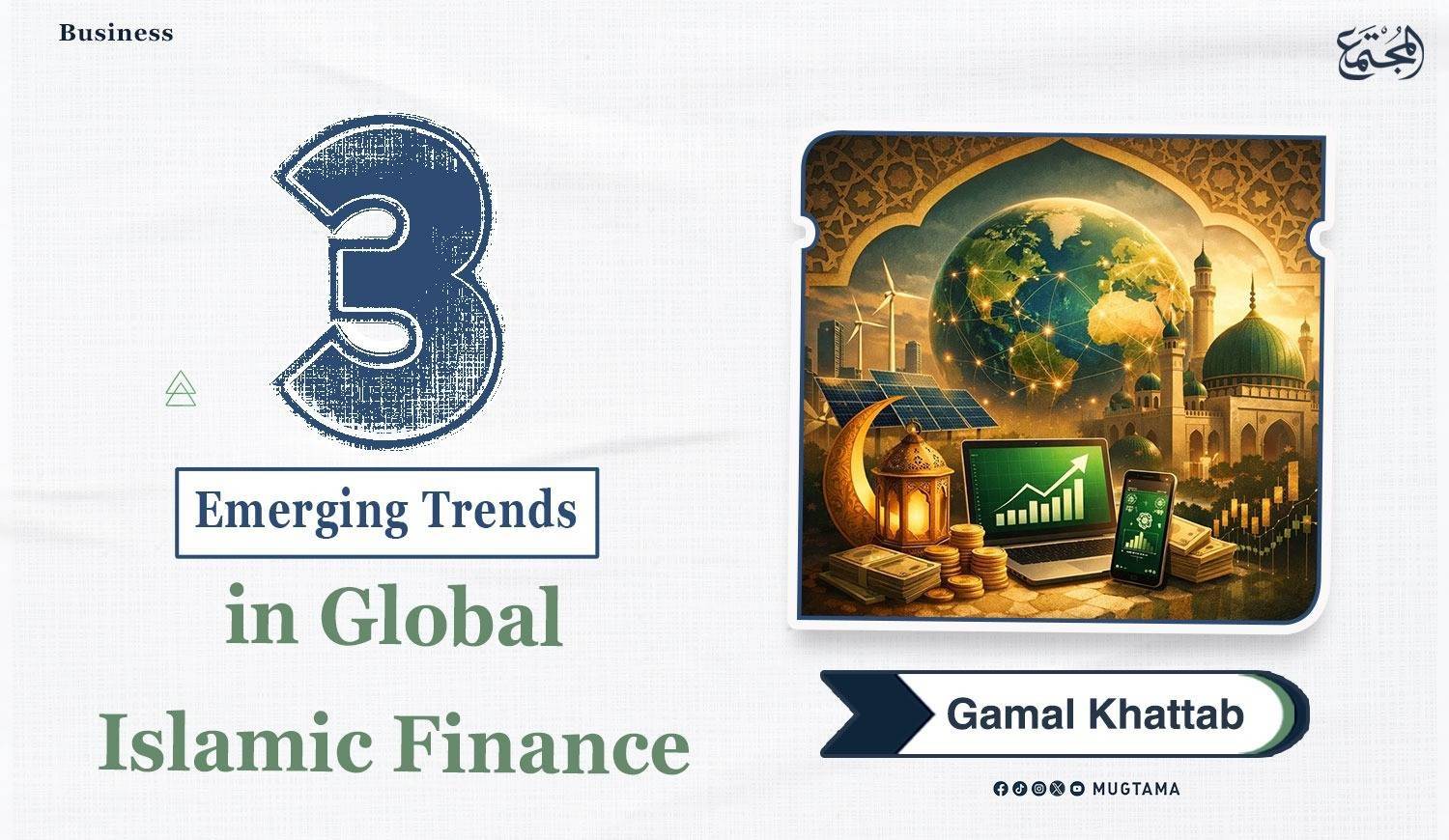
3 Emerging Trends in Global Islamic Finance

Because Allah knows His creation and their worldly and spiritual affairs, His law remains the ultimate reference and salvation for humanity in all fields. {Does He who created not know, while He is the Subtle, the Acquainted?} [Al-Mulk 14].
Islamic finance is no longer confined
to markets with Muslim majorities. It has become one of the fastest-growing
pillars of ethical finance worldwide. Global Islamic finance assets are
projected to surpass USD 3 trillion, attracting both Muslim and non-Muslim
investors seeking stability and ethical alternatives.
Technology, particularly financial
technology (FinTech), is accelerating this transformation. The convergence of
Shariah compliance and digital banking expands financial inclusion, reshapes
consumer expectations, and offers a model for a more resilient global economy.
First Trend: Rise of Digital-Only Islamic Banks
Fully digital Islamic banks, often
referred to as “neo-banks,” are capturing the attention of Millennials and Gen
Z Muslims worldwide. From the growing Islamic FinTech scene in the UK to
platforms in Southeast Asia and the GCC, these banks are redefining access to
financial services.
Key drivers include:
- No physical branches: Eliminating traditional branch costs allows
digital banks to offer competitive rates and lower fees.
- Strict Shariah compliance: These platforms adhere to principles such as the
prohibition of interest, ensuring profits through ethical, asset-backed
transactions.
- Global reach: Mobile-first platforms enable expatriate communities to access
Shariah-compliant services seamlessly, bridging continents.
This reflects a generational shift, as
young Muslims expect digital convenience without compromising religious
values—precisely what digital Islamic banks deliver.
Second Trend: Tokenization and Islamic FinTech
Blockchain technology continues to
revolutionize Islamic finance. Tokenization—the issuance of digital
representations of assets—is being applied to sukuk (Islamic bonds), making
them more accessible and transparent.
This trend relies on:
- Smart contracts: Automated agreements coded on blockchain can enforce Shariah rules,
such as profit-sharing or ensuring asset-backed transactions.
- Lower compliance costs: Embedding rules directly into code enables
instant, cost-effective auditing.
- Global accessibility: Digital sukuk can be traded across borders,
opening Islamic finance to investors previously hindered by barriers.
This innovation ensures compliance is
not only transparent but scalable, allowing Islamic finance to compete with
mainstream digital assets while preserving its ethical foundation.
Third Trend: Convergence with ESG Investing
Global investors increasingly
recognize that Shariah-compliant finance naturally aligns with Environmental,
Social, and Governance (ESG) principles:
- Shared exclusions: Both frameworks avoid harmful industries such as
gambling, alcohol, tobacco, and weapons.
- Risk-sharing models: Islamic finance emphasizes partnership and
asset-backed stability, reducing systemic risks compared to debt-heavy
systems.
- Ethical appeal: Non-Muslim investors seeking sustainable, ethical portfolios are
entering the halal finance ecosystem, expanding its reach.
This convergence creates powerful
synergy: Islamic finance is seen not only as Shariah-compliant but also as a
mainstream ethical investment option.
Benefits of Digital Islamic Banking for the Global Economy
The rise of Shariah-compliant digital
banking offers tangible benefits to the global economy:
- Financial inclusion: Millions of unbanked individuals, especially in
Africa and South/Southeast Asia, gain access to formal financial systems
via mobile-first Islamic platforms.
- Stability: Asset-backed and risk-sharing models reduce reliance on speculative
debt, providing a more resilient macroeconomic foundation.
- Cross-border growth: Digital platforms enable seamless transactions
across regions, boosting trade and investment between Muslim-majority and
non-Muslim countries.
By embedding ethics into finance,
Islamic digital banking provides a sustainable growth model in an increasingly
volatile global market.
The three emerging trends—digital
Islamic banks, blockchain-based Islamic FinTech, and convergence with ESG
investing—illustrate how halal finance is evolving into a major force. What was
once seen as a parallel system is now a cornerstone of the global ethical
banking revolution.
With digital innovation accelerating, halal Islamic finance is poised to reshape not only Muslim economies but also the broader landscape of responsible global finance.
Footnotes
- 1 · ICD – LSEG Islamic Finance Development Report
- 2 · Standard Chartered Report (2025)
- 3 · Islamic Financial Services Board (IFSB) Stability Report
- 4 · Standard Chartered Islamic Finance Outlook
- 5 · Deloitte Middle East Islamic FinTech Insights
- 6 · PwC Global Islamic Banking Report
- 7 · World Bank – Financial Inclusion & Islamic Digital Banking Studies