









Principles of Islamic Loans
Justice in Financial Transactions: Lending the Needy is an Obligation

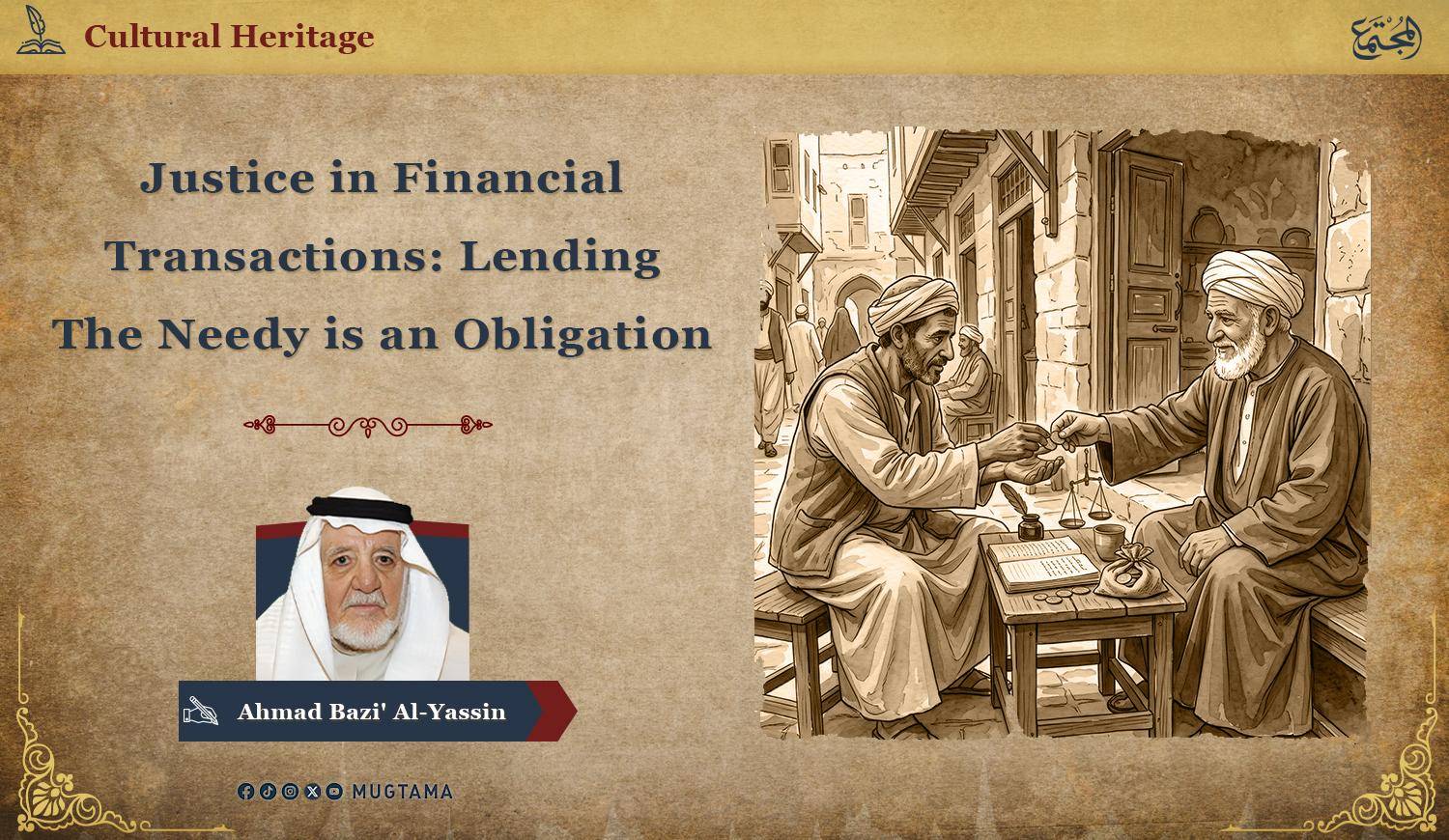
Loans in Islam are established upon solid rules of justice, free from exploitation or fraud.
Among the most important types of
loans are:
The Good Loan (Qard Hasan):
This involves lending to someone in need for essential
consumer goods. Such a person must find someone among the members of society
willing to grant them a loan out of solidarity and mutual assistance,
establishing foundations of love among people and avoiding animosity and envy
between the wealthy and those in hardship. In the event that repayment proves
impossible, the loan is settled from the Zakat of Muslims.
The Investment Loan (Qiradh/Mudarabah):
In this model, the financier partners
with someone skilled in trade, industry, agriculture, or contracting—the former
contributing capital and the latter contributing labor. The outcome between
them is to share the profit according to the agreed-upon ratio. If a loss
occurs, the worker incurs no financial loss other than their time and effort,
thereby remaining safe from being humiliated by debt to the capital owner.
Financial loss falls solely on the
capital, and since profit is achieved in the majority of cases, it is in the
financier's interest to operate through this method, as they will receive the
larger share of the profit. This is a sound, psychologically comfortable, and
financially profitable approach that has proven successful in past and present
experiences. Were we to apply it more broadly and generally, we would find
immense goodness and eliminate financial anxiety along with the violent shocks
resulting from transactions with pre-determined interest rates over fixed
periods—the practice currently applied in many countries around the world.
The Paradigm of Other Economic Systems
The capitalist system asserts that
money must yield money after a period from its borrowing, whether for a
consumer purpose or otherwise—even if to satisfy the pangs of hunger—or for an
investment purpose, even if the borrower suffers a catastrophic loss due to
force majeure. We all know that money without labor is sterile, so how can the
sterile give birth?
Islam prohibited this type of
transaction due to its lack of the spirit of cooperation among people, as it
obligates the borrower to return the principal along with its interest even if
a loss occurs—even if the matter requires selling their residential home and
furniture. The financier will not relinquish their money unless the borrower is
deprived of their civil rights in society, which crushes their morale and
humanity. True Islam safeguards humanity because it is far more valuable and
precious than materialism; based on this principle, it prohibited fixed
interest over specified periods, which is designated in Sharia as Riba
(usury).
Opposing systems state that there is
no private ownership for the individual. This system contradicts the human
disposition (fitrah) upon which Allah created His servants. When an
infant is born crying, it settles contentedly upon acquiring ownership of food
through nursing. As the child grows, its material instincts develop alongside
it; it then collides with this system, which kills ambition within it,
preventing it from aspiring to a better life and a brighter future, clothing it
in gloom, rebellion, and dissatisfaction. This is impermissible in Islam
because humanity loses the practice of its Allah-given freedom to employ its ambition
within the framework of justice and order.
The Balanced Islamic System
When comparing the Islamic system with
other systems applied in the East and West, we find that the loan system in
Islam is a balanced and just middle path capable, upon its implementation, of
bringing happiness to humanity, as it contains the remedy for all ailments. It
recognizes ownership within the bounds of humanity and for its service, and it
commands cooperation. Thus, it is a cooperative system to the utmost degree.
Why then do we, the community of
Muslims, drift right and left, blundering about, when safety and peace lie
within our hands?
Would you like to translate any
further historical pieces from Al-Mujtama magazine or analyze specific economic
concepts mentioned in this text?
Published in Issue No. 1 of Al-Mujtama Magazine, Tuesday, March 17, 1970
