




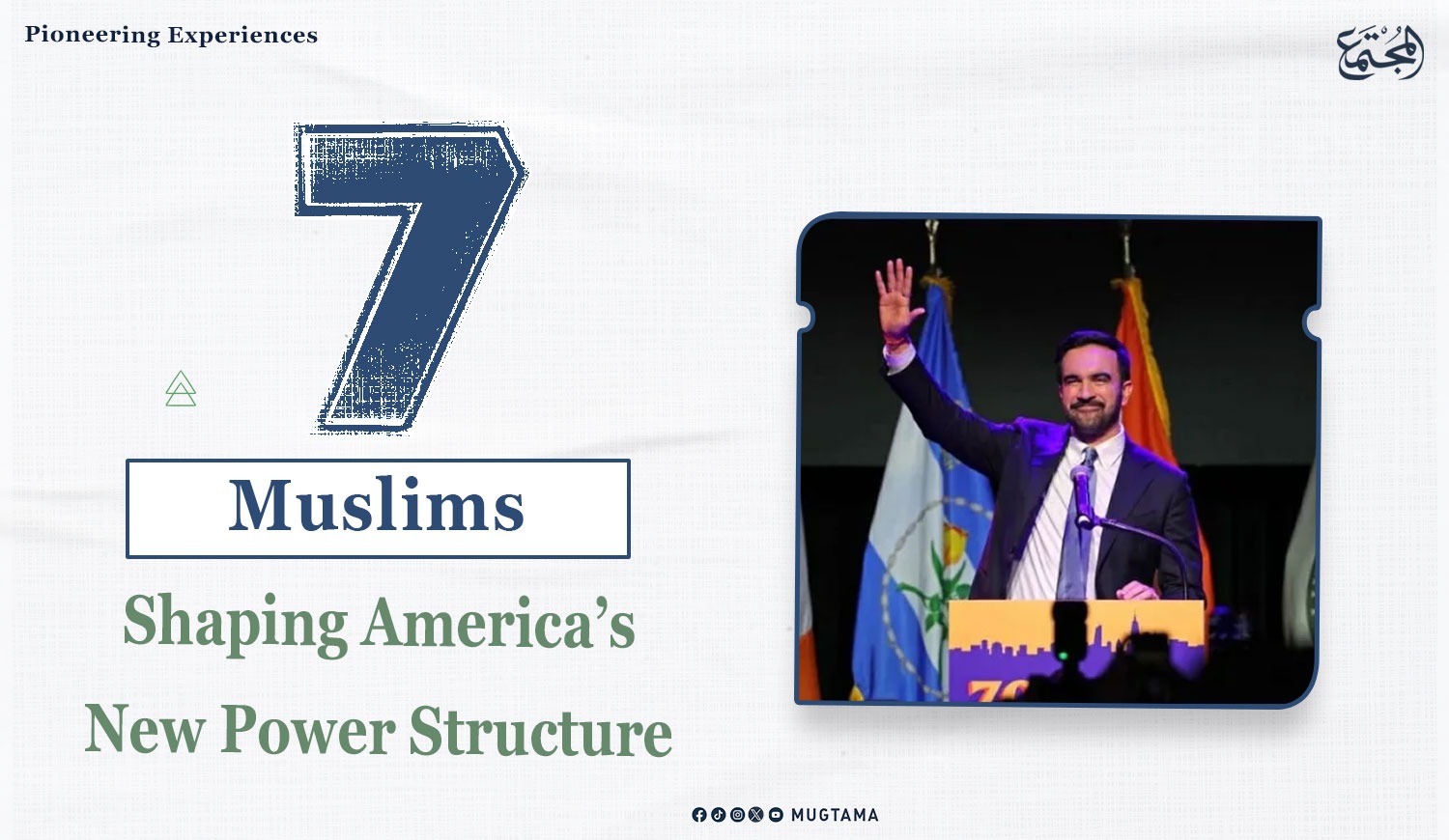
7 Muslims Shaping America’s New Power Structure
The 2025 U.S. elections witnessed a
historic moment, as the American Muslim community broke records with the
victory of no fewer than 38 candidates—yet the real significance lies not in
the number, but in the quality.
This year represented a genuine turning
point, in which the community shifted from merely seeking representation to
exercising actual power. Instead of settling for seats on school boards, we
witnessed a remarkable rise to high executive positions (the mayor of the
largest U.S. city), sensitive judicial offices (judges), and roles at the heart
of law enforcement (sheriff).
Here is a list of the 7 most prominent
winners who represent this profound strategic shift in American politics:
1. Zohran Mamdani — Mayor of New York City:
Zohran Mamdani’s victory (age 34) is the biggest political earthquake of the
year. He is not only the first Muslim mayor and the first South Asian mayor of
New York, but also the youngest mayor of the city in a century.
More importantly, Mamdani—a vocal democratic socialist—did not win despite
his identity but because of his radical economic platform focused on
affordability (such as freezing rents and raising the minimum wage). He faced a
fierce and organized Islamophobic campaign (a 925% increase in online
hostility) and accusations of jihadism, yet he prevailed.
Mamdani presented a new model proving that a progressive Muslim candidate can
build a strong coalition of the working class and immigrants that can overcome
politics of fear and hatred.
2. Ghazala Hashmi — Lieutenant Governor of Virginia:
Dr. Ghazala Hashmi (61) made national history as the first Muslim woman in U.S.
history to be elected to a statewide office.
Hashmi represents a different path from Mamdani; she is a moderate Democratic
academic whose motivation for entering politics was Donald Trump’s 2017 Muslim
ban. Her position is far from symbolic; as lieutenant governor, she presides
over the state senate and holds the tie-breaking vote in a deeply divided
Virginia—giving her direct power over the fate of all major legislation.
3. Siddiq Kamara — Sheriff of Delaware
County, Pennsylvania:
This victory is one of the most strategic. Siddiq Kamara overturns the
traditional narrative entirely; he is a Black Muslim refugee born in Liberia
who fled civil war, and is now the top law-enforcement official in a major
county.
His life story is extraordinary: from refugee to National Guard officer, to
special agent in the state attorney general’s office, and now sheriff. He
represents a massive shift—from a community once viewed as a security suspect
to a community electing leaders to reform the justice system from within.
4. Ajmeri Hoque — Municipal Court
Judge, Franklin County, Ohio:
Ajmeri Hoque represents another breakthrough in the justice system. She is the
first Muslim judge in Ohio’s history and previously worked as a defense
attorney and former prosecutor.
The strategic importance is clear: during the 2024 pro-Gaza student protests, Hoque
was among the attorneys who defended arrested student demonstrators. Just
months after defending them in court, she ran and won a judgeship. The
community is no longer content with electing lawyers to defend it; it is now
electing them to become the judges issuing rulings.
5. Sam Rasoul — Member of Virginia House of Delegates (Re-elected):
Sam Rasoul, an American of Palestinian descent and currently the
longest-serving Muslim legislator in the U.S., symbolizes political maturity in
matters of foreign policy.
Rasoul faced harsh, organized attacks accusing him of “antisemitism” for openly
using the term genocide to describe the Israeli war on Gaza. In the past, such
attacks were political poison that ended careers—but Rasoul won re-election by
a landslide. His victory proves that openly defending Palestinian rights is no
longer necessarily a liability, and that voters trust their local
representative more than smear campaigns.
6. Abdullah Hammoud — Mayor of Dearborn, Michigan (Re-elected):
The sweeping re-election of Abdullah Hammoud to a second term consolidates the
executive power of the community. His victory, along with Mo Beydoun’s win in
neighboring Dearborn Heights, transforms the greater Detroit area into a stable
and influential political power base.
This win reinforces Dearborn—home to the largest concentration of Muslims and
Arabs in the U.S.—as a force that cannot be ignored nationally, especially in
Michigan, a pivotal swing state in presidential elections.
7. Hamdi Mohamed — Seattle Port Commissioner, Washington (Re-elected):
This victory shows deep strategic thinking. The port commission is not a
symbolic position; it oversees a massive economic force (the airport and
seaport).
Hamdi Mohamed, the first Somali woman ever elected to public office in
Washington state, uses her position to ensure environmental justice and
equitable economic progress for neighborhoods around the port—areas largely
inhabited by immigrants and minorities. This is an excellent example of using
elected power to directly influence the economy and environment.
Read Also:
-
Who’s Fanning the Flames of Islamophobia in Dearborn?
-
US: Controversial Article Sparks Outrage Among Michigan Muslims
-
First Muslim confirmed by US Senate as religious freedom envoy
-------------------------------------------------------------
