




5 Most Dangerous Jewish Holidays at Al-Aqsa Since Early 2026
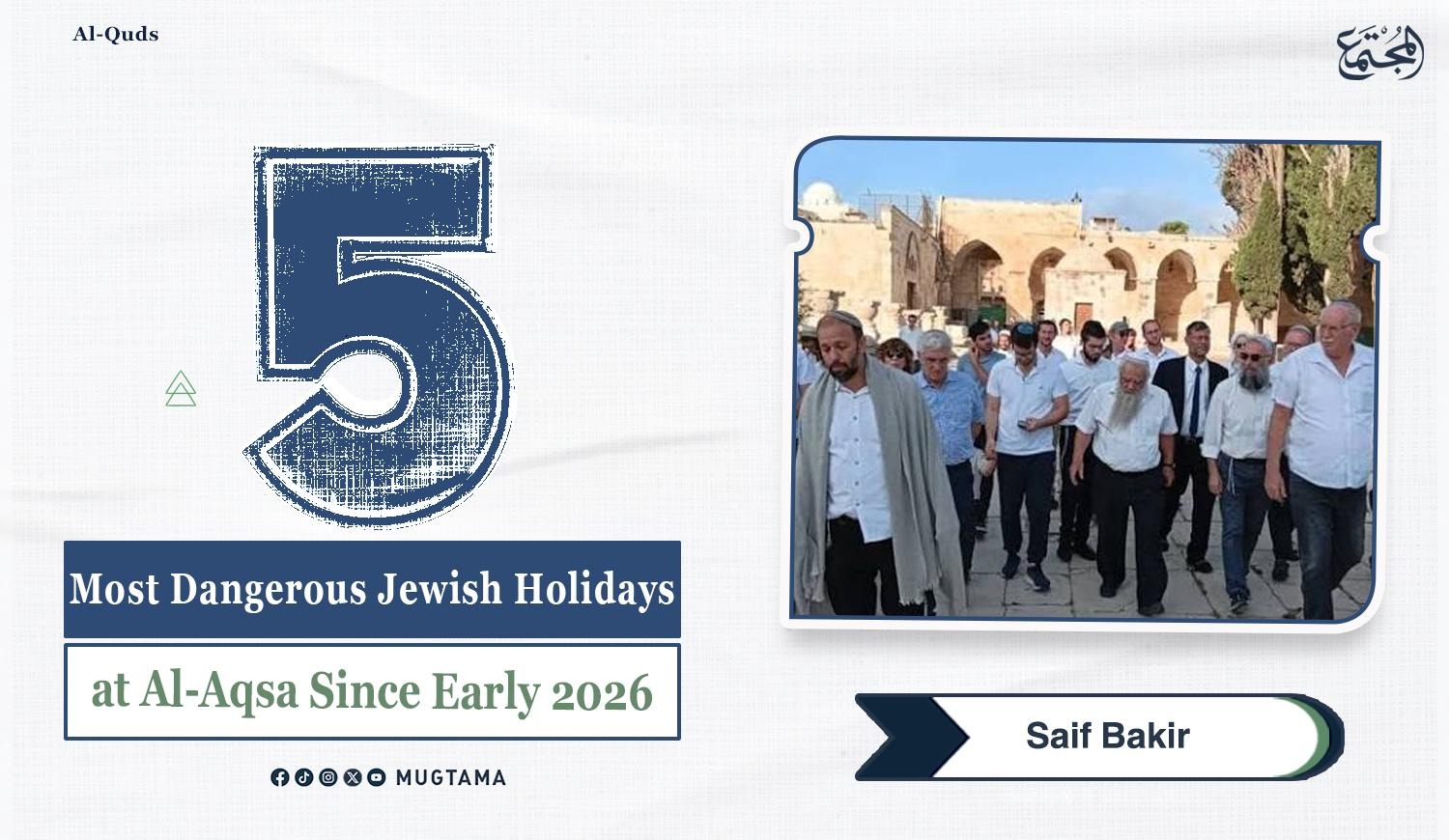
Settler incursions into the Al-Aqsa Mosque compound have
surged during Jewish holidays under heavy Israeli police escort, drawing
participation from government ministers and Knesset members who perform public
prayers and religious rituals in its courtyards.
Since early 2026, these holidays have increasingly served as
flashpoints for escalating violations, aimed at creating new facts on the
ground and altering the mosque's historic and legal status quo, while severe
restrictions continue to be imposed on Palestinian worshippers.
Below are the five most volatile Jewish holidays and
observances, ranked by the scale of incursions and the severity of recorded
violations.
1. Anniversary of the Occupation of East Jerusalem
On May 14, 2026, approximately 1,490 Israeli settlers broke
into the Al-Aqsa Mosque compound to mark so-called "Jerusalem Day,"
which commemorates the 1967 occupation of the city's eastern sector, according
to a report by the Palestine News Network (PNN) citing the Jerusalem
Governorate.
The incursions were led by Israel’s far-right National
Security Minister, Itamar Ben-Gvir, who raised an Israeli flag inside
the courtyards and performed provocative gestures. The event unfolded under
strict police security that severely curbed Palestinian access to Al-Aqsa and
barred specific age demographics from entering, while the contentious
"Flag March" took place in the Old City.
The Jerusalem Governorate warned that settler calls to
ramp up incursions in coordination with political figures are aimed at
dismantling the historic and legal status quo of the holy site.
2. The Anniversary of the Destruction of the Alleged
"Temple"
On July 23, 2026, the Al-Aqsa Mosque compound witnessed one of
the year’s most dangerous waves of incursions as 4,248 Israeli settlers forced
their way inside in a single day to mark the so-called "destruction of the
temple," according to the Jerusalem Governorate citing the Palestinian
news agency WAFA.
Far-right minister Itamar Ben-Gvir led the incursions
alongside Knesset members, rabbis, and leaders of ultranationalist settler
groups, flanked by a heavy deployment of Israeli occupation forces.
The storming was marked by severe violations, including the
introduction of what Palestinian reports identified as a "temple
stone," alongside the performance of overt Jewish prayers and Talmudic
rituals. The Jerusalem Governorate warned that these measures are deliberate
steps to impose new religious and political realities at the holy site and
institutionalize its temporal and spatial division.
3. Rosh Hashanah (The Jewish New Year)
On September 13, 2026, 593 Israeli settlers stormed the
Al-Aqsa Mosque compound during what is known as the "Hebrew New Year"
(Rosh Hashanah), according to statistics from the Jerusalem Governorate
published by Wattan News Agency.
The raid followed a closure of the compound to settler entries
on Saturday, September 12; nevertheless, extremist "Temple Mount"
groups renewed demands to open the site to incursions even on the Jewish
Sabbath.
These coordinated moves fall under sustained efforts to
broaden incursion windows during Jewish holidays, while tightening restrictions
on Palestinian worshippers and entrenching overt religious rituals inside the
mosque's courtyards.
4. Yom Kippur (The Day of Atonement)
The Al-Aqsa Mosque compound recorded the incursion of 1,678
Israeli settlers on September 20 and 21, 2026, marking the eve and observance
of what is known as "Yom Kippur" (The Day of Atonement), according to
the Jerusalem Governorate.
The total was broken down into 992 settlers on the first day
and 686 on the second—a tally the governorate described as the highest ever
documented for this holiday.
The storming saw public and collective biblical prayers and
rituals, alongside the smuggling in of religious vestments, prayer scrolls, and
ritual paraphernalia, with the direct participation of Israeli government
officials. The incursions coincided with tightened security clampdowns and
severe entry curbs imposed on Palestinian worshippers.
5. The Feast of Booths / Tabernacles (Sukkot)
During the first five days of the Jewish holiday of Sukkot
(Feast of Tabernacles), between September 27 and October 1, 2026, a total of
9,138 Israeli settlers forced their way into the Al-Aqsa Mosque compound,
according to data from the Jerusalem Governorate published by Wattan News
Agency.
The breakdown of daily incursions was reported as follows:
- September 27: 1,500 settlers
- September 28: 1,792 settlers
- September 29: 1,462 settlers
- September 30: 2,474 settlers
- October 1: 1,910 settlers
The period saw a marked escalation in public prayers and
Talmudic rituals within the courtyards and immediate surroundings of the
mosque, coinciding with severe Israeli occupation measures against worshippers,
including the sealing of certain gates, the issuance of banishment orders
against Jerusalemites, and systematic harassment targeting Islamic Waqf staff.
According to the
governorate, the cumulative number of incursions logged across Rosh Hashanah,
Yom Kippur, and the first five days of Sukkot reached 11,409 settlers through
the end of October 1, 2026.
