







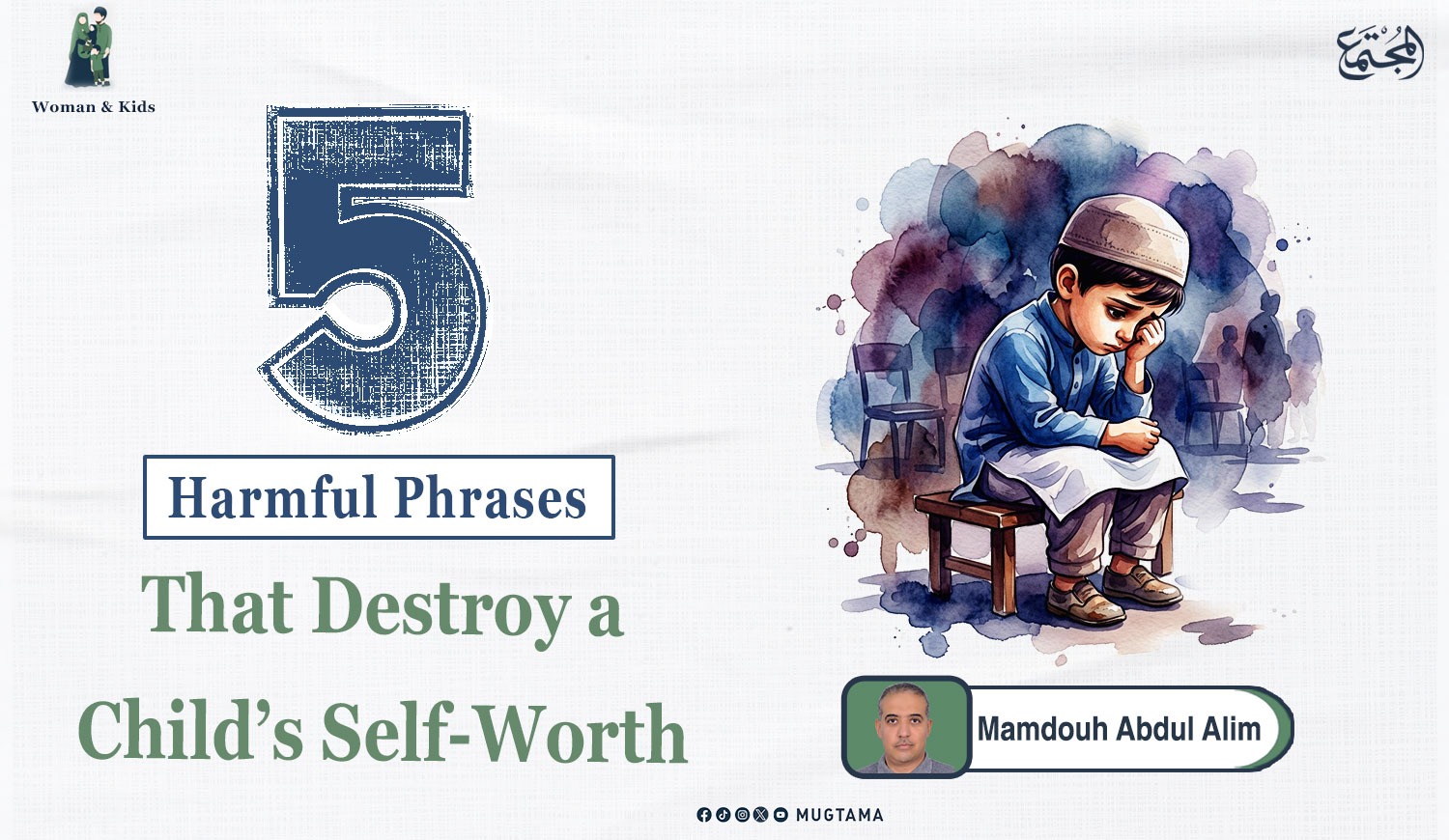
5 Harmful Phrases That Destroy a Child’s Self-Worth

Words
carry immense influence in the life of an individual and society. Therefore,
the Quran presents a vivid, tangible example of their impact through the
parable of the good tree and the evil tree.
Allah
Says, {Do you not see how Allah compares a good
word to a good tree? Its root is firm and its branches reach the sky, ˹always˺ yielding its fruit in every season by
the Will of its Lord. This is how Allah sets forth parables for the people, so
perhaps they will be mindful. And the parable of an evil word is that of an
evil tree, uprooted from the earth, having no stability.} [Ibrahim 14:24–26]
However,
many parents do not realize the tremendous impact words have on shaping a
child’s personality. They do not understand that one sentence can create within
a soul what years cannot. A single word can
revive a dead heart—and a single word can kill a living one.
There are
words that
destroy rather than build, words that leave no marks on the skin but carve the
deepest wounds into the heart. As the poet clarifies:
The wound of the sword may heal and disappear,
But the wound of the tongue remains as long as life remains.
Words are
education. A phrase is a stance. Speech is a responsibility. A parent must weigh his words with the scale of the
Shari`ah, intellect, and wisdom. Allah Commanded us to choose our words
carefully: {Tell My ˹believing˺ servants to say only what is best.} [Al-Isra’
17:53]
Meaning: they must choose the best words and avoid words that destroy and do not
build—especially with children.
Types of Harmful Statements towards Children
Here we
pause at five types of harmful statements that drain from our children the
seeds of hope and uproot from their hearts the roots of emotional stability.
1. Words That Crush a
Child’s Dignity and Self-Worth
“You are
stupid.” “You are a failure.” Etc.
Such statements shake human dignity to the core. When we tell a child, “You are
stupid,” we are not correcting a behavior—we are issuing a sweeping judgment
that insults the entire worth of the child. It is anger escaping through the
tongue in the most destructive way.
Look at
the Prophet’s method
(peace be upon him) in dealing with children—even when they make mistakes. Anas
Ibn Malik said: “I served God's messenger for
ten years and he never blamed me for anything I didn’t do or anything which was
destroyed at my hand. If any member of his family blamed me, he said, ‘Leave
him alone, for if anything were decreed it would happen.’” (Narrated
by Imam Ahmad 13419)
The
Prophet (peace be upon him) never mocked children, never humiliated, never
scolded, and never insulted them.
Dr.
Muhammad Al-Yousuf, consultant psychiatrist, says: “Parents have no right to
violate the dignity of their son or daughter. Human dignity is protected in the
seventh heaven, guaranteed by Allah. It is not for parents to belittle or
insult or stab their child’s honor. Dignity is a red line.”
A parent
must therefore protect the child’s dignity and avoid humiliation.
2. Words That Destroy a
Child’s Self-Esteem
Self-esteem is not a
passing emotion, it is the backbone of a child’s personality. If it breaks,
every aspect of life bends with it.
Parents
sometimes unintentionally destroy this self-esteem.
When we tell a child: “You always disappoint me.” “Your friends are all better
than you.” —we are stripping him of his most precious possession: self-appreciation.
Such
statements silence the inner voice that says, “I can succeed,” and replace it
with a whisper that says, “I am a failure.” Thus, the child grows hesitant and
fearful.
The
Prophet (peace be upon him) prohibited a person from belittling himself,
saying: “Let not any one of you belittle
himself.” (Narrated by Imam Ahmad
11255 and Sunan Ibn Majah 4008) This Prophetic guidance is a clear call not to
degrade one’s own worth.
Dr.
Mustafa Abu As-Saa`d says: “Developing signs of self-esteem in the
child—especially during early childhood—determines the features of his
personality and future behaviors… Self-esteem drives the child to learn, adopt
good manners, solid faith, righteousness, and uprightness. It also enables the
child to acquire social skills and adapt to others without blind imitation or
uncontrolled dependence.”
3. Words That Destroy a
Child’s Emotional Security
Emotional
security is not a luxury. It is the soil from which all values and behaviors
grow. When this soil shakes, everything above it withers.
Parents
sometimes destroy emotional security by making their children fear them—through
constant threats, punishments, or statements like:
“I don’t love you.” “You are not my son.”
Children
do not need a perfect home—but they
need a heart that assures them of unconditional love, even when they make
mistakes. Punishment must never carry hatred or revenge.
Allah
Commanded the Prophet (peace be upon him): {It is
out of Allah’s mercy that you ˹O Prophet˺ have
been lenient with them. Had you been cruel or hard-hearted, they would have
certainly abandoned you.} [Ali `Imran 3:159]
4. Words That Kill a
Child’s Creativity
Creativity
does not grow in fear. It does not bloom under criticism. It grows in a safe home. A child does not distinguish between play and
exploration, between mistakes and learning—he sees every experience as a chance
to understand and try.
When we
stifle his imagination or mock his attempts, we teach him that thinking
differently is dangerous and stepping outside the norm is wrong.
Caliph `Umar
Ibn Al-Khattab (may Allah be pleased with him) set a powerful example: he
brought the young Ibn Abbas close, seated him among elders, asked him
questions, and encouraged his insight.
Do not
extinguish ideas, fuel them. Share their interests. Encourage and
support them.
5. Words That Destroy a
Child’s Independence
Independence
is not born with the child—it is planted through encouragement and guidance. It
is killed by excessive interference or overprotectiveness.
Parents
sometimes extinguish their child’s independence with statements like: “Leave
your homework, I will do it for you.” “Don’t eat by yourself—I will feed you.”
These
phrases send one message: “You are incapable.”
Repeated
often, they convince the child that he cannot do anything on his own and must
rely on others to make decisions.
Dr.
Abdulkarim Bakkar says: “We need a new culture in parenting—one that cultivates
skill, not dependency; responsibility, not constant assistance. We must give
our children opportunities to work—not only money.”
We must
involve children in responsibilities
and teach them decision-making.
Also Read:
- For These 10 Reasons, Do Not Suppress Your Naughty Child
- 5 Prophetic Examples of Empathy Toward Others
- Ihsan (Perfection) in Everyday Interactions
-------------------------------------------------------------