





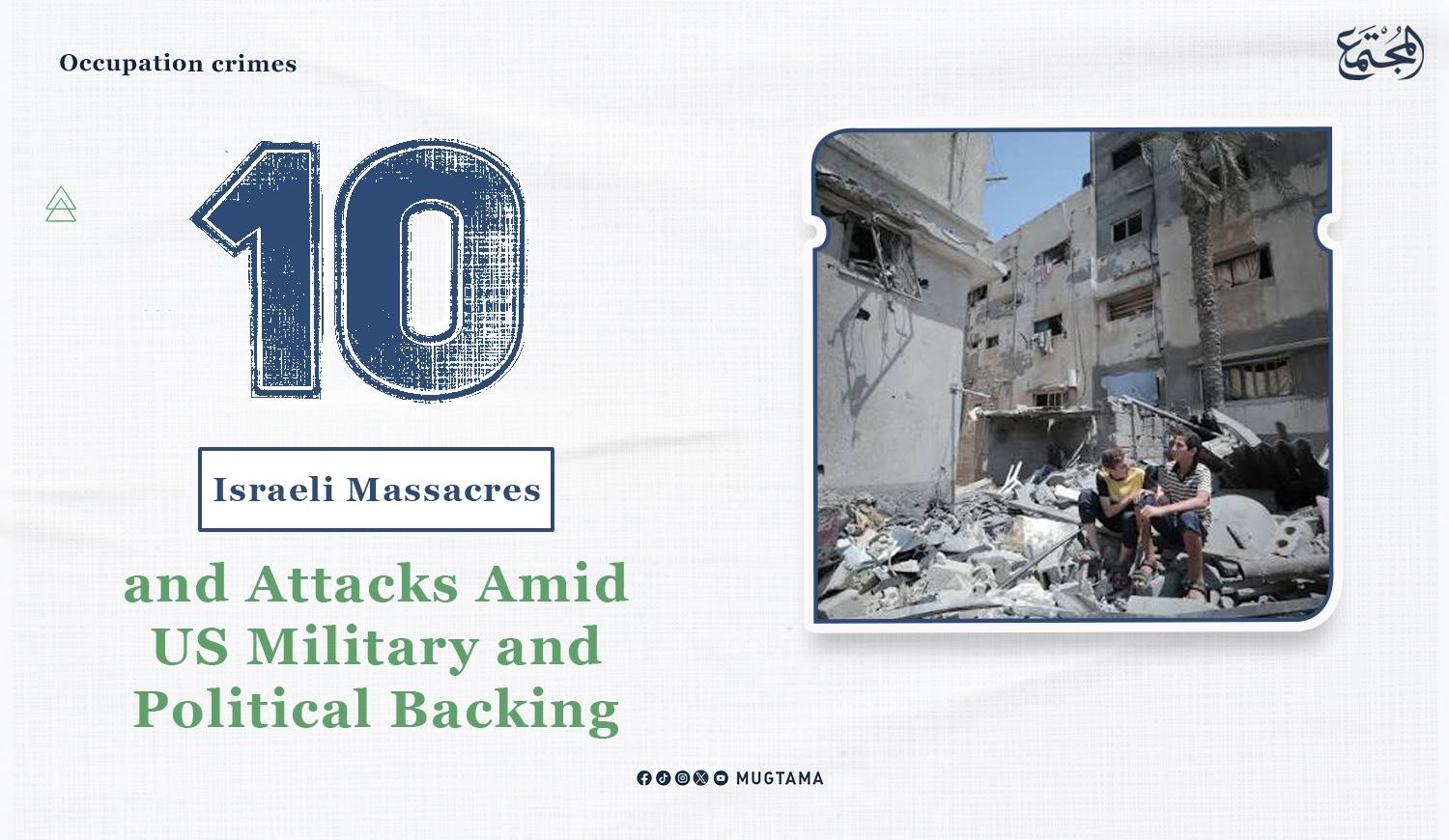
10 Israeli Massacres and Attacks Amid US Military and Political Backing
Throughout the modern
Arab-Israeli conflict, Israeli wars and attacks have never been isolated
military actions; rather, they have structurally relied on a strategic
partnership and unconditional support from the United States. This backing has
manifested in two key dimensions: an advanced military arsenal that provided
the means for direct bombardment and destruction, and a political-diplomatic
umbrella at the UN Security Council that blocked international accountability
and entrenched impunity.
This list examines 10 Israeli
massacres and assaults spanning over five decades, exposing how sustained US
arms and backing have been deployed on the ground.
1. Bahr al-Baqar Massacre – Egypt (April 1970)
The bombing of the Bahral-Baqar primary school in Egypt's Sharqia Governorate on April 8, 1970, during
the War of Attrition, stands as one of the most prominent Israeli attacks
targeting Egyptian civilians, claiming the lives of 30 children and wounding
dozens more. The incident sharply highlighted the role of US military aid to
Israel—most notably the supply of F-4 Phantom II fighter-bombers and advanced
weaponry that bolstered its aerial supremacy. While Israeli officials claimed
the strike targeted a military installation, Egyptian records document that the
aircraft deployed bombs and missiles directly striking the school, resulting in
its total destruction.
2. Sabra and Shatila Massacre – Lebanon (September 1982)
The Sabra and Shatila massacre took place in West Beirut between September 16 and 18, 1982, during
the Israeli invasion of Lebanon, when Lebanese militias slaughtered Palestinian
refugees and camp residents while Israeli forces encircled the area and
facilitated the gunmen's entry. The massacre claimed the lives of hundreds to
thousands of people, with estimates varying regarding the exact death toll.
The US dimension lies in
Washington's failure to uphold the security guarantees pledged by its special
envoy, Philip Habib, to protect Palestinian civilians remaining in Beirut
following the PLO's evacuation. As Israeli forces cordoned off the camps,
permitted the entry of the militias who perpetrated the killings, and fired
illumination flares to light the area at night, these actions drew widespread
condemnation regarding Israel's direct culpability and the United States'
failure to ensure civilian protection.
3. Ibrahimi Mosque Massacre – Hebron (February 1994)
During dawn prayers in the
holy month of Ramadan, settler Baruch Goldstein opened fire with an automatic
rifle on Muslim worshipers inside the Ibrahimi Mosque, killing 29 and wounding
dozens more.
The weapon used was a
US-origin/manufactured Galil / M16 military assault rifle. Diplomatically,
Washington leveraged its influence to block any explicit condemnation holding
Israel, as an occupying power, directly accountable for arming and protecting
extremist settlers.
4. The First Qana Massacre – Lebanon (April 1996)
Israeli artillery shelling
directly targeted the headquarters of the Fijian UNIFIL battalion, where
displaced civilians had sought refuge during 'Operation Grapes of Wrath,'
killing 106 civilians.
The strike was carried out
using US-origin 155mm artillery shells. Politically, Washington wielded its
veto power at the UN Security Council to derail a draft resolution explicitly condemning
Israel for the atrocity.
5. Jenin Refugee Camp Massacre – West Bank (April 2002)
A sweeping invasion and a
suffocating siege were imposed on the Jenin refugee camp under 'Operation Defensive Shield,' marked by heavy bombardment, the razing of entire
residential quarters, and the killing of civilians and resistance fighters,
leaving dozens dead.
The assault heavily relied on
American hardware, specifically armored Caterpillar D9 military bulldozers and
AH-64 Apache attack helicopters.
6. Al-Fakhura School Massacre – Gaza (January 2009)
Israeli artillery shelled the
perimeter of an UNRWA-run school sheltering hundreds of displaced people in
Jabalia refugee camp during the Israeli military offensive ('Operation Cast
Lead' / 'Battle of al-Furqan'), killing over 40 Palestinians.
The assault was carried out
using US-supplied artillery rounds and white phosphorus shells manufactured in
Arkansas.
7. Shujaiya Massacre – Gaza (July 2014)
Intense, indiscriminate
aerial and artillery bombardment struck the densely populated neighborhood of
Shujaiya during the pre-dawn hours, killing more than 70 civilians, mostly
women and children.
Facing on-the-ground
munitions shortages, the Israeli military relied on tapping into the US War
Reserve Stockpile Allies-Israel (WRSA-I) to replenish 120mm tank rounds and
155mm heavy artillery shells."
8. Al-Ahli Arab (Baptist) Hospital Massacre – Gaza (October 2023)
An airstrike struck the
courtyard of the Al-Ahli Arab (Baptist) Hospital, which was crowded with
displaced families, patients, and medical personnel, killing approximately 500
civilians in one of the deadliest single strikes in the history of the
conflict.
The strike was carried out
using precision-guided aerial munitions supplied as part of Washington's accelerated
military aid pipeline following the outbreak of Operation Al-Aqsa Flood.
9. Al-Mawasi Khan Younis Massacre – Gaza (July 2024)
Intensive airstrikes
deploying tons of high explosives struck displaced families' tent encampments
in an area designated by the Israeli military itself as a 'humanitarian safe
zone,' killing more than 90 Palestinians.
On-site investigations and
weapons fragment analyses confirmed the use of US-manufactured 2,000-pound
(approx. one ton) GBU-31 JDAM precision-guided heavy bombs—high-yield munitions
whose deployment in civilian tent encampments is prohibited under international
humanitarian norms due to their catastrophic blast yield.
10. Al-Tabaeen School Massacre – Gaza (August 2024)
A direct strike targeted a
prayer hall inside a school sheltering thousands of displaced civilians in the
Al-Daraj neighborhood of Gaza City during dawn prayers, utilizing three heavy
missiles that killed over 100 worshipers, incinerating and tearing their bodies
to shreds.
Munitions remnants documented the use of US-manufactured GBU-39 Small
Diameter Bombs (SDB), precision-guided munitions deployed in the attack.