






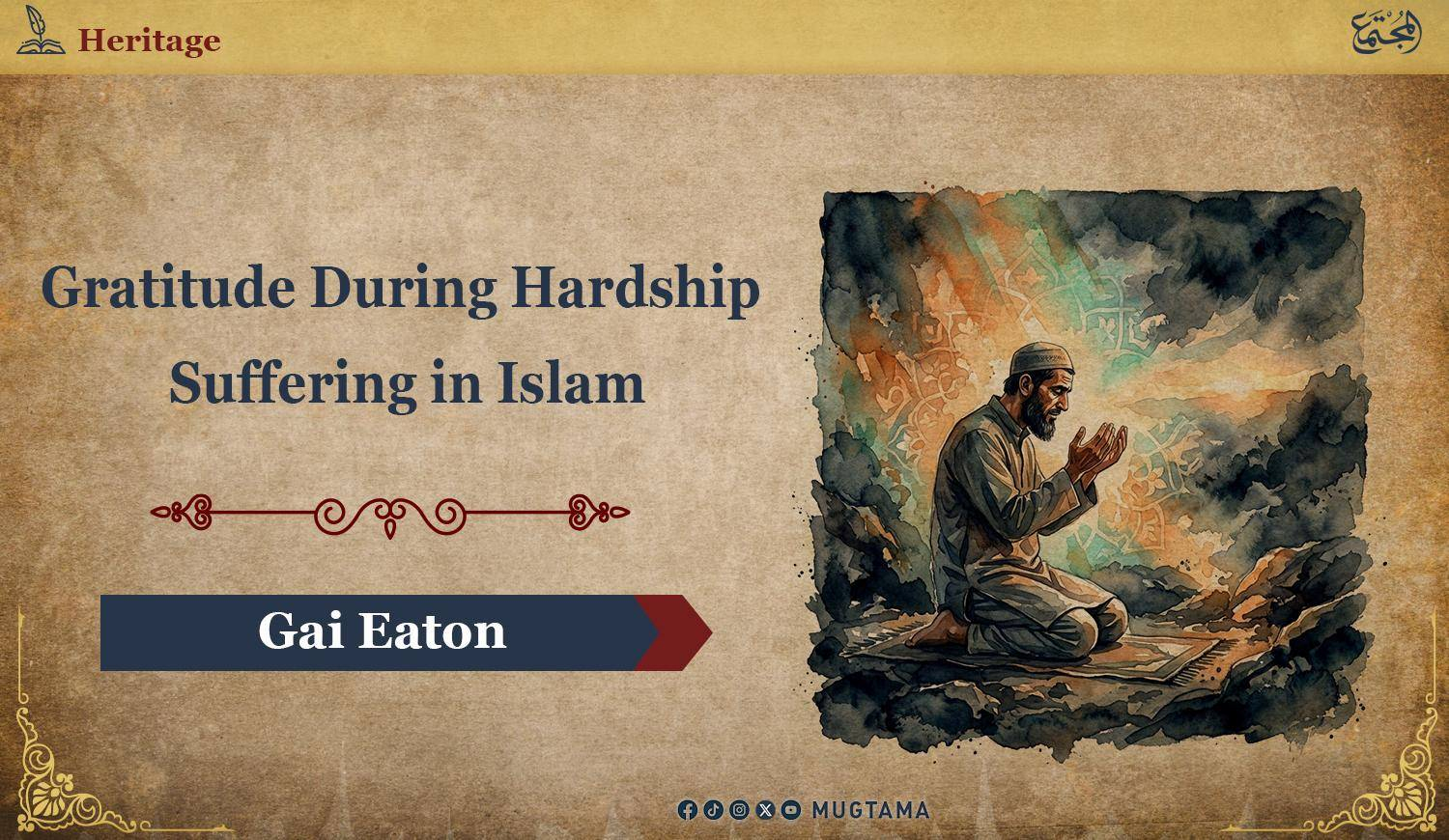
Gratitude During Hardship… Suffering in Islam

Gratitude on a
fine day in a happy family is one thing, gratitude in the face of loss and
suffering is quite another. Suffering has been with us for a long time, to say
the least, but the “problem of suffering” as the dominant theme of religious
and philosophical debate is of fairly recent origin.
It
becomes a problem on this scale only when a great number of people begin to
feel that it should not exist and that human beings have some kind of right to
perpetual happiness. There are still good Christians who, in the face of bitter
loss, are able to say, “The Lord giveth and the Lord taketh away, blessed be
the name of the Lord!”, rejoicing in the gift and accepting the loss, but they
are in a minority; for most people in the West today, a God who allows us to
suffer is not a God in whom it is easy to believe.
How Islam Understands Grief and Hardship
The
Muslim view is based upon an awareness that all we have or enjoy is a gift or a
loan, and upon an acceptance of the destiny willed by God for each individual soul. On the one
hand: {Allah asketh naught of any soul save that
which He hath given it.} [At-Talaq 65:7], {He
it is who causeth you to laugh and causeth you to weep, and He it is who giveth
death and giveth life.} [An-Najm 53:43–44], and {To
Allah we belong and unto Him we return.} [Al-Baqarah 2:156]; and, on the
other, {No affliction befalleth in the earth or
within yourselves but it is in a Record before We bring it into being—indeed
that is easy for Allah!—that you may not grieve over what escapes you nor
rejoice over what comes to you.} [Al-Hadid 57:22–23].
The
knowledge that God is the sole Owner of ourselves and of all that exists does
not preclude human emotions, which are themselves God-given.
Once,
when the Prophet (peace be upon him) was occupied with some people, one of his
daughters sent him a message that her little son was dying; he told the
messenger to return and remind her that, “What
Allah takes belongs to Him, what He gives belongs to Him, and He has an
appointed time for everyone . . .” His
daughter then sent the messenger back asking him to come to her, and he went to
her house with some of his companions. The child was now on the point of death,
and tears flowed from the Prophet’s eyes. “What
is this?” one of the people asked
him. “This,”
he said, “is compassion, which Allah has placed in the hearts of His servants. Allah shows
compassion only to those of His servants who are compassionate.”
Finding Meaning Without Denying Pain
How is
this to be reconciled with the Quranic command not to grieve? The point,
clearly, is that our natural feelings must never be taken out of their proper
sphere and elevated to the rank of philosophical principles.
The fact
that I am sad does not mean that the world is out of kilter, the fact that I
have been hurt does not mean that God is unjust, and the fact that my personal
life may have been darkened by tragedy does not mean that no sun shines upon
creation. It is when emotion is transposed to a different dimension that we
have a “problem of suffering” and
this, precisely, is what has happened in our time.
-------------------------------------------------------------
Taken from “Islam and the Destiny of Man” by Gai Eaton
