









8 Declassified Files Reveal the U.S. Role in the 1948 Nakba
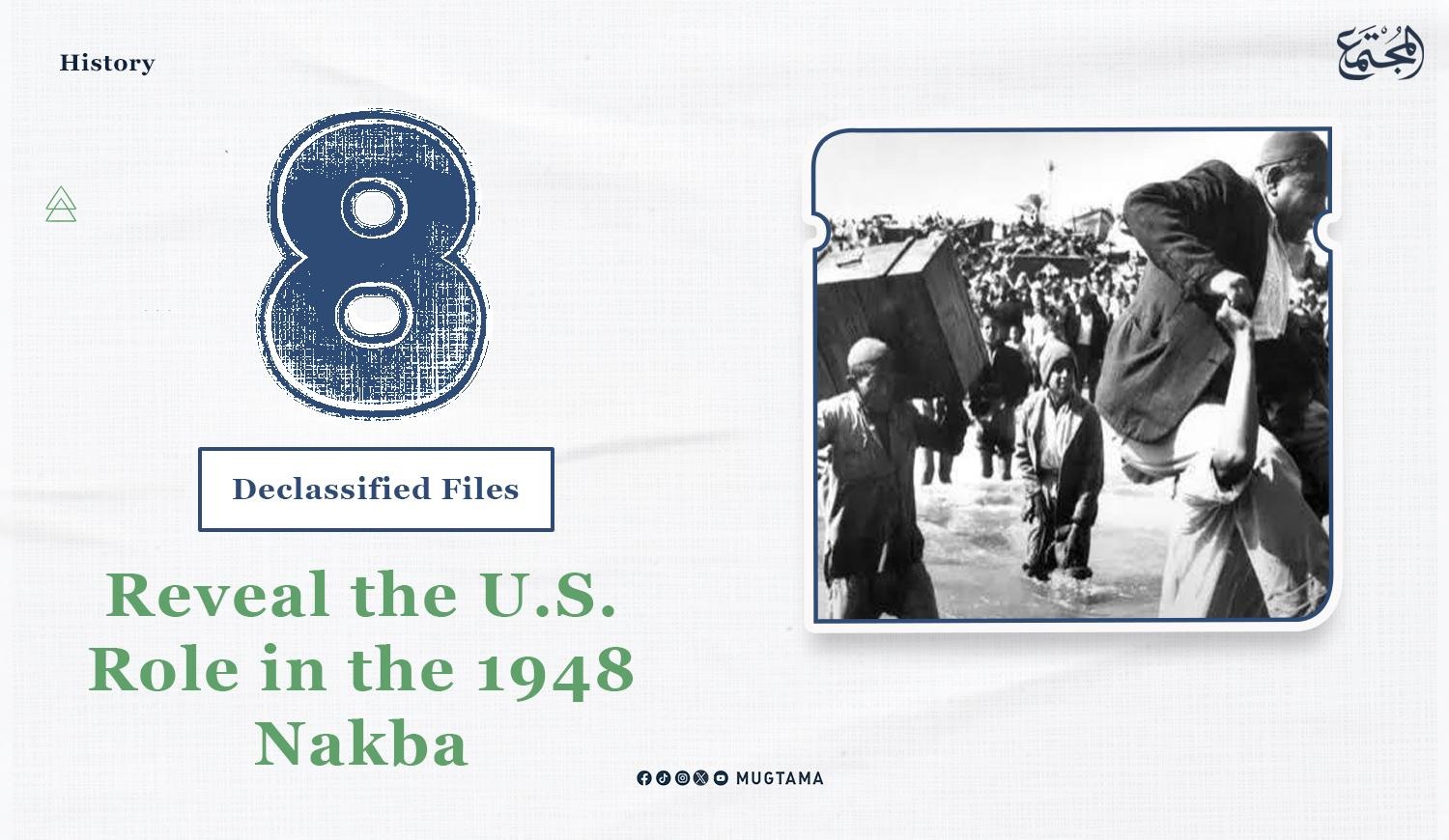
At precisely 6:11 PM
Washington time on May 14, 1948, President Harry S. Truman sat in his office to
sign a hurriedly drafted, single-page declaration. On it, the phrase 'Jewish
State' had been struck through by hand and replaced with 'State of
Israel'. That swift move—announced a mere eleven minutes after David Ben-Gurion’s declaration in Tel Aviv—was far from an improvised diplomatic
reflex. It was the culmination of a clandestine campaign quietly orchestrated
across Washington's intelligence corridors, economic backrooms, and
policy-planning bureaus.
Declassified diplomatic
archives, CIA files, and U.S. military intelligence records reveal that
Washington’s involvement in the 1948 Nakba went well beyond overt political
sympathy. It was a calculated sponsorship: fully cognizant of the catastrophic
realities on the ground, and deliberately aimed at securing territorial control
and cementing the displacement as an irreversible fait accompli.
Document 1: The State Department’s 1947 Assessment on the 'Jewish
Military Council'
The report detailed that by
mid-1947, the Haganah’s military strength had reached a mobilization capacity
of 45,000 trained combatants, bolstered by an estimated 3,000 to 5,000 fighters
from the Irgun and Stern Gang paramilitaries. This force operated under a
centralized general staff, backed by domestic armories and covert munitions
plants (Ta'as).
By contrast, the assessment
calculated Palestinian capabilities to be limited to a few thousand irregular
volunteers, crippled by the absence of a unified command, devoid of heavy weaponry,
and possessing an ammunition reserve barely sufficient for a few weeks of
fighting.
This report documented the
U.S. administration's prior knowledge of the Zionist militias' overwhelming
superiority, directly refuting the enduring narrative that Washington was
merely acting to shield an imperiled minority.
Document 2: Truman’s Cable to French President Vincent Auriol and
the Strong-Arming of the Partition Vote (November 1947)
Declassified diplomatic
cables exchanged between November 24 and 28, 1947, reveal that the White House
sent encrypted communications via the U.S. Ambassador to Paris, Jefferson Caffery, exerting direct pressure on French President Vincent Auriol.
The American dispatches
issued stark threats, specifically:
1. Reassessing
France’s share under the Marshall Plan, putting the crucial Interim Aid Bill—then
pending before Congress and valued at over $500 million—directly on the line.
2. Halting
vital emergency wheat shipments and relief aid, aimed at stabilizing France
amid sweeping, Communist-led nationwide labor strikes.
Document 3: The Tacit Arms Embargo Bypass and Covert Financial
Pipelines (1947–1948)
On December 5, 1947,
Secretary of State George C. Marshall declared a formal U.S. arms embargo on
the Middle East. However, archival records demonstrate that this policy was
applied with selective asymmetry:
- Tax-Exempt
Covert Financing: The Internal Revenue
Service (IRS) granted tax-exempt status to donations directed to the
United Jewish Appeal (UJA), which amassed $150 million in 1948 (equivalent
to roughly $1.8 billion today). A substantial portion of these funds was
funneled directly into financing covert European arms procurements, chief
among them the Czech arms pipeline known as Operation Balak.
- The
Panamanian Dummy-Airline Pipeline: Federal
authorities turned a blind eye to the illicit export of surplus military
transport aircraft—including Curtiss C-46 Commandos and Boeing B-17 Flying
Fortress heavy bombers—from American airfields. Organized by veteran
aviator Al Schwimmer, these aircraft were registered under shell companies
in Panama before being retrofitted and deployed to break aerial blockades
and carry out strategic bombing missions in Palestine.
- One-Sided
Enforcement: While the embargo
was ruthlessly enforced against Arab armies and Palestinian
combatants—cutting off their traditional supply channels—a steady
trans-Atlantic logistical and financial pipeline operated unhindered from
within the United States to empower the Haganah.
Document 4: The G-2 Military Intelligence Dossier on 'Plan Dalet'
(April 1948)
The military intelligence
report, dated mid-April 1948, monitored the Haganah’s transition from a posture
of limited defensive operations to an offensive operational strategy designed
to consolidate territorial control under what the document termed: the Haganah
Master Operational Plan (Plan D).
The document delineated the
military plan’s objectives, which included encircling Arab villages, as well as
dynamiting houses and demolishing vital infrastructure to prevent the inhabitants
from returning.
The U.S. military archives
substantiate that Washington possessed documented accounts of the unfolding
ethnic cleansing operations a full month prior to the declaration of the
establishment of the state.
Document 5: The Fateful White House Showdown: Minutes of the May 12,
1948 Meeting on Recognizing Israel
Clifford submitted a
political memorandum advocating for the immediate recognition of the Jewish
State the moment it was declared, arguing that it would secure Truman’s victory
in the 1948 presidential election, lock in the crucial swing states of New
York, Pennsylvania, and Illinois, and guarantee vital Democratic campaign
funding.
According to the verbatim
minutes, Secretary of State George C. Marshall forcefully fired back:
'The proposal presented by
Clifford is not based on military or foreign policy considerations, but is a
transparent attempt to win domestic electoral votes. Making such a decision
will undermine the credibility of the United States and its strategic interests
for decades to come. If you were to take this step, and I were to vote in the
election, I would vote against you, Mr. President.'
Truman overrode the stark
warnings of his Secretary of State and senior department officials, deciding to
proceed with immediate recognition in pursuit of domestic electoral gains.
Document 6: The Declassified Recognition Cable and the Immediate
Financial Underwriting (May 14, 1948)
The original declaration of
recognition consists of merely two typewritten paragraphs on a single sheet of
paper. It bears a handwritten edit crossing out the phrase 'the new Jewish
state' and inserting 'the State of Israel' in the penmanship of
Press Secretary Charles Ross, following the receipt of an eleventh-hour cable
from Eliahu Epstein confirming the fledgling state's official name.
Simultaneously, the White
House directed the Export-Import Bank of the United States to open a $100
million line of credit and development loan (formally authorized in early
1949). This provided an immediate financial bedrock that underwrote the nascent
state's operational expenditures and general wartime budget.
This instantaneous
recognition torpedoed ongoing deliberations in the United Nations General
Assembly, which was actively debating an alternative international trusteeship
proposal to broker a ceasefire. In doing so, it effectively stripped
Palestinians of the legal standing to resist the takeover of their homeland,
reclassifying their struggle into a confrontation against a sovereign, internationally
recognized state.
Document 7: Declassified CIA Intelligence on the Depopulation of
Safed, Jaffa, and Haifa (April–June 1948)
CIA documents submitted to
President Truman described the Zionist tactics used to depopulate Palestinian
cities. Intelligence reports documented the shelling of residential
neighborhoods and city markets with mortars fired from elevated positions
during Operation Misuraha, alongside the use of loudspeakers broadcasting
Arabic-language messages warning that disaster had struck.
CIA cables also recorded that
indiscriminate Irgun shelling of the city, combined with the Haganah’s siege
during Operation Hametz, led to the displacement of more than 65,000 residents.
These reports reveal that
U.S. policymakers in Washington received contemporaneous intelligence
confirming the systematic use of terror and intimidation to drive civilians
from their homes.
Document 8: The UN Conciliation
Commission Records: How Washington Yielded on the Right of Return (1949)
During the 1949 Lausanne Conference, U.S. records documented Israel’s
refusal to allow the mass return of Palestinian refugees. Despite Truman’s
initial threats to suspend a $100 million loan, Washington retreated under
congressional pressure, shifting toward resettlement in Arab countries and
humanitarian aid through UNRWA. This policy helped entrench Palestinian
displacement and undermine the implementation of UN General Assembly Resolution
194 on the right of return.